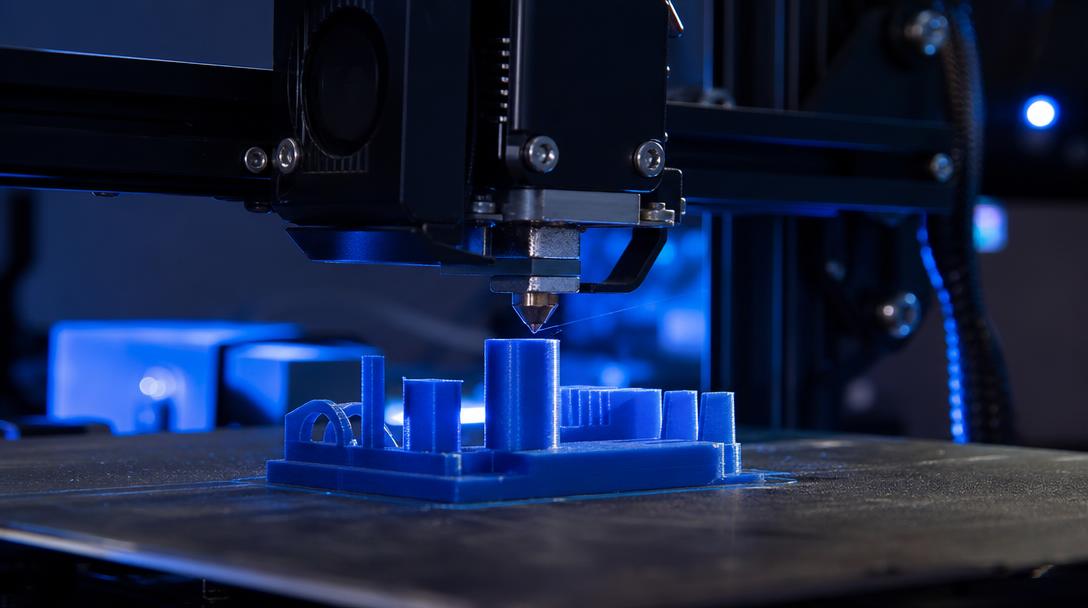
Phaetus Liber Hotend for Snapmaker U1: How High Flow Affects Print Time
In FDM printing, speed depends not only on a printer’s movement capabilities; the amount of molten filament that can pass through the nozzle per unit of time also sets a limit. The Phaetus Liber high-flow hotend, developed for the Snapmaker U1, is a recent accessory designed to address this constraint. Manufacturer tests reported in TCT Magazine’s September 25, 2026 article show volumetric flow rates 66% higher for PLA, 87% higher for ABS, and 43% higher for PETG HF than with the previous U1 stainless steel hotend under the same energy conditions. These results should not be interpreted as an equivalent reduction in print time for every model.
What does higher volumetric flow change?
Volumetric flow describes the amount of plastic a hotend can melt and deliver to the nozzle per unit of time. Even if the print head moves quickly, the slicer may limit speed if the filament cannot be melted fast enough, or the lines may not form at their intended width. The Liber hotend’s Split-Flow melt channel is designed to increase contact between the filament and the heated surface, enabling higher flow.
This improvement may be especially useful for large solid areas, long perimeter walls, and continuous extrusion paths. However, for fine details, frequent direction changes, short layers, or prints that require cooling time, other factors determine the overall print time. Model geometry, layer height, the material’s print profile, cooling, and the printer’s motion limits should all be considered together. The manufacturer’s flow figures compare capacity; they do not guarantee a specific print time for a particular part.
Key features of the hotend designed for the U1
According to the manufacturer, the Liber is a hotend assembly designed for use with the U1. Its construction includes a Split-Flow melt channel, a DLC-coated hardened steel nozzle, and a precision-machined integrated heat break. The hardened tip may be more suitable than a standard brass tip for filaments containing abrasive additives; however, check the latest technical documentation for compatibility and operating limits.
Snapmaker and Phaetus provide separate percentage increases for PLA, ABS, and PETG HF in their comparative tests. These figures apply only in comparison with the U1 stainless steel hotend used in the tests; they cannot be directly generalized to other printers, different nozzle diameters, or every filament formulation. PETG HF refers to a specific class of high-flow material; it does not mean that every PETG spool will deliver the same results.
How to assess the actual benefit for your part
An accessory’s high-flow capability does not mean every user needs to upgrade. First, check whether your print profile is reaching the limits of your current hotend. If the slicer reduces speed because of the flow limit, and your jobs include parts with broad surfaces or long extrusion paths, the increased capacity may be useful. If you mostly print small, detailed models, the difference may be limited.
- Check compatibility first: The product was developed for the U1; do not assume it is suitable for another printer.
- Test with a real part: Compare print time, surface finish, and layer bonding using the same model, material, and quality target.
- Monitor flow and quality together: When increasing speed, also check extrusion consistency and layer adhesion.
- Factor in maintenance: Nozzle type, wear, and replacement-part requirements affect the overall value of using the hotend.
Choosing the right material and geometry for an FDM project is just as important as the printer’s capabilities; you can explore the options on our printing materials page. If you would like to outsource production of your part, our 3D printing service page explains the process. Visit affordable 3D printing prices for pricing information, or calculate an instant quote for your file. Our print orientation guide is also a useful resource for understanding how print orientation affects strength and surface finish.
In summary, the Liber hotend is a tangible accessory development for U1 users looking for greater extrusion capacity. The reported flow increases are noteworthy, but only a test under the same conditions can show how print time and quality will change for your part.


 Türkçe
 العربية
 Русский
 فارسی
فارسی Deutsch