
3D Printing for Electronics and IoT
Produce the enclosures, brackets and housings around your circuit without tooling costs, starting from a single part and field-testing as you go
A good circuit is only as good as the body that carries it
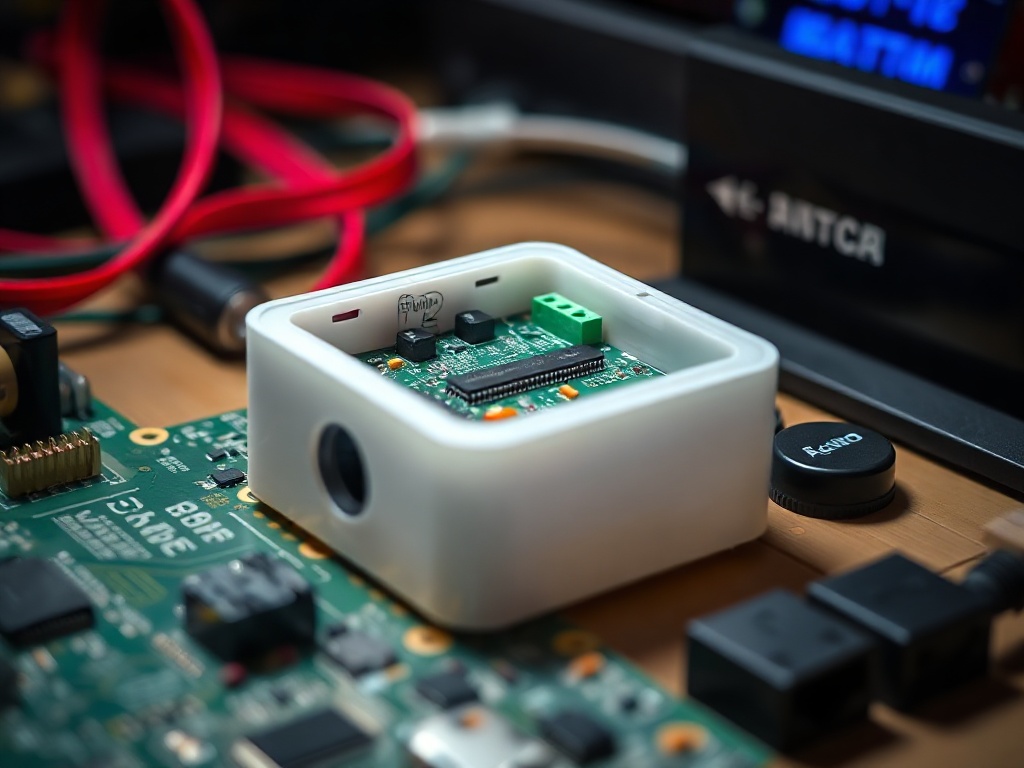
The success of an electronic product does not end with the chips and traces on the board; the physical body that protects, secures and presents that board to the user is just as decisive as the circuit design itself. Most PCB enclosures, holding brackets or IoT device housings never reach the volumes that would justify making a mold. This is exactly where the value of additive manufacturing shows itself: you can start from a single unit without paying for tooling, test the prototype in the field and receive a revised version the next day if there is a point you do not like.
Every body we produce is made to the real dimensions of your board. The positions of the mounting holes, the standoff heights and the connector cutouts are modeled to fit your board exactly; if all you have is a physical sample, we turn it into a digital model through reverse engineering and move from there into production.
Which parts we supply during your development process
From a prototype board to final pre-series validation, the physical parts that hardware teams need again and again are usually the following:
- Custom cases and enclosures: Enclosure designs with ventilation holes, connector cutouts and near-sealed protection.
- PCB holders and mounting brackets: Board beds with standoff support, plus connection parts suitable for panel and DIN rail mounting.
- Connector, button and knob parts: Front panel buttons, connector frames and interface covers.
- Cooling channels and air guides: Internal parts that direct airflow on boards that run hot.
- Cable management parts: Clips, pass-through grommets and channel profiles that tidy up the clutter.
- Prototype boxes: Temporary bodies obtained quickly for field trials and presentations.
Which material for which part
The right filament choice changes according to the environment the part will work in. If a durable, long-lasting enclosure is wanted, PETG or ABS stand out; ABS can also be processed with sanding and acetone vapor to gain a smooth surface. If the design has not settled yet and your aim is rapid iteration, easy-to-print and inexpensive PLA is ideal for the first rounds. In hot-running areas such as power regulators, or in outdoor devices exposed to sunlight, PC is preferred because it keeps its shape under heat. For brackets that carry a mechanical load and places where extra strength is needed, nylon or carbon-fiber reinforced options come into play. This variety lets us produce the different parts of the same project, each with the engineering plastic best suited to it.
You see the price up front and proceed with a budget set per gram; all your projects are kept confidential under NDA at your request. We are by your side at every stage, from a single validation prototype to low- and medium-volume series production. Share your board drawing or the sample you have with us, and let us work out the most suitable material and production plan together: get a quote now.
How Does the Process Work for Your Electronics and IoT Projects?
Our electronics and IoT 3D printing process moves forward while respecting the confidentiality and sensitivity of your project. Simply share your ready 3D model (STL, STEP, OBJ or 3MF) with us. We review your file and check whether details such as wall thickness, screw bosses, lid snap-fits and ventilation channels are suitable for printing. After your approval, we put it into production and complete most jobs within 1 business day. Once production is finished, we get approval via photo and collect payment after approval.
Who Is It Suitable For?
- Hardware ventures and startups: Sensor boxes, development board enclosures and pre-series prototype cases.
- R&D and engineering teams: PCB holders, mounting brackets and test fixtures.
- Makers and hobby electronics enthusiasts: Custom enclosure designs for boards such as Raspberry Pi, Arduino and ESP32.
- Industrial IoT companies: Durable cases resistant to heat and moisture for field devices.
With our 17 different material options and transparent per-gram pricing, we respond to all the needs of your electronics projects, from a single prototype to a small series. We are ready to sign an NDA for your projects that require confidentiality.
Frequently Asked Questions
Which material should I choose for printing an electronics enclosure?
For most IoT and electronics enclosures, PETG is ideal; it is durable, moisture-resistant and easy to print. For enclosures exposed to higher heat or impact we recommend ABS, and for industrial applications requiring high temperature and mechanical strength we recommend PC (polycarbonate). If you share the operating environment of your project with us, we can determine the most suitable material together.
How precisely can you print parts such as PCB holders and brackets?
With FDM technology we confidently print screw bosses, board slots and snap-fit details. To get the best result on very fine details with tight tolerances, we recommend paying attention to minimum wall thickness and clearance allowances in your design. When you send your file, we check these points before printing and give you feedback.
I do not have a 3D model, only an idea. Do you do design?
Our main service is printing ready 3D models; for the most accurate result you need to have a print-ready model. If you have a file in STL, STEP, OBJ or 3MF format, we can put it into production right away. We can assess your need for design support according to the scope of the project, so feel free to contact us about this.
How long does an enclosure print take and how is the price determined?
We print most electronics enclosure and bracket jobs within 1 business day; the time can vary according to the size and quantity of the part. Pricing is done transparently per gram, meaning the weight of your part and the material you choose determine the price. For an instant price you can upload your file from our quote page, and you can review the material prices on our production prices page.
My prototype enclosure design is confidential. Do you provide confidentiality?
Yes. Confidentiality is extremely important for hardware prototypes and pre-patent designs. If you request it, we sign an NDA (non-disclosure agreement) and do not share your files and project details with third parties. Your design is used only for your own production.
Can I have multiple parts or a small series produced?
Yes, we provide support from a single prototype to small series production. We can print multiple units of the same enclosure or different parts (case, lid, bracket, holder) in a single order. Since the total production time will change as the quantity increases, if you share your plan we can give you clear information about the delivery time.
 Türkçe
 العربية
 Русский
 فارسی
فارسی Deutsch