
Electronics Enclosure 3D Printing: Custom Project Boxes Made for You
Custom-sized boxes and enclosures for your Arduino, Raspberry Pi, PCB and sensor projects. Built with durable FDM materials like PETG, ABS and ASA, with an instant quote and 1 business day delivery.
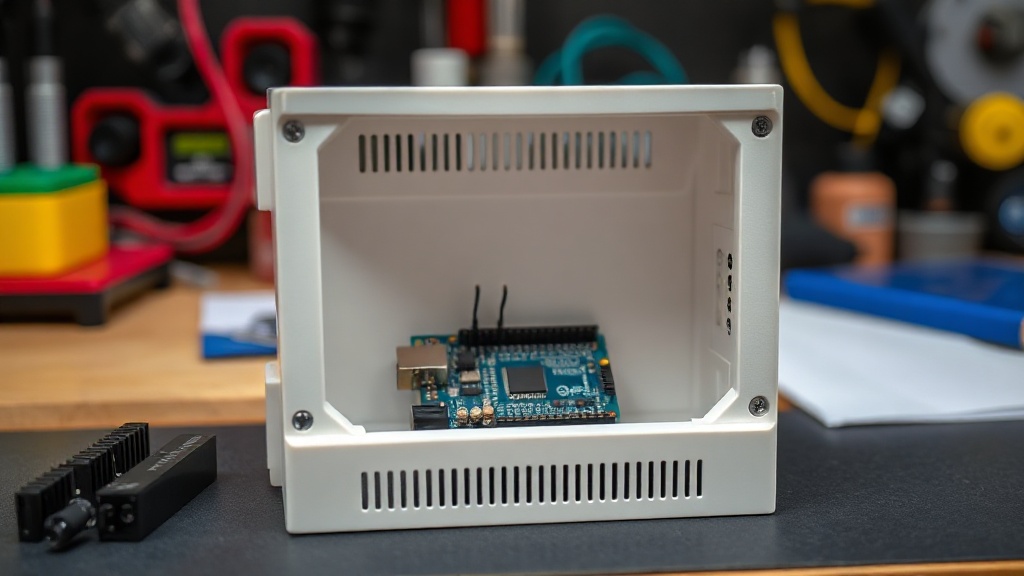
Custom Electronics Enclosure 3D Printing
Off-the-shelf boxes are often too big, have the connector cutouts in the wrong place, or just won’t fit your board properly. Our electronics enclosure 3D printing service exists to solve exactly that problem: we produce a housing that matches the exact dimensions of your Arduino, Raspberry Pi, ESP32, sensor module or your own custom PCB. You’re not buying a ready-made box from a store; you send us your measurements, a photo of your board, or your STL/STEP file, and we print a box made just for you.
When you upload your STL, OBJ or STEP file, you see the price in your browser instantly; thanks to transparent per-gram pricing, there are no surprises. If you don’t have a model yet, just share your board dimensions, connector positions and the lid type you want. Once you approve, we start production and deliver most jobs within 1 business day.
- Boxes for Arduino Uno / Nano / Mega and clone boards
- Raspberry Pi (3/4/5) and Pi Zero enclosures
- ESP32, ESP8266 and microcontroller project boxes
- Custom PCB and circuit board enclosures
- Sensor, relay, power supply and IoT device boxes
Which Material? PETG, ABS and ASA
For electronics housings, the right material depends on where the box will be used. The option we recommend most is PETG: a tough, impact-resistant, moisture-resistant filament with a good price/performance balance; it’s an ideal starting point for most devices in a room or workshop environment. For projects that may heat up or are exposed to slightly higher temperatures indoors, ABS offers greater heat tolerance.
If the box will sit outdoors, in direct sunlight or inside a vehicle, we recommend ASA; it is more stable against UV than PETG and ABS, and more resistant to yellowing and becoming brittle in the sun. For mechanically stressed parts such as hinges, clips or connectors, reinforced filaments like PA (nylon) may be preferred. With our 17 different FDM materials, we can choose the best fit for your project’s environment together. Note: We produce only with the FDM (filament) method; we do not offer resin, SLA or metal laser printing.
Ventilation, Mounting Holes and Lid Details
A good enclosure is more than just a box; your board needs to dissipate heat, be secured with screws, and open and close easily. We account for all of this in the design. We add ventilation slots near heat-generating components; because long thin slots print more cleanly in FDM than small round holes, we prefer grille-style ventilation.
We add mounting towers (bosses) that raise the board off the floor, screw holes, and where needed heat-set insert seats for brass nuts; this prevents thread wear on lids that are opened and closed many times. On the lid side we offer screwed, snap-fit or sliding lid options. We position connector and cable outlets according to the actual locations on your board, leaving clearance for FDM tolerance.
- Ventilation grilles near heat-generating components
- Mounting towers and screw holes for the PCB
- Heat-set insert seats for brass nuts
- Screwed, snap-fit or sliding lid options
- Precisely sized cutouts for USB, power and sensor connectors
How It Works and the Limits
The process is simple: upload your file (STL/OBJ/STEP) or send your board dimensions, see the instant price, and request a quote online. The form reaches us, we clarify the details, move to production, and usually deliver within 1 business day. Payment is taken after design and price approval.
To be honest: boxes printed with FDM are sturdy and functional, but because of their layered structure we do not guarantee full waterproofing (IP67) without an added gasket, and plastic material alone does not provide EMI/RF shielding. If there are harsh conditions such as the open air, splashing water or high heat, let us know from the start; with the right material and wall thickness, let’s plan the most durable solution possible together.
Related: Instant price calculation with your STL file · Our FDM printing materials
Frequently Asked Questions
I don’t know my board dimensions, can I just send a photo?
Yes. If you send a clear photo of your board and, if possible, a few measurements taken with a ruler, we can model the housing for you. If you have a ready STL/STEP file, uploading it gives even faster results.
Which material should I choose?
For most indoor projects PETG is ideal; it’s tough and moisture-resistant. For projects that heat up we recommend ABS, and for outdoors and sunlight, UV-resistant ASA. If you’re unsure, describe the usage environment and we’ll recommend the most suitable FDM material for you.
Will the box be waterproof?
Because FDM printing is layered, we do not guarantee full waterproofing (IP67) without an added gasket. We can make splash-resistant designs that are suitable for outdoor use with materials like ASA and have a well-fitting lid; tell us your needs and we’ll clarify what’s possible.
Can ventilation and screw holes be added?
Yes. We add ventilation grilles based on heat-generating components, mounting towers and screw holes to secure the board, and if needed heat-set insert seats for brass nuts. For lid type, screwed, snap-fit or sliding options are possible.
How quickly will I receive it?
Once the file and approval are settled, we deliver most electronics box prints within 1 business day. Quantity and size can affect the timeline; we’ll share the estimated time with you when you order.
 Türkçe
 العربية
 Русский
 فارسی
فارسی Deutsch