
3D Printing Solutions for the Defense Industry
Durable parts in the field within days, with no tooling investment
How do you speed up part supply in shortened development cycles?
In defense projects, a design can change several times within a single week; at that pace, waiting for a mold to be cut or sitting in long procurement queues locks up the schedule. Additive manufacturing removes this bottleneck: once the file is approved, you receive a usable, real part within days, with no tooling investment. Instead of halting the line while waiting for the third revision of a bracket, you can test every iteration and move on to the next.
The parts we produce in our workshop using the FDM method are selected from a broad range of engineering thermoplastics. A library of seventeen materials, spanning from PLA and PETG to the ABS, TPU and nylon families, and on to reinforced composites, lets us match every application to its specific load and environmental conditions. In defense industry 3D printing requests, what matters to us is not how the part holds up on the table, but how it endures in the field.
Carbon-reinforced nylon for parts that take a beating in the field
An operational environment means vibration, impact, temperature swings and constant handling. Carbon fiber reinforced nylon (PA-CF) stands out precisely for these conditions: it offers high mechanical strength while damping vibration, and it preserves its dimensional stability under temperature changes, preventing assembly tolerances from drifting. In fixtures that are repeatedly mounted and dismounted, this stability directly extends the part’s life in the field.
If the need is a more flexible grip or vibration isolation, we switch to TPU; if chemical resistance is required, we move to PETG or nylon. We decide which material is right by discussing the scenario the part will operate in together; if needed, we also support you on the design side with suggestions that make the geometry manufacturable and durable.
Typical use cases
- UAV/drone body panels and aerodynamic fairings
- Assembly and fit testing through rapid prototyping
- Field fixtures: equipment adapters, mounting brackets, cable channels and operator handles
- Reproduction of spare parts through reverse engineering for systems that have gone out of inventory
- Training sets and simulator components
- Low- and medium-volume serial production
Reproducing a component that has fallen outside the supply chain and can no longer be purchased, by scaling it up from a sample you have in hand, is often the only practical solution. By scanning and modeling the existing part, we help you keep the system running instead of scrapping it.
Confidentiality, speed and transparency
In defense work, confidentiality is non-negotiable; that is why we carry out all projects under an NDA and never take the technical data you share outside the project. There are no surprises in pricing: we share the cost on a per-gram basis, visible upfront, and we do not move to production until you approve. Approved jobs are usually put into printing within one business day.
Share your project’s technical files and let’s clarify the material and production plan together. Get a quote now and start your order.
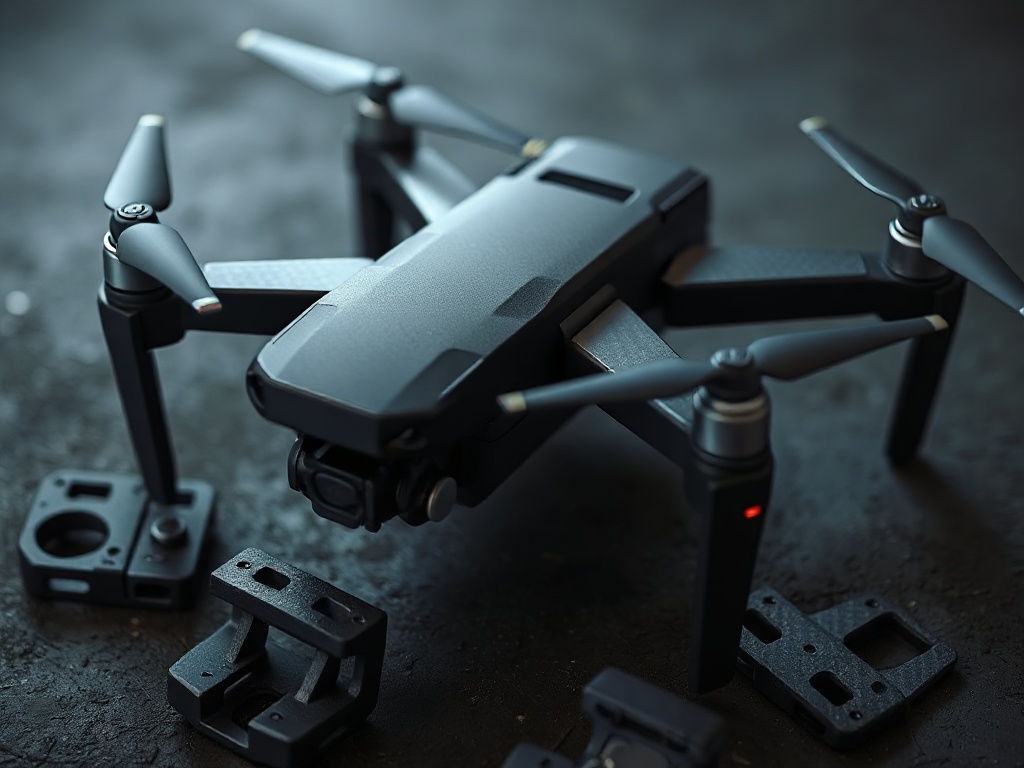
How the 3D printing process works in the defense industry
The process begins when you send us the 3D model and technical requirements of your part. We assess your expectations for strength, temperature resistance and dimensional tolerance, then recommend a suitable material and print orientation. After your approval, we move into production and, as a rule, complete the print in 1 business day; following dimensional inspection, we ship it. For projects requiring confidentiality, we sign an NDA before any file sharing, so that your designs and technical data are used only for production.
Which parts is it suitable for
- UAV/UCAV components: lightweight body parts, sensor and camera housings, cable channels
- Field and test fixtures: assembly fixtures, calibration gauges, ergonomic handles
- Out-of-inventory spare parts: reproduction of discontinued components (via reverse engineering)
- Prototype and validation parts: form, fit and function tests before serial production
Material selection
For structural load-bearing parts we recommend high-strength materials such as carbon and glass fiber reinforced nylon; for zones exposed to heat, we recommend technical filaments with enhanced resistance. Together we determine the one best suited to your application from a total of 17 materials. Our current production prices are transparent on a per-gram basis.
Frequently Asked Questions
Which materials do you recommend for UAV and field parts?
For UAV parts that bear structural loads and need to be lightweight, we recommend materials with a high strength-to-weight ratio such as carbon reinforced nylon (PA-CF). For field fixtures, jigs and housings, durable technical filaments are a good fit. If you tell us the operating conditions of your part (load, temperature, outdoor environment), we determine the most accurate choice together from among 17 materials.
How is the confidentiality of our designs and technical data ensured?
Confidentiality is essential in defense projects. Upon your request, we sign an NDA (confidentiality agreement) before any file sharing. The 3D models and technical documents you share are used only for the production of your part, are not shared with third parties, and are archived or deleted after production according to your request.
Can you reproduce an out-of-inventory (discontinued) spare part?
Yes. If you have a 3D model, we can print it directly; if not, we reproduce it by taking measurements from a sample part or by modeling from technical drawings (reverse engineering). This method offers a fast and economical solution for components that have become hard to source or have been discontinued entirely. Simply share the sample or drawing with us.
How long does production take and how is delivery handled?
As a rule, we complete the print time within 1 business day after approval. The total delivery time may vary depending on the number of parts, size and selected material; we provide a clear timeframe before the order. Once produced, parts are shipped to your address after dimensional inspection. For urgent needs, you can reach us through the quick quote form.
How is pricing calculated?
Pricing is done with a transparent per-gram unit price based on the amount of material the part uses; there are no surprise line items. The material you select, the part volume/infill ratio and the quantity determine the cost. You can see all current unit prices on our production prices page, and when you send your file you can get a clear price quote.
Which file formats do you accept?
For printing we most commonly use the STL format; we also accept formats such as STEP, OBJ and 3MF. Solid models like STEP give us more flexibility for material suggestions and editing when needed. If you do not have a model, we can also provide modeling support from a sample or technical drawing.
Related Guides
- Additive Manufacturing in the Defense Industry
- Reproducing Broken Parts for Drones and RC Vehicles with Drone Spare Part Printing
- Is PLA+ Really More Durable Than Regular PLA? What Is PLA+, and Who Is It Right For?
- Printing with Nylon (PA): What You Need to Know for High Durability
- Polycarbonate (PC) Filament: The Most Heat- and Impact-Resistant Option
 Türkçe
 العربية
 Русский
 فارسی
فارسی Deutsch