
Automotive 3D Printing Service
Hold the geometry in your hand, validate it and move it to series production with no tooling cost
A part’s fate is decided during development
In automotive, the cost and timeline of a project are usually determined not by the product itself but by the development process that leads to it. Testing a new geometry with a sample in hand before committing it to tooling eliminates the risk of pouring a million-dollar investment into a flawed injection mold. Automotive 3D printing removes exactly this risk: the designer, engineer and assembly team can physically put the same part on the table within days and see its fit and assembly behavior under real conditions. We run this process with additive manufacturing (FDM), building a separate material recipe for every zone, from under the hood to the interior trim.
We have close to seventeen engineering materials ranging from plastics to fiber-reinforced technical polymers, and we match each application to its point of use. For hot areas such as the engine bay, we choose heat-resistant ABS, PC and nylon (PA); for vibration-damping mounts, flexible TPU; and for rigid brackets and sensor carriers, carbon-fiber-reinforced composites. For first-round form and fit checks, economical options such as PLA or PETG are often more than enough.
Use cases from the workshop bench to the race track
The requests we receive on the automotive side don’t fit into a single category; in the same week we can print both an R&D validation model and an interior trim clip that went out of production years ago. The areas we work on most often are:
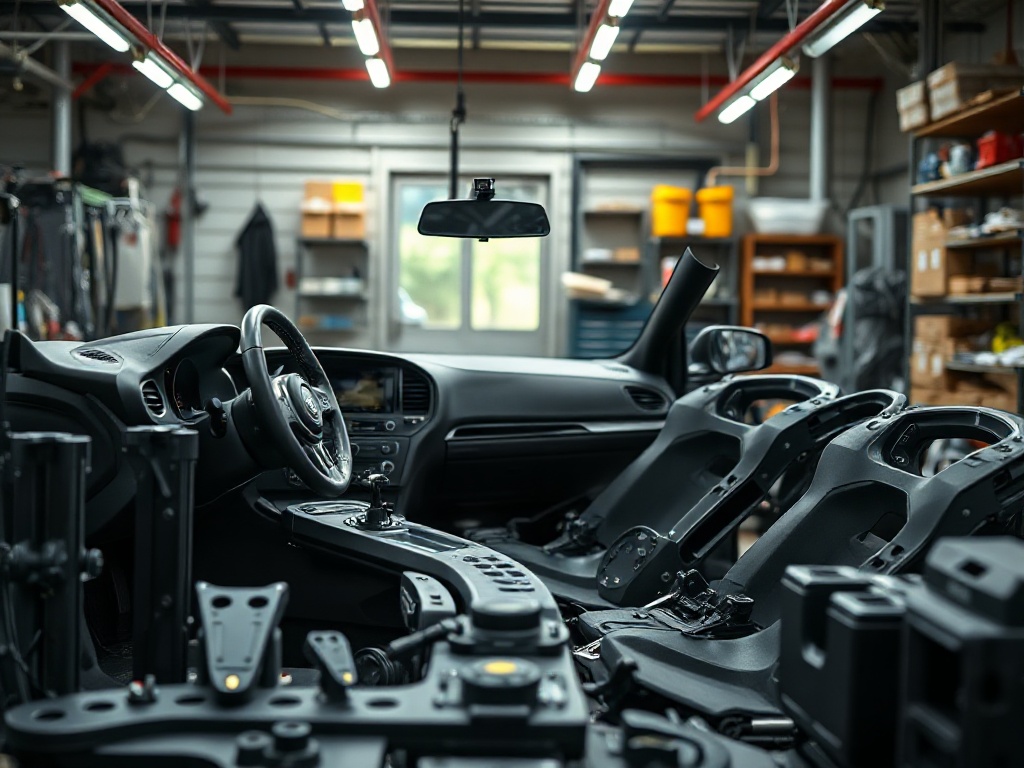
- Design validation models: dashboard cross-sections, air duct trials and early-stage snap/grip tests of clips.
- Jigs, fixtures and assembly aids: in-line mold inserts, welding and assembly fixtures, ergonomic operator-specific holders.
- Classic and rare vehicle spares: interior trim clips, grille details and control knobs whose supply chain has closed.
- Lightweight parts for motorsport: air ducts, cable brackets and precisely positioned sensor holders.
- Customized interior components: console organizers, phone cradles and vehicle-specific carrier parts.
Reverse engineering, confidentiality and repeatable batches
If all you have is a worn-out part with no catalog left, we measure it, turn it into a digital model and then reproduce it with a current material; reverse engineering is the capability that comes to the rescue most at this point. If it involves a development that hasn’t reached the market yet, we run the process under NDA, like an R&D line we don’t share. In low- and medium-volume series production, having every part come out to the same dimensions as the previous one is a baseline for us; we maintain color, hardness and dimensional consistency throughout the batch.
On the cost side, we don’t like surprises: once the part’s weight is clear, the price is clear too, and we move to production only after you approve. In other words, no machine runs before you see the budget.
Let us start from your project drawing or the sample in your hand and give you a clear price and lead time; you can start your order today by filling out the quick quote form.
How Does the Automotive 3D Printing Process Work?
The process starts when you send us the 3D model of your part. We review your file in STL, STEP, OBJ or 3MF format and assess the material, infill ratio and print orientation according to the part’s intended use. For a jig, dimensional stability is the priority; for a bracket near the engine bay, heat resistance is. We present the clear price and delivery time for your approval, and once approved we begin printing. For standard jobs, printing is completed in 1 business day; we only take payment after approval.
Who Is Automotive 3D Printing For?
This service is for all automotive professionals who need fast, cost-effective functional parts:
- R&D and design teams: Prototypes for form and fit validation before investing in tooling.
- Production engineers: Jigs, fixtures, gauges and holding aids for the assembly line.
- Classic car restorers: Reproduction of clamps, grilles, buttons and trim parts that are no longer available.
- Tuning and modification shops: Custom air ducts, brackets and interior parts.
All your projects are kept confidential under NDA; your original designs and technical files are not shared with third parties.
Frequently Asked Questions
Which heat-resistant materials do you use for automotive parts?
For hot environments such as the engine bay, high-temperature-resistant materials like ABS, ASA and PETG stand out; for exterior parts exposed to UV and weather, ASA in particular is preferred. For functional parts that need higher strength, reinforced options (carbon/glass fiber-filled nylon derivatives) are also available. Among a total of 17 materials, we recommend the one best suited to your part’s operating temperature and load.
How long does it take to print a production-line jig and fixture?
A standard-sized jig or fixture is usually ready for printing in 1 business day. The time may vary depending on the part’s size, quantity and chosen infill ratio; for dense and large parts the print time can be longer. We share the exact delivery time together with the quote after reviewing your file.
Can you reproduce a part for my classic car that is no longer available?
Yes, if you have the 3D model (STL, STEP, etc.) of your original part, we can go straight to printing. If you don’t have a model, we can guide you through the design/modeling step when you share the part’s dimensions or photos. Classic car trim, clamp, grille and interior parts are quite suitable for FDM printing.
How is pricing determined?
Our pricing is based on a transparent per-gram tariff; the fee is calculated according to the part’s weight and the chosen material, with no hidden items. You can review the current per-gram prices on our production prices page. When you send your file, we present the part-specific net amount for your approval.
Which file format should I send for a design validation prototype?
We accept all of the STL, STEP, OBJ and 3MF formats; for assembly validation, the STEP format is ideal for preserving dimensional precision. You can send your file via the quote form. If there is a surface error in the file that needs repair, we inform you before printing.
How is the confidentiality of my designs protected?
All automotive projects are handled under an NDA (non-disclosure agreement). The CAD files, prototype designs and proprietary part geometries you send are not shared with third parties and are used only to produce your order. If you have additional confidentiality requirements for your R&D-stage secret projects, we can clarify them before printing.
Related Guides
- The Use of 3D Printing in Automotive
- Reproducing Broken Parts with Drone Spare Part Printing for Drones and RC Vehicles
- Drilling Jig 3D Printing: A Simple Guide to Designing a Template for Repetitive Workshop Tasks
- 3D Printing in Spare Part Manufacturing
- Reproducing a Washing Machine Button Knocked Off by a Robot with Spare Part 3D Printing
 Türkçe
 العربية
 Русский
 فارسی
فارسی Deutsch