
Medical and Dental 3D Printing: From Patient Data to a Tangible Model
Surgical planning models, custom anatomical replicas and dental appliances from your DICOM and STL data
When Scan Data Becomes a Model You Can Hold in Your Hand
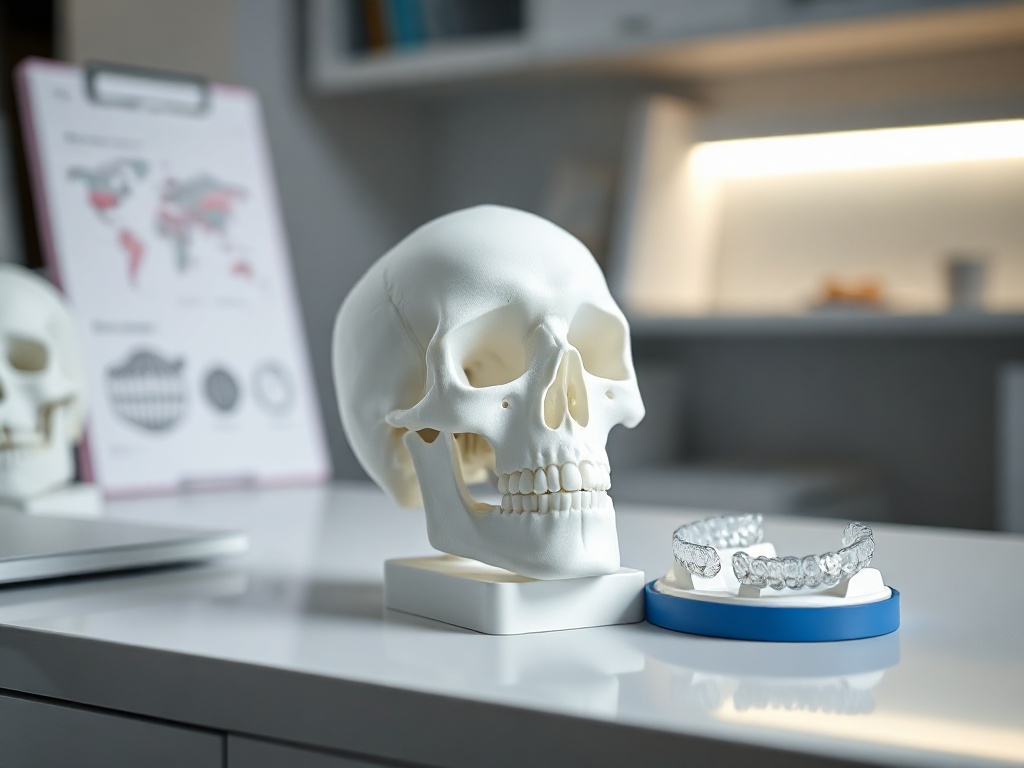
There is a real difference between making a surgical decision by looking at a CT slice or an intraoral scan file, and planning by taking that anatomy into your hand at a 1:1 scale and examining it. For the clinical team, seeing a skull fracture, a defect in the jawbone, or the course of a root canal on a physical model places pre-operative planning on a far more concrete footing. This is exactly where we come in: we turn your DICOM or STL data into a model you can touch and measure, using fused deposition modeling (FDM).
The imaging data you provide is the foundation of the process. We prepare the file from the CT or intraoral scanner for production while preserving scale integrity, and we set the layer and infill parameters according to the application so that anatomical detail is not lost in the print. Which material works best depends on the intended use; that is why we discuss from the very start whether the model will sit on a desk, go through sterilization, or require a flexible surface.
Production That Earns Its Place in the Clinic and the Lab
For non-patient-contact work intended for planning and production support, the printing process is both fast and budget-friendly. The jobs we work on most often include:
- Surgical planning models: pre-operative simulation on bone, skull and jaw replicas
- Custom anatomical models: a 1:1 copy of a patient’s specific structure
- Dental appliances: working models, clear aligner molds, temporary crowns and surgical guide bodies
- Prosthesis and orthosis prototypes: physical validation of a design before it is adapted to the patient
- Laboratory apparatus: sample holders, fixtures and auxiliary parts for repetitive procedures
- Educational models: durable anatomical models for student and in-clinic instruction
We also select the material according to the type of job. For anatomical models, PLA or PETG is generally preferred for the balance between detail sharpness and cost. For appliances that carry mechanical load or are expected to be more heat-resistant, ABS and PC stand out. For flexible parts that need to conform to the patient’s surface, we work with TPU.
Let’s Be Clear About Regulatory Limits and Confidentiality
There is one point we want to underline firmly here. The parts we produce with FDM are for planning, education and production support. End products that enter the body or remain in prolonged patient contact require biocompatible certified material and compliance with medical device regulations (MDR). If you have such a need, we clarify these requirements together and define the scope correctly; for non-patient-contact applications, our standard printing applies. All of your patient data and design files are kept under NDA and are not shared with third parties.
Share your imaging file with us and let’s determine the right method and material together. You can get started by submitting your data through our quote and order form.
How does the process work?
The medical and dental 3D printing process begins with turning your imaging data into a print-ready model. The general flow is as follows:
- Data sharing: You share your tomography output (DICOM series) or the STL/OBJ/STEP file obtained after segmentation.
- Assessment and quote: We review the model’s size, volume and material requirement and provide a quote based on transparent per-gram pricing.
- Approval and printing: After you approve the quote, printing is usually completed within 1 business day; payment is then collected.
- Delivery: The model is inspected and handed over to the courier.
Converting DICOM data into a surface model (STL), known as segmentation, is a separate step; if you already have this ready, the process moves faster.
Who is it suitable for?
This service is suitable for physicians working in oral and maxillofacial surgery, orthopedics, orthodontics and maxillofacial fields, as well as dental clinics, dental laboratories and medical R&D teams. It is frequently chosen for anatomical bone models, educational models and dental appliance production used in pre-surgical planning and patient information. All of your projects are kept confidential under NDA.
Frequently Asked Questions
Can I send my tomography (DICOM) file directly, or do I need to convert it to STL?
A surface model (STL/OBJ/STEP) is required for printing. Converting a raw DICOM series into a print-ready model (segmentation) is a separate step and is usually carried out by the physician or the software you use. If your STL file is ready, the process moves much faster; if you are not sure, share your file through our quote form and let’s assess it together.
How long does a surgical planning model take to be ready?
After your approval, printing is usually completed within 1 business day. If the model is very large or multiple parts are required, the time may extend somewhat; we will inform you of the exact time at the quote stage.
Can the models you print be used in a patient’s mouth or body?
Our service is geared toward producing anatomical models, surgical planning mock-ups and educational/presentation appliances with FDM technology. Patient-contact end products (intraoral appliances, implants, etc.) require biocompatibility and compliance with medical device regulations; since we do not hold these certifications, we do not produce such products for clinical use. We provide the models for planning, education and visualization purposes.
How is the price of a model determined?
Pricing is done per gram, transparently according to the material; in other words, the amount of material the part consumes is taken as the basis. For anatomical models, the internal infill ratio and size directly affect the cost. You can review current unit prices on our production prices page, and get a quote with your file for an exact figure.
Which material should I choose?
For surgical planning and anatomical models, PLA or PETG, which offer good dimensional stability, are common choices; for more durable presentation models, PETG or ABS is suitable. From our total of 17 material options, we provide guidance according to your intended use. Just let us know your color and transparency requirements.
Will my patient data and project files stay confidential?
Yes. All your files and projects are protected under an NDA (non-disclosure agreement); the data you share is used only for the printing job and is not shared with third parties. We also recommend anonymizing identifying information before sending us your patient data.
 Türkçe
 العربية
 Русский
 فارسی
فارسی Deutsch