TPU or Wood PLA? A Flexible Functional Part or Wood-Look Décor?
Choosing between TPU and Wood PLA starts with how the part will be used: a protective component that needs to flex and a decorative model designed to look like wood call for different materials. TPU is considered for flexible FDM parts, while Wood PLA is used for prints containing wood particles and designed to emphasize surface appearance. Understanding what each filament does well—and what it is not suited for—helps avoid mismatched expectations.
What are TPU and Wood PLA used for?
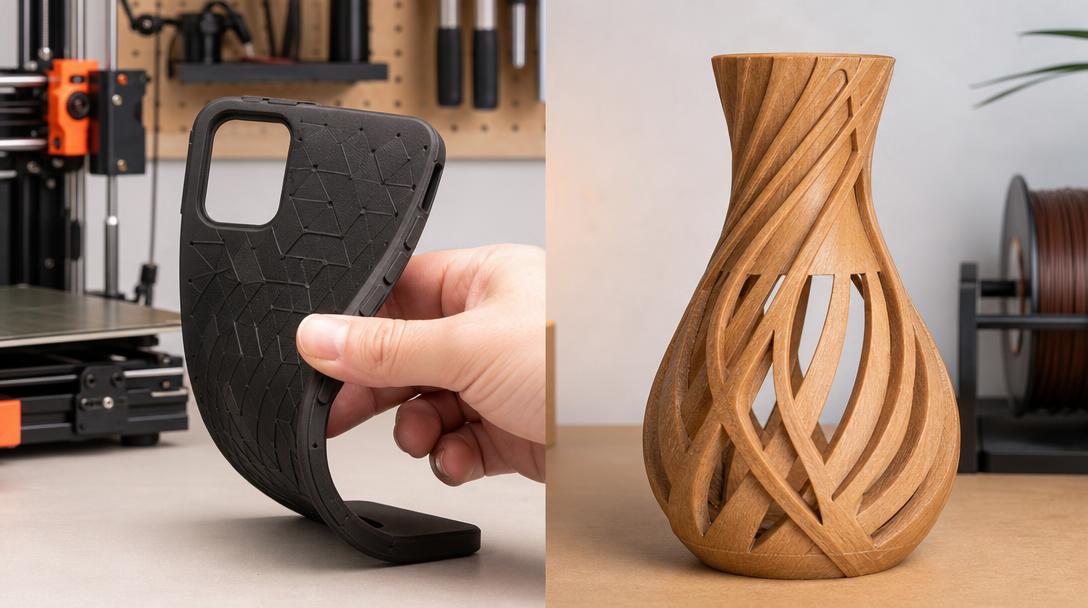
TPU is a flexible filament based on thermoplastic polyurethane. Depending on the material’s selected hardness and the part’s geometry, a printed component may be suitable for bending and absorbing some impact. It can be considered for parts that need flexibility, such as cable protectors, flexible bumpers, feet, or grip surfaces. However, not all TPU parts are equally soft; the design and material grade determine the result.
Wood PLA is a wood-filled version of PLA-based material. It does not hide the traces of layered production; instead, it can be used for decorative objects designed to have a wood-like color and texture. Models, presentation pieces, and accessories where appearance matters are more natural applications for this material. It is not real wood, so you should not choose it expecting the same strength, workability, or environmental behavior as solid wood.
Flexibility, rigidity, and outdoor use
The main difference between the two materials is flexibility. TPU makes sense for a shape that needs to bend or compress, while Wood PLA generally produces a rigid part. It is not suitable to expect a flexible seal or impact-absorbing cover from Wood PLA. Likewise, TPU is not a direct substitute for a decorative object with fine details, a hard surface, and a wood-like feel.
For outdoor use, do not decide based on the material name alone. Sunlight, temperature changes, continuous loads, part thickness, and print orientation should all be considered together. If Wood PLA is used outdoors for decorative purposes, environmental exposure may change its appearance and dimensions over time; TPU’s flexibility alone does not guarantee long-term UV resistance either. For a critical application, test under real conditions and verify that the material is suitable.
Printability and choosing the right part
Because TPU is flexible, it is important to keep the filament path under control and adjust the print profile to suit the material. Printing too fast or with unsuitable settings can cause feeding problems. Wood PLA produces a different visual result; because it contains filler particles, the printer and nozzle conditions need to be suitable for the material. For both filaments, the manufacturer’s profile and the part’s geometry are good starting points.
- A part that flexes, compresses, or conforms to a surface: Consider TPU.
- A wood-like appearance and decorative surface: Wood PLA is a more suitable candidate.
- High rigidity or precise dimensions: Consider the geometry, print orientation, and service load together rather than relying on the material name alone.
- Outdoor use: Verify sunlight and temperature conditions separately; do not assume either option will automatically withstand all outdoor conditions.
Before deciding, clarify the part’s function, the surface it will touch, and how much flexibility is acceptable. You can explore options from different material families on our printing materials page and assess whether your project can be produced through our 3D printing service.
Price and final considerations
The part’s size, infill percentage, number of walls, and support requirements affect production costs; choosing a different material for the same geometry can also change the estimate. You can review our general pricing approach on the affordable 3D printing prices page, or use your file to get an estimate with our online 3D printing calculator. TPU is intended for flexible functional parts, while Wood PLA is intended for decorative parts with a wood-like appearance. Defining the usage conditions and appearance you expect from the outset will help you make a more informed choice.



 Türkçe
 العربية
 Русский
 فارسی
فارسی Deutsch