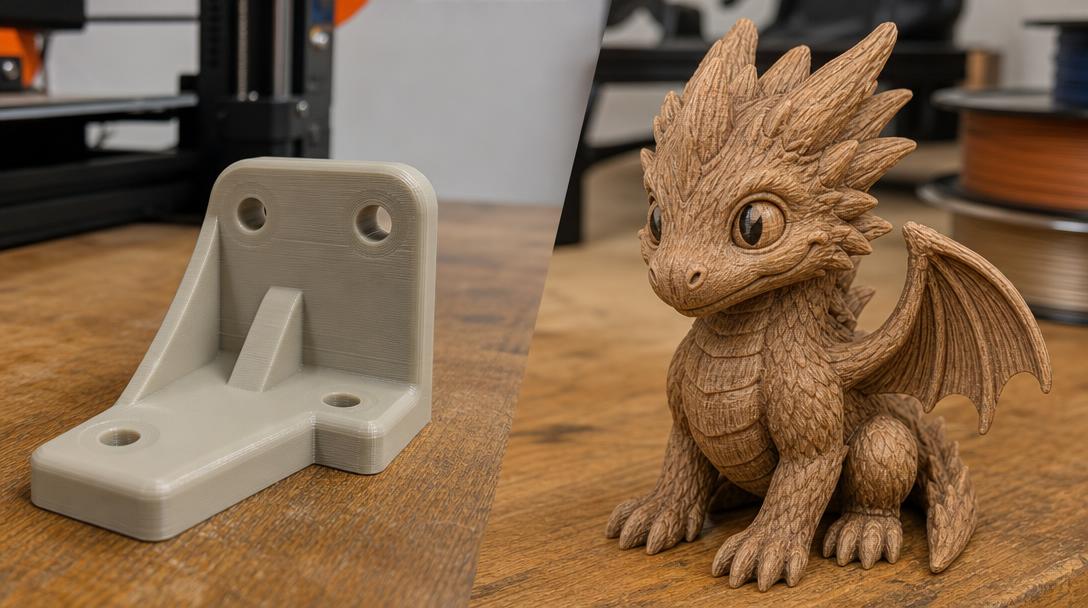
PLA+ vs Wood PLA: Everyday Use or Wood-Look Decor?
The answer to whether PLA+ or Wood PLA is right for you depends on whether you want a functional part or a decorative model that stands out with a wood-like texture. Both are PLA-based options used in FDM printing, but their additives and ideal applications differ. When choosing, consider not only appearance but also the load the part will bear, its environment and your expectations for the finished print.
When is PLA+ a better choice?
PLA+ can be considered for everyday accessories, enclosures, prototypes and visual models. Since formulations modified from standard PLA vary from one manufacturer to another, “PLA+” does not refer to a single, fixed technical specification. So it is not wise to assume a specific level of strength or heat performance based on the name alone; actual usage conditions and material data matter.
If the part’s dimensions and surface finish are priorities, PLA+ may be the more straightforward choice. For items such as boxes, organizers, connector covers or product prototypes, clean geometry and function take precedence. For a part that will be exposed to sunlight and heat for long periods outdoors, however, do not automatically assume that the PLA family is suitable; other FDM materials may be worth considering depending on the conditions.
What does Wood PLA offer—and what doesn’t it?
Wood PLA is a family of PLA-based filaments containing wood particles or fibers, and is chosen to give prints a matte, textured, wood-like appearance. It makes sense for projects where appearance is key, such as decorative objects, scale models, presentation pieces and visual prototypes. It is not solid wood and should not be treated as a load-bearing material or an outdoor material like wood.
Fillers can affect printing behavior. It helps to choose a nozzle and settings in line with the manufacturer’s recommendations, then check the surface finish and details with a small test print. Do not assume Wood PLA will produce the same results with every type of fine detail; the filler content and filament formulation vary by product.
Choose based on the part
- Function and a simple appearance: PLA+ is a more natural starting point for parts such as everyday accessories or enclosures.
- Wood effect: Wood PLA offers an appearance advantage for decorative items, scale models and display pieces.
- Impact and load: The “PLA+” label alone does not guarantee performance; consider the part’s geometry, print orientation and the manufacturer’s technical information together.
- Outdoor use and heat: Keep in mind that both materials are PLA-based; check material suitability separately for continuous exposure to sunlight or heat.
- Appearance after printing: Wood PLA’s texture enhances the decorative effect, while PLA+ suits designs that call for a more neutral finish.
In short, the choice is not about “which is better?” but about the part’s purpose: consider PLA+ when function is the priority, and Wood PLA when a wood-like appearance matters most. Explore the material options on our printing materials page, and learn about our 3D printing service for your part. You can view an estimated price for your file using the 3D printing price calculator; for an overview of the general differences between these two materials, see our guide to Wood PLA and decorative filled filaments.


 Türkçe
 العربية
 Русский
 فارسی
فارسی Deutsch