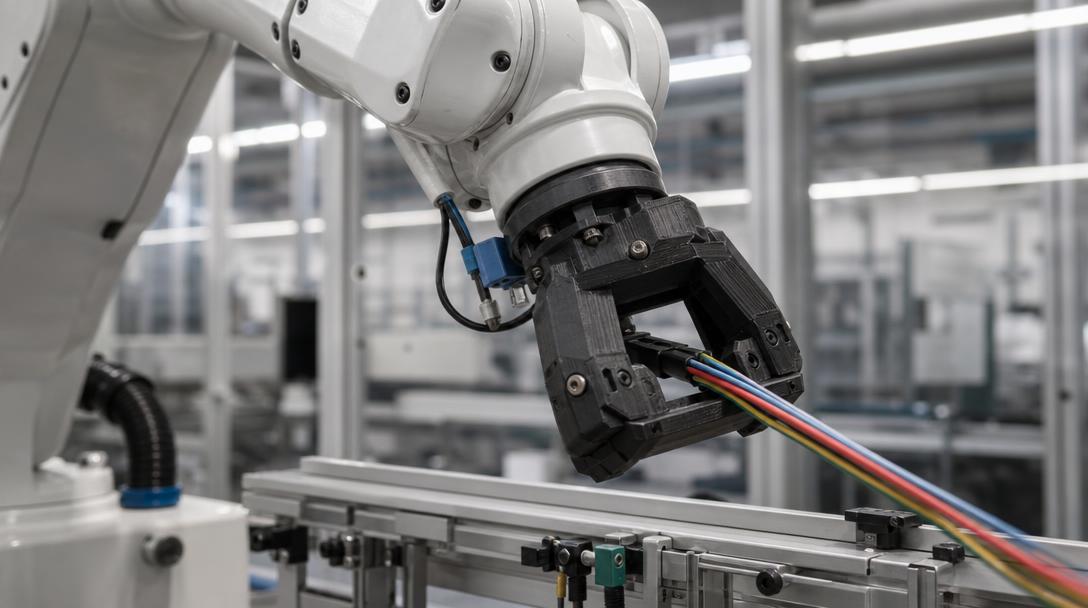
HellermannTyton Produces Robot End-of-Arm Tools Faster with FDM
FDM 3D printing is being considered in factories not only for making prototypes, but also for producing custom tools used every day on the production line. HellermannTyton, which makes cable management products, began producing in-house with FDM the tools fitted to the ends of its robot arms. The company’s experience shows how speeding up design changes for low-volume, product-specific auxiliary tools can affect production workflows.
Why are tools at the end of a robot arm important?
Known as end-of-arm tooling, these tools perform tasks such as gripping, moving, positioning or packaging parts. They are often designed around a specific product and automation step on the production line. In a conventional supply process, revisions can take weeks when the design, manufacture and replacement of a custom tool depend on an external supplier. In the example HellermannTyton shared with TCT Magazine, in-house production reportedly made it possible to test new designs within a few days.
HellermannTyton reports that it has printed 38 different tools to date on a Stratasys Fortus 450 system, and that together they have completed tens of millions of cycles. According to the company, reductions of up to 50% in tool weight and lead time, and up to 75% in cost, were achieved. These figures relate to one company’s application; they do not mean that the same gains will be achieved for every part or facility.
How were concerns about durability addressed?
When additive manufacturing was first evaluated, the team questioned whether plastic parts could withstand the strength demands between layers and repeated cycle loads. After trials with supplier SYS Systems, nylon 12 carbon-fiber-reinforced material was evaluated, and the designed tool was tested under real operating conditions. The key lesson is not to select a material based only on catalogue data: make a test part that represents the actual gripping force, load direction, contact surface and repeated cycles.
The performance of FDM parts can be affected by print orientation and toolpath decisions. For a load-bearing tool at the end of a robot arm, therefore, model orientation, the geometry of connection points and the placement of layers relative to the load direction should all be part of the design. If a part failure could affect safety or product quality, testing and validation should not be skipped.
Which businesses could apply this approach?
This approach may be worth considering for production lines with frequent product changes, a small number of custom grippers or guides, and a need for tooling revisions. First, document the existing tool’s function, load, cycle count and operating environment. Then review the design for printability and, where appropriate, test a prototype on the actual production line. If the results are successful, spare copies can be reproduced from the digital file. However, applications involving high temperatures, chemical exposure or critical safety requirements need a separate expert assessment of material and design suitability.
Ucuz3D’s 3D printing service for FDM-manufacturable fixtures, enclosures and custom tools can be a starting point for assessing whether a file is ready for production. When considering materials, you can explore printing with engineering materials; to see an estimated cost, use the affordable 3D printing price calculator. Since part volume and material choice can affect the cost estimate, reviewing the guide to how print orientation affects part strength can also help clarify design decisions.
The practical takeaway from the HellermannTyton example is not that FDM can replace every factory tool; it is that it can be a production alternative worth testing in-house for low-volume tools with suitable geometries that need frequent revisions. Success on the production line depends not only on the printer, but also on the right material, a design that accounts for the loads, and validation under real operating conditions.


 Türkçe
 العربية
 Русский
 فارسی
فارسی Deutsch