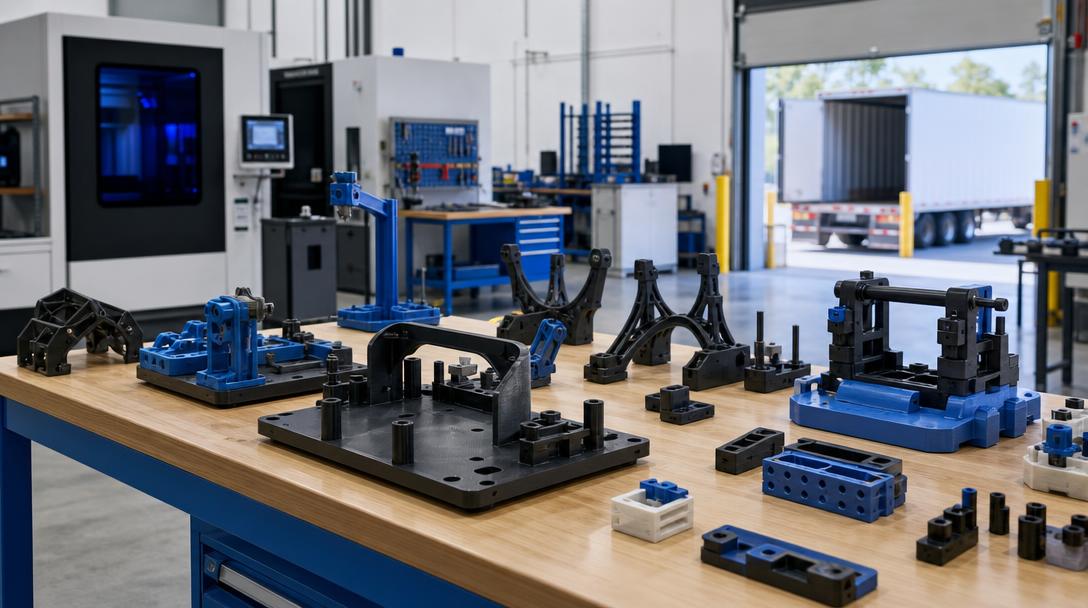
Makelab’s New Workshop Opens the Door to Automotive Supply with 3D Printing
Winning a new customer in automotive supply is about more than being able to produce the part; loading access, production capacity and process control can also be decisive. New York-based Makelab’s new production facility stands out in this respect: the company expanded its infrastructure to serve large-scale customers in the automotive supply chain. The growth of 3D printing in automotive production is also an important signal for organizations that rely on manufacturing services.
What has the new facility changed?
According to a 13 October 2026 report by 3D Printing Industry, Makelab moved into a new 3,840-square-foot facility in Brooklyn. The company says that logistical and physical infrastructure constraints at its previous location made it difficult to work with large manufacturers. In the specific example given in the report, a Tier 1 automotive supplier sent a large truck to collect an order; the previous workshop did not have the access needed to accommodate this kind of delivery.
This detail shows that additive manufacturing is about more than printer capacity. Access to the production space, the flow of materials and parts, post-processing and shipping are also part of customer requirements. Makelab says that its new facility handles the entire workflow in-house, from file preparation and printing to post-processing, and applies quality control at each stage. The report does not specify the technology used or the type of part in the automotive order, so it should not be presented as a specific FDM application. Even so, the example shows that logistics can be a separate selection criterion, independent of the manufacturing method, when choosing a service provider. Since large customers work to fixed delivery schedules and standard shipping arrangements, a workshop’s ability to fit into those systems matters from the quotation stage through to delivery.
Why do manufacturing services matter in automotive supply?
Suppliers sometimes need to produce small batches, prototypes, custom fixtures and production aids without investing in conventional tooling and molds. For suitable geometries and materials, 3D printing is one option for meeting these needs, but it is not the right method for every part. Load, temperature, vibration, environmental conditions, dimensional tolerances and required quantity should all be considered together. If the part’s function is not yet clear, printing a prototype first to check fit or ergonomics can support a better-informed decision about production runs.
For FDM applications such as fixtures, assembly aids, enclosures and functional prototypes, material choice and print orientation are just as important as the design. When looking for a 3D printing service for your automotive project, sharing where and how the part will be used makes it easier to assess a suitable manufacturing method. For more information about layer orientation and how FDM parts behave under load, see our guide to print orientation.
Practical lessons from scaling up a workshop
Makelab’s example is a reminder that industrial customers expect more from a manufacturing partner than just a fleet of machines. A repeatable workflow, quality control and manageable shipping are what turn increased capacity into a dependable service. For design teams, bringing manufacturing expertise into the process early can also help prevent decisions about part segmentation, assembly, tolerances and materials from turning into costly revisions later on.
- Consider logistics as early as design: Part dimensions, packaging and delivery methods can affect the production plan.
- Describe the function: Load, temperature and the operating environment are key inputs for material selection.
- Validate first: A prototype or fixture can be useful for testing a design in the field before production.
In automotive supply, this report highlights the growing importance of production infrastructure and end-to-end processes; it does not, by itself, prove the superiority of any particular printing technology or part. If you need an FDM prototype or fixture, first clarify the technical requirements, then find out about affordable 3D printing prices, or upload your file to see an instant quote for online 3D printing. Our guide to the advantages of 3D printing for prototyping may also be helpful for similar development projects.


 Türkçe
 العربية
 Русский
 فارسی
فارسی Deutsch