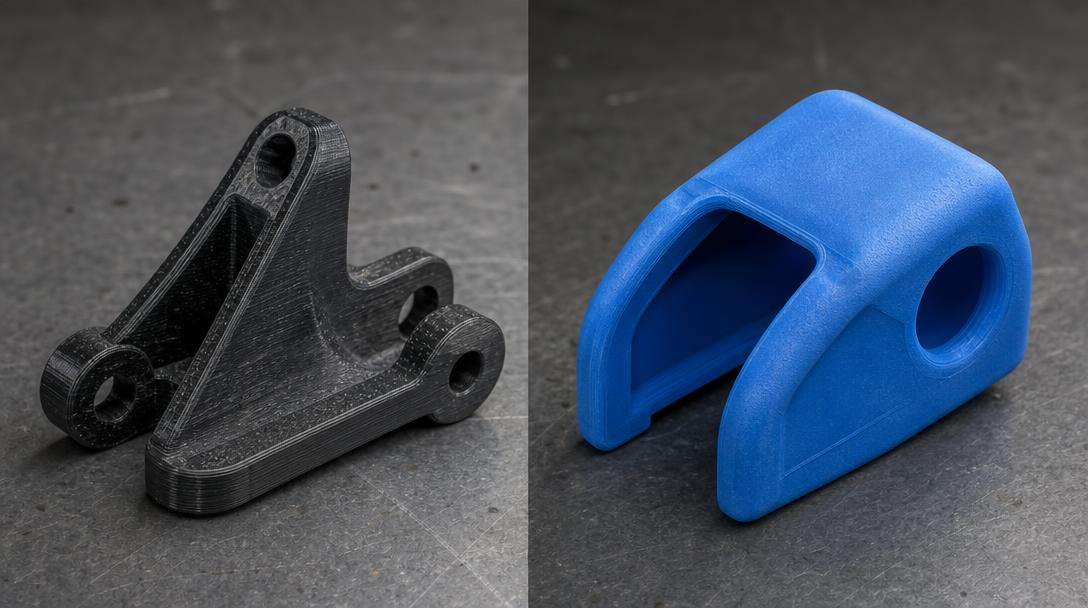
Carbon-Fiber-Reinforced Filament or TPU? A Rigid Technical Part or a Flexible Protective Part?
The answer to whether you should use carbon-fiber-reinforced filament or TPU depends on whether the part needs to remain rigid or flex to absorb impact. In FDM printing, these two materials do different jobs: carbon-fiber-filled filament is intended for parts that need greater rigidity when properly designed, while TPU is used for flexible parts that can change shape. Make your choice based not only on the material name, but also on the load, contact surfaces, environment and printing requirements.
Different functions: rigidity or flexibility?
Carbon-fiber-reinforced filament is an FDM filament made by adding short fibers to a polymer-based material; a printed part is not a true carbon-fiber composite or metal. The additives can help achieve rigidity and dimensional stability in some prints. However, the result depends on the base polymer, print orientation, part geometry and settings. Printing a thin part that needs to flex from this material may not deliver the intended function.
TPU belongs to the flexible thermoplastic elastomer family. It can be considered for parts expected to change shape, such as cases, vibration dampers, flexible feet or protective parts that come into contact with cables. TPU may not be a suitable substitute for a rigid support or a part that needs to maintain precise dimensions over time. “Impact resistance” is not enough on its own to guide your choice: a sharp impact and repeated bending can produce different results.
Outdoor conditions, heat and impact
For either option, performance outdoors cannot be guaranteed by the filament family alone. The base polymer in a carbon-fiber-reinforced product matters when assessing UV and temperature performance; with TPU, the formulation and operating conditions also affect the result. If the part will be used in direct sunlight, inside a vehicle or near a heat source, check the product’s technical data sheet and the actual operating temperature. Giving one general temperature limit for these materials would be misleading.
In an assembly exposed to impact or vibration, TPU may work as a protective spacer that absorbs energy by flexing. For a bracket that needs to stay in position, support a connection or remain rigid, carbon-fiber-reinforced material may be a more suitable candidate. However, fiber additives do not automatically make a part unbreakable; layer orientation and the geometry of connection points still matter. This is why the effect of print orientation on part strength matters as much as the material.
Printing ease and design choices
When printing TPU, the filament’s flexibility can make feeding and retraction more sensitive; settings need to be adjusted carefully, especially with long, narrow filament paths. With carbon-fiber-reinforced filaments, the printing requirements of the base material must be considered, along with the potentially abrasive nature of the fiber additives. Choosing a nozzle suitable for the filament and equipment is important. In either case, testing fits, screw holes and thin sections in an initial prototype is safer than moving straight to a functional part.
Before deciding, note which way the part needs to flex, how much load it will carry and which surfaces it will contact. If a rigid body only needs vibration isolation, you could also consider dividing the design into two functional zones; however, combining different materials in a single print is not possible with every printer or design. You can explore general filament options on our printing materials page, and read about 3D printing with engineering materials for material considerations in engineering applications.
Which material suits which part?
- Carbon-fiber-reinforced: Can be considered for suitably designed fixtures or brackets expected to remain rigid, retain their shape and provide a technical appearance.
- TPU: Better suited to applications that need to change shape, such as flexible guards, bumpers, vibration-absorbing spacers or soft protection around cables.
Material and geometry should be evaluated together; the final choice depends on conditions such as load, temperature and service life. When preparing your part for production, you can share its intended use as part of our 3D printing service, get an estimate using the calculator for low-cost 3D printing prices, and check the online 3D printing price for your file. Pre-printing consultation can help clarify the material and orientation choices that best suit your part’s function.


 Türkçe
 العربية
 Русский
 فارسی
فارسی Deutsch