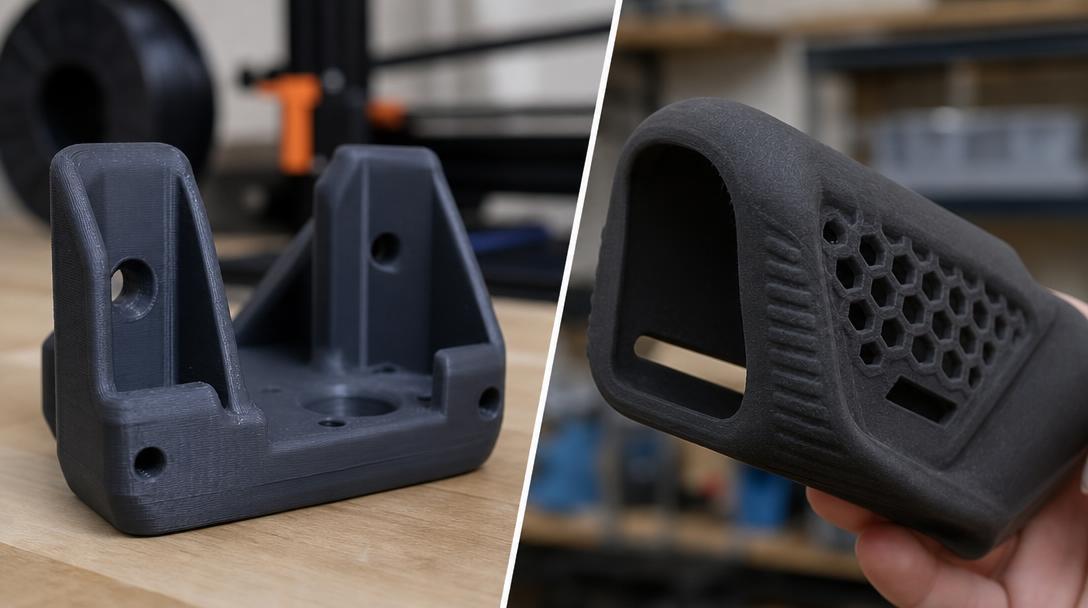
PLA+ or TPU? Rigid Fixture or Flexible Protector?
The answer to whether to use PLA+ or TPU depends on how the part needs to behave under load. Are you designing a rigid body that holds its shape, or a flexible part that is expected to bend and return to its original form? The two filaments do not serve the same purpose; when choosing, consider the intended use, geometry, and ease of printing together.
The key difference: rigidity and flexibility
PLA+ is a variant of the PLA family and can be considered for prototypes, covers, enclosures, and desktop fixtures that need to retain their shape. The name “PLA+” does not refer to a single standardized formula: additives and performance can vary by manufacturer. So don’t assume a specific PLA+ product’s impact or heat performance based on its name alone.
TPU is a thermoplastic polyurethane used for flexible FDM parts. It can work well for designs such as flexible cases, bumpers, feet, or gasket-like components. However, “flexible filament” does not mean a part will withstand every load or be leakproof in all conditions; design, hardness grade, print orientation, and wall structure all affect the result. Explore our printing materials to see the available filament options.
Which material for which part?
- Part that needs to stay rigid: PLA+ can be a more suitable starting point for decorative prototypes, dimensional inspection fixtures, or rigid enclosures.
- Part that needs to flex and soften impacts: TPU can be considered for designs such as protective cases, flexible bumpers, or vibration-contact points.
- Precision-fit part: Dimensions are generally easier to adjust with PLA+. Since TPU’s flexibility can affect the fit, it’s useful to check tolerances with a prototype print.
- Repeated bending: TPU’s flexibility can be an advantage, but sharp corners, thin sections, and print-layer orientation can affect fatigue behavior.
Ease of printing and design
PLA+ is one of the easier options to manage for most users, though bed adhesion, cooling, and the manufacturer’s filament profile still matter. TPU’s printing behavior varies with its flexibility, and it may require careful settings to reduce bending or jamming as the filament feeds. Before printing, check that your printer is compatible with flexible filament, review the manufacturer’s recommendations, and consider the part’s dimensions.
For either material, don’t treat infill percentage as the only measure of strength. The number of outer walls, wall thickness, layer orientation, and where the load is applied to the part are often just as important as infill. For parts such as clips or thin flexible arms in particular, rounding sharp internal corners and spreading stress over a wider area can help extend the design’s service life. See our print orientation guide to learn how part orientation and layers relate to strength.
Heat, outdoor use, and realistic expectations
Choosing PLA+ or TPU alone does not guarantee suitability for outdoor use or high temperatures. Formulations vary, so verify critical limits such as operating temperature using the filament manufacturer’s technical information. If a part will be exposed to prolonged sunlight, a hot car interior, or chemicals, don’t choose between these two out of habit; clearly describe the conditions of use and ask for guidance on the right material.
If your file is ready, you can share the part’s intended use as part of our 3D printing service and get advice on materials and design. To check an estimate without committing to a fixed amount, upload your file to our 3D printing price calculator; the part’s geometry and selected settings affect the estimate.
A quick rule of thumb
If the part needs to hold its shape, start with PLA+; if it needs to flex or soften impacts, consider TPU. When the function is near the limits of either material, check the design with a small test print and test the part under its actual working load. Describing what the part needs to do, rather than relying on the material name alone, makes it easier to choose correctly.



 Türkçe
 العربية
 Русский
 فارسی
فارسی Deutsch