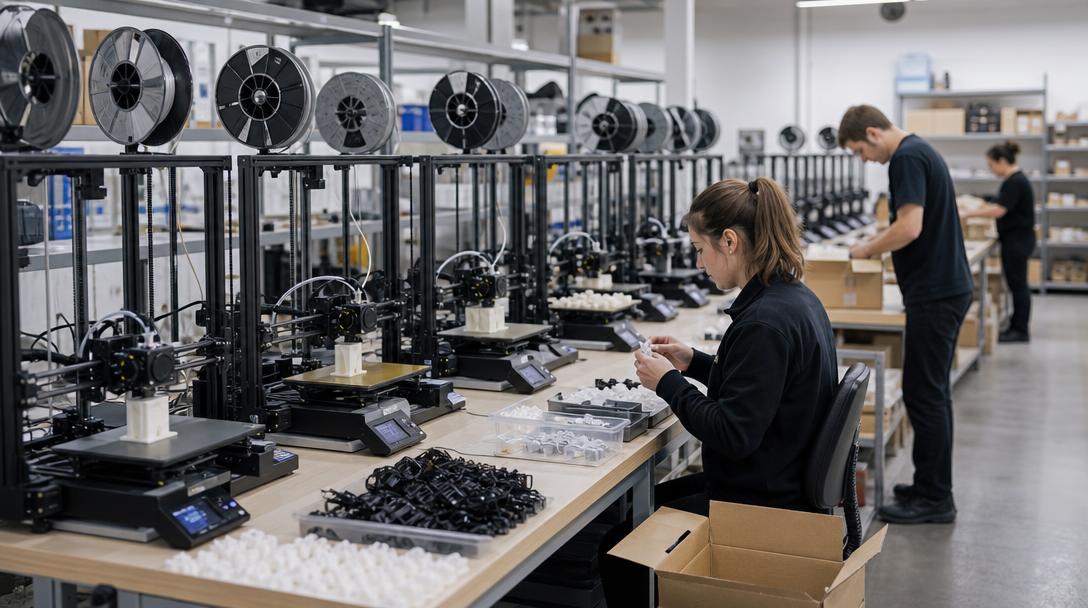
Huafast’s 15,000-Printer FDM Production Network: How Desktop Printers Become a Factory
Thousands of desktop printers working within the same production network show how FDM printing can scale beyond prototyping. According to a 25 September 2026 field report by 3D Printing Industry, China-based Huafast has around 15,000 printers across its network of locations; all 5,600 devices at its Shenzhen operation are reported to be Bambu Lab machines. These figures are company-reported; the real value of the report lies in showing how the production farm operates behind the scenes.
More than printer numbers: managing capacity
Simply buying a large number of machines does not, by itself, create production capacity. Orders need to be assigned to printers, while material supply, print inspection, post-processing, packing and dispatch all need to run to the same schedule. The report describes Huafast’s operation as covering not only its production floor but also processes such as finance, administration, processing and warehousing. The actual output of a printer fleet depends on how well these processes work together.
This distinction is especially important when setting delivery dates. In one example shared by the company’s founder, an order for more than 50,000 toys was completed in seven days, with around 1,000–2,000 printers allocated to the job. It was estimated that using more machines could have cut the time to three days, but orders from existing customers would then have remained in the production queue. So the total number of printers is not the same as the capacity available for a specific order.
An advantage for products with fast-changing demand
Huafast’s customers include businesses that sell through their own channels and online marketplaces. Demand for a product idea that spreads quickly on social media can rise in a short time; however, as similar products multiply, both prices and interest can change just as quickly. Compared with methods that require investment in moulds and lengthy preparation, an FDM print farm can offer the flexibility to allocate production according to demand. In return, large quantities of parts must be produced with repeatable quality and orders dispatched on time.
That is why the question “How many printers are there?” matters just as much as how production is planned. As operations scale up, it becomes increasingly important for the same file to produce consistent results on different machines, for suitable print profiles to be used, for material supply to remain steady and for quality to be controlled. Even as the machine fleet grows, the bottleneck may shift to labour, packing, material flow or dispatch.
What small businesses can learn
This example does not mean every product needs to be made using thousands of FDM-printed units. For low-volume, personalised or uncertain-demand parts, printing can be considered for pre-mould production or short runs. When making a decision, consider the part geometry, required quantity, surface finish expectations, material and delivery schedule together. Printing a limited number of samples first can help validate how the product will be used and how the production process will work.
If you need a prototype, enclosure, fixture or spare part, you can assess whether FDM is suitable through our 3D printing service. Take a look at our affordable 3D printing prices page to see the estimated cost of your model, or upload your file to get an instant estimate with our 3D printing price calculator. You can explore our printing materials to choose a filament based on the part’s function, and use our 3D printing design guide to check whether your design is suitable for production.


 Türkçe
 العربية
 Русский
 فارسی
فارسی Deutsch