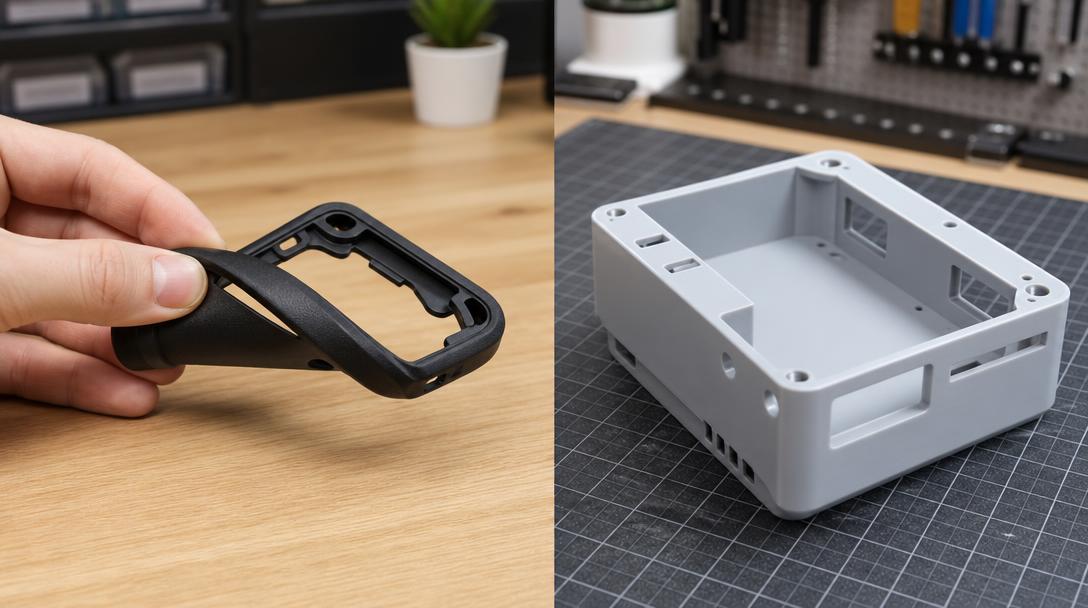
TPE or HIPS? Flexible Protection or a Lightweight Prototype?
The answer to whether to use TPE or HIPS depends on whether the part needs to flex or retain its shape. Both are thermoplastics that can be used in FDM printing, but they are not interchangeable. TPE is suited to flexible parts, while HIPS is considered for more rigid, lightweight prototypes and housing components. Choose based not only on the filament name, but also on the part’s load and operating environment.
First, define the part’s function
TPE is suitable for parts that can bend after printing and largely return to their original shape once the force is removed. In examples such as a flexible bumper, protective case, vibration-damping spacer, or a component held in place by compression, flexibility is the function itself. However, TPE does not necessarily mean a material that is resistant to every kind of impact, soft, or easy to print; its flexibility can vary depending on the product formulation and printing conditions.
HIPS, on the other hand, is a rigid printing material in its own right. It can be considered for applications such as lightweight enclosures, prototypes that need to maintain their shape, or models intended for post-processing. Although its name is often heard in the context of support materials, HIPS is not used only as a support. When selected as the printed part material, the required shape stability and expected service load should be considered together. For both materials, final performance is affected by geometry, wall structure, layer orientation, and print quality.
Flexibility, rigidity, and behavior under load
If a part needs to compress and rebound, grip a surface, or absorb vibration, TPE’s flexibility can be an advantage. By contrast, TPE may move too much for a part that needs to retain its shape, provide a flat surface, or maintain fixed dimensions. TPE may not be the right choice if you expect it to serve as a rigid support or provide a precise snap-fit connection.
HIPS is a more suitable choice for a prototype or lightweight housing that needs to retain its shape, but it is no substitute for a flexible seal or a protective part designed to absorb impact by flexing. Rigidity also does not automatically mean high load capacity: the part’s wall thickness, orientation, and connection points are key factors. Load-bearing parts for real-world use require design and testing; safety decisions should not be based on the material name alone.
Printability and design considerations
Flexible filaments can be more sensitive to the feed path and print settings. If the model has thin, long flexible arms, the possibility that they may deform during printing should also be taken into account during design. Since flexibility is not the goal with HIPS, it is more suitable to design the part as a rigid body. For both materials, check compatibility with the printer and the selected profile; giving a single universal temperature or setting value would be misleading.
- Consider TPE: If you are designing a part that needs to flex, compress, or protect a surface.
- Consider HIPS: If you need a lightweight, rigid prototype or enclosure that must not flex.
- Reconsider both: If the part will operate under continuous high loads, high temperatures, or outdoor conditions, first verify the operating requirements and suitable material options.
For a broader overview of support use and material differences related to HIPS, you can also read the guide to PVA and HIPS support materials. To compare the general options, see our printing materials.
Choose based on the part
In summary, TPE is a strong option for protective parts and spacers where flexibility is part of the function, while HIPS is suited to lightweight, rigid parts that need to retain their shape. If your design file is ready, you can discuss the part’s intended use and suitable material as part of our 3D printing service. To see an estimated cost, visit our affordable 3D printing prices page; upload your file to get an online estimate with the 3D printing price calculator. Sharing the part’s intended function before printing helps make the material selection more suitable.


 Türkçe
 العربية
 Русский
 فارسی
فارسی Deutsch