Stratasys Introduces the F870 FDM Printer: Toyota and Rivian Use It for In-House Factory Production
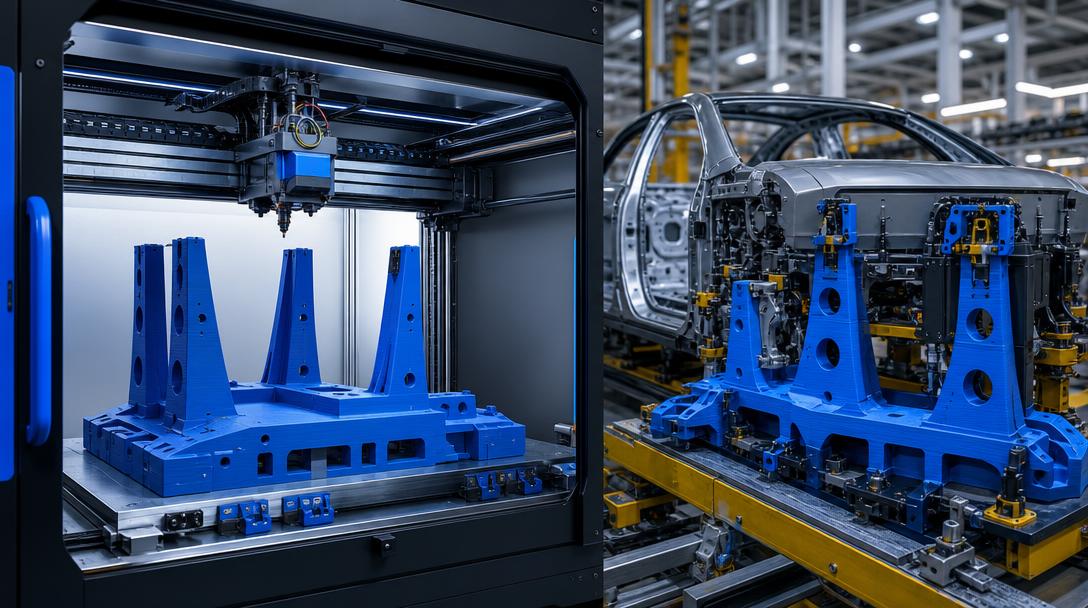
FDM 3D printing is being used not only at the prototyping desk but also in the production workflows of automotive factories, including for larger parts. Stratasys introduced its new large-format F870 system on 9 September 2026; Toyota Production Engineering and Rivian Automotive were among the first users to install the machine at their own facilities. This development is notable because it enables fixtures, tooling and production-aid parts to be prepared more quickly inside the factory.
What need does the F870 address?
According to Stratasys, the F870 was developed for industrial manufacturers, automotive OEMs and aerospace and defence production lines. The system has a fully heated build chamber measuring 1,000 x 610 x 610 mm. This volume supports the goal of producing larger fixtures, assembly jigs and production aids as single parts.
The important point here is not just the build volume. A part used on a production line must maintain its dimensions, be printable with consistent results and fit into the existing workflow. A large-format FDM system should therefore not be viewed simply as a desktop printer with a larger box; material, temperature management, printing time and quality control must all be evaluated together.
Why are the Toyota and Rivian examples important?
According to TCT Magazine’s report dated 9 September 2026, Toyota Production Engineering installed the F870 at its Georgetown, Kentucky facility, while Rivian Automotive installed it at its Plymouth, Michigan facility. In-house tooling and production aids are among the main applications. These parts are not visible in the final product, but they directly affect production speed and the operator’s work.
For example, an assembly fixture can help hold a part in the same position every time. A customised guide or inspection tool can enable an operator to carry out measurement and assembly steps more consistently. The ability to quickly redesign a part to meet changing requirements can reduce the waiting time associated with moulds or external suppliers. However, the real benefit does not come from 3D printing every part; it comes from correctly selecting parts that are needed in low volumes, change frequently or take too long to produce using conventional methods.
Material selection and takeaways from an FDM perspective
The material family announced for the F870 includes Nylon 12CF, ASA, ABS and the new FDM ABS Draft. Carbon-fibre-reinforced nylon may be considered for tools that require rigidity and dimensional stability; ASA can be suitable for applications exposed to outdoor conditions, while ABS may be preferred for functional parts when an appropriate enclosure and temperature management are used. However, the potential of the material alone is not enough if the part design and print orientation are not correct.
- Fixtures and guides: Rigidity, repeatable dimensions and wear on contact surfaces should be assessed together.
- Large parts: Chamber temperature, interlayer stress and bed adhesion become critical.
- Repeated use: Process monitoring and quality control should be planned when the same part will be printed repeatedly.
- Initial assessment: The part’s load, operating temperature, environment and expected service life should be clearly defined.
At Ucuz3D, you can review printing options with engineering materials to make these kinds of choices according to the actual function of an FDM part. Before production, the part’s print orientation and the load it will carry should also be assessed; our guide to print orientation and part strength offers a practical starting point.
What does this mean for Ucuz3D readers?
The F870 news shows that major manufacturers are using FDM not only for visual prototypes but also for real auxiliary parts on the production line. Naturally, industrial systems in this class do not have the same capacity as desktop printers. Even so, with the right geometry, suitable material and a controlled production approach, small businesses and design teams can benefit from the same principles when producing fixtures, enclosures, tools and spare parts.
If you are looking for a 3D printing service for your project, you can determine the appropriate production approach by sharing the part’s operating conditions and required quantity. When considering costs, evaluating the part’s geometry, material selection and production process together is a more reliable basis for decision-making than focusing solely on cheap 3D printing prices. If your file is ready, you can get an instant quote for your project through the online 3D printing process.


 Türkçe
 العربية
 Русский
 فارسی
فارسی Deutsch