Sumitomo Chemical and Gutenberg Develop LCP Filament for FFF: A New Option for High-Heat and Precision Parts
FDM filament options can be limited for parts that require high temperatures, dimensional stability and electrical performance. Sumitomo Chemical and Japanese 3D printer manufacturer Gutenberg announced on 1 September 2026 that they had developed liquid crystal polymer (LCP) filament and moulding technology for this field. The project stands out for engineering-grade prototypes and low-volume part production because it is designed specifically for direct manufacturing using the FFF method.
html”>Sumitomo Chemical announcement, 1 September 2026.
Why is LCP filament important?
LCP stands out as a high-performance engineering plastic with heat resistance, high strength, a low dielectric constant, low dielectric loss and dimensional stability. However, transferring these properties to FFF printing is not easy. Producing the filament consistently and shaping it in a controlled manner after it exits the nozzle requires specialised process knowledge because of the material’s structure and molecular orientation.
Sumitomo Chemical says it has developed material design and filament production technology for LCP, while with Gutenberg it has focused on stable moulding by studying the printing process. According to the announcement, the technology aims to control LCP’s distinctive molecular orientation. This means it is not merely an announcement of a new raw material, but also a process development effort intended to improve the material’s usability in an FFF printer.
Which applications are being targeted?
The announcement highlights peripheral components for semiconductor manufacturing equipment, humanoid robot components for physical AI applications, communications and next-generation mobility. The companies state that LCP could enable complex geometries and part integration, making it suitable for low-volume, high-mix production needs.
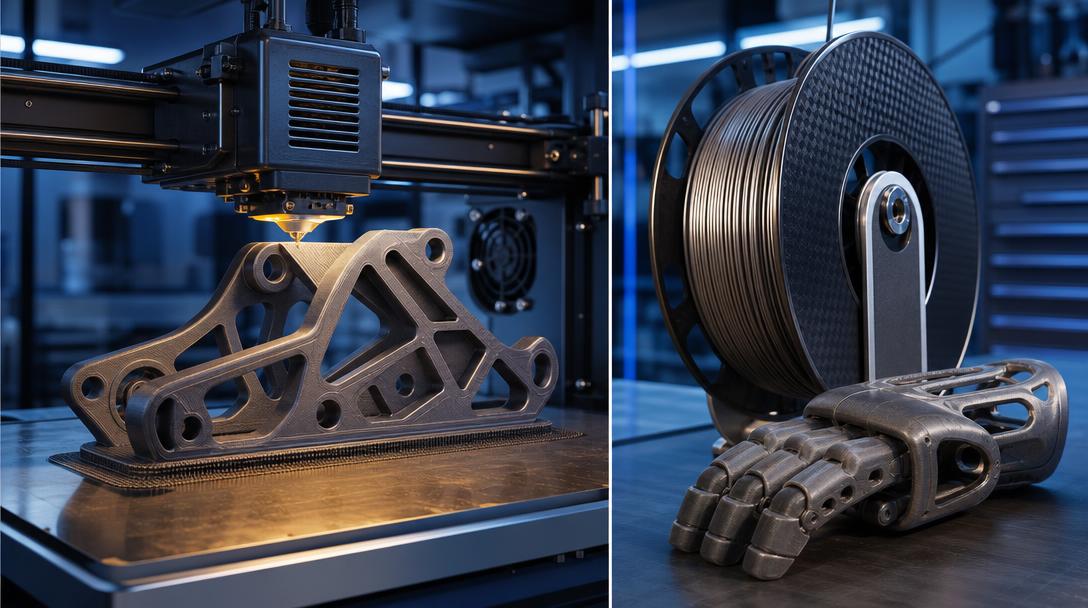
A robot hand housing capable of operating in high-temperature conditions is shown as an example. This does not mean that the material is automatically the right choice for every part. Before real-world use, temperature, load, chemical environment, layer orientation and printing parameters must be validated together. The announcement also states that LCP’s fracture resistance was compared with aluminium alloys using a test method compliant with standards under specific conditions; it would not be correct to generalise this result directly to all designs.
What does this mean in practice for FDM users?
The initial aim of LCP filament does not appear to be easy printing on desktop printers, but rather more flexible development of high-performance, low-volume and complex parts. For such a material, printer temperature capacity, heat management, an enclosed build chamber, bed adhesion, drying and process repeatability will be critical. The manufacturer’s announcement states that sample presentations are planned to begin in 2026; therefore, it is best not to set firm performance expectations before commercial availability, compatible printer profiles and real-world field data become clear.
When reviewing Ucuz3D’s engineering materials 3D printing options, consider not only the material’s technical name but also the part’s function and production conditions. If it is possible to validate a prototype with a more widely available FDM material, considering high-performance filaments only when they are genuinely needed can help maintain a sound cost rationale.
What should you consider before deciding?
- Will the part operate continuously at high temperatures, or will it only experience short-term heat exposure?
- Are electrical insulation and dimensional stability more important than impact resistance?
- Does your printer support the required temperature range and controlled process conditions?
- Does the advantage of low-volume production justify the more complex print preparation?
The new LCP solution is an important material development step showing that FFF is not limited solely to visual prototypes. However, until samples and independent tests become more widespread, the best approach is to compare the manufacturer’s data with your own part requirements. Once your production needs are clear, you can get support from the 3D printing service page, review the price per gram model and assess the most suitable production route using the instant price tool.



 Türkçe
 العربية
 Русский
 فارسی
فارسی Deutsch