HIPS or Carbon Fiber Reinforced? Lightweight Prototype or Rigid Technical Part?
In FDM printing, material selection determines not only a part’s appearance but also how rigid it will remain, how it will handle impact, and how smoothly the printing process will proceed. HIPS and carbon fiber reinforced filament are two different options in this respect. HIPS is a more accessible thermoplastic focused on prototyping, while carbon fiber reinforced filament is an engineering material designed to improve rigidity and dimensional stability by adding short carbon fibers to the base polymer.
What are HIPS and carbon fiber reinforced filament used for?
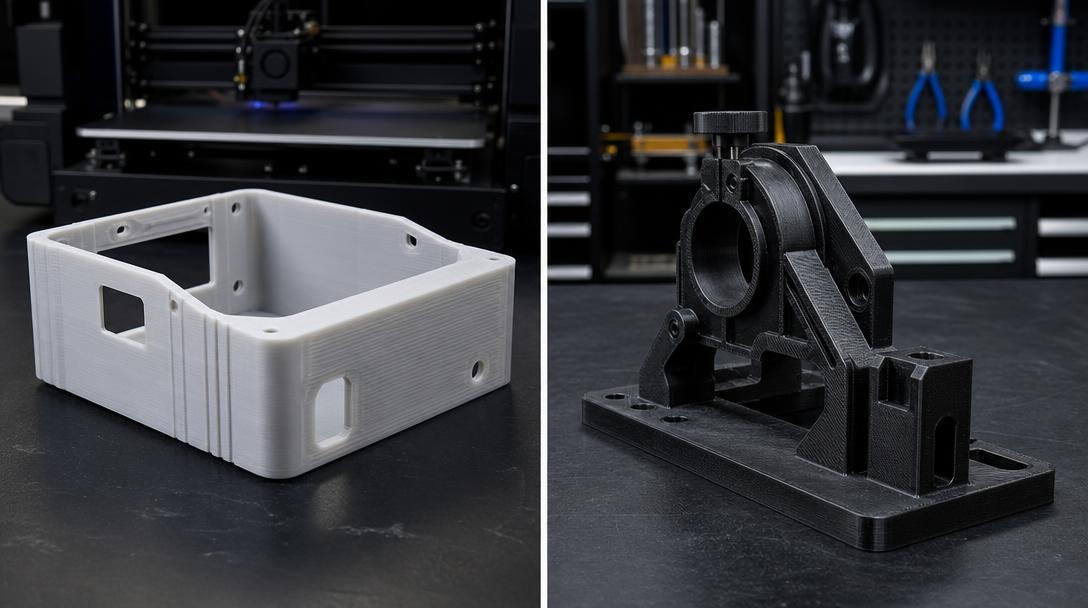
HIPS can be used for lightweight prototypes, enclosure parts, visual models, and fixtures subject to low to moderate stress. Its surface can be practical to process and paint with suitable print settings. It is also known as a support material in some multi-material workflows; however, here we are evaluating HIPS as the primary part material.
Carbon fiber reinforced filament, on the other hand, stands out for parts that require rigidity, low flex, and dimensional stability. The fibers inside it do not reinforce the part equally in every direction; layer orientation, fiber distribution, wall count, and the type of base polymer all affect the result. Therefore, carbon fiber reinforcement should not be treated as a guarantee that solves every strength problem on its own.
Differences in rigidity, impact resistance, and outdoor use
If rigidity is your priority, the carbon fiber reinforced option is generally a more sensible starting point than HIPS. In parts such as a sensor mount, measuring fixture, assembly jig, or housing that must retain its shape under vibration, reduced flex can be an advantage. However, as rigidity increases, the part may behave more brittly; the direction of impact and the orientation of the layers matter.
HIPS can be a more forgiving choice for lightweight prototypes and aesthetic experiments. However, for parts expected to withstand continuous impact, high clamping force, or load-bearing use, it is not advisable to decide without testing the material properties and print orientation. Do not automatically assume that HIPS is safe outdoors. You need to check the product’s technical data for exposure to sunlight, temperature changes, and moisture. Carbon fiber reinforcement does not magically change the base polymer’s outdoor performance either; the load-bearing material remains the determining factor.
Printability and equipment requirements
HIPS can offer an easier starting point on desktop FDM printers with the right bed and temperature settings. Even so, warping or layer adhesion problems may occur depending on the brand, color, and printer geometry. With carbon fiber reinforced filament, abrasive fibers can wear a standard brass nozzle more quickly. A hardened steel or other wear-resistant nozzle recommended by the manufacturer may be required. Keeping the filament dry, monitoring the flow, and using a profile suitable for the material are important for consistent printing.
This difference shows why choosing carbon fiber should not be evaluated solely by spool cost. The nozzle, test adjustments, failed prints, and print time are also part of the total cost. In many projects, it may be more rational to validate the design with HIPS through faster prototyping and test it before moving to the final functional part. To see the gram-based production approach for your part, you can review the price per gram page.
Which one should you choose for which part?
- HIPS: lightweight enclosures, visual prototypes, models to be painted, low-load covers, and design-validation parts.
- Carbon fiber reinforced filament: rigid jigs, measuring fixtures, connection parts that must retain their shape under vibration, and technical prototypes.
- Before deciding: clarify the load scenario, operating temperature, outdoor conditions, and print orientation; then produce a small test part.
By sharing your part’s dimensions and intended use, you can receive production support through the 3D printing service option. See the engineering materials page to explore suitable technical options; if your model is ready, you can upload your file using the instant price tool.



 Türkçe
 العربية
 Русский
 فارسی
فارسی Deutsch