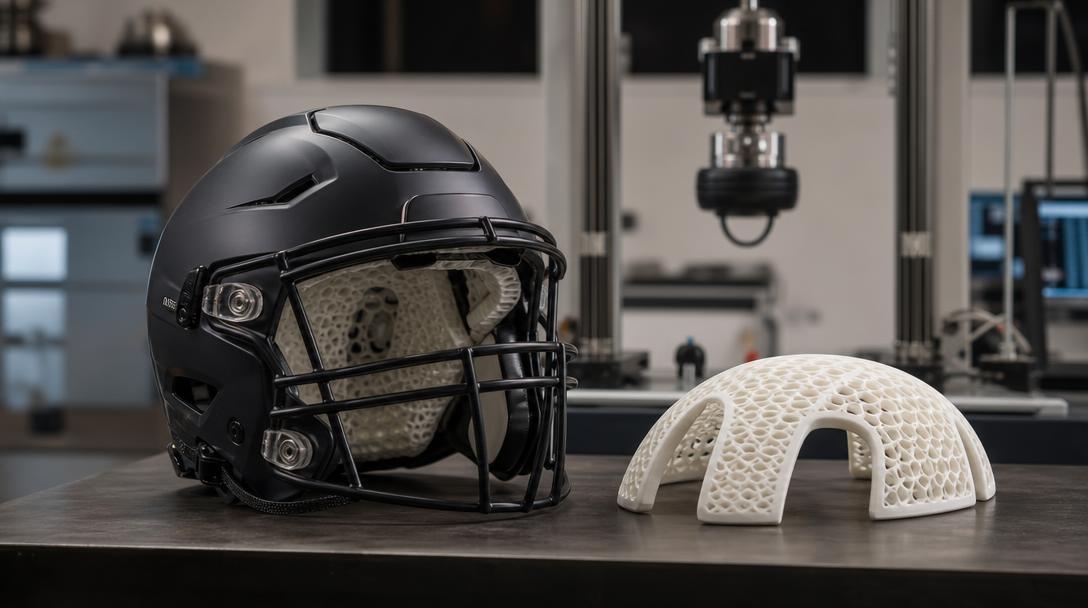
Stanford’s 3D-Printed Helmet Study Opens a New Path in Impact Safety
Helmet safety in American football is being revisited from the perspective of 3D printing. A study by Stanford University researchers uses 3D printing and advanced design methods to improve how a helmet behaves during impact. This is not a direct consumer product launch; however, it is a noteworthy example showing that FDM and similar additive manufacturing approaches are not limited to prototype housings or simple fixtures.
The news was published by ABC7 Bay Area on September 9, 2026. The focus of the report is the potential of a 3D-printed design to improve safety in football helmets and reduce the risk of concussions. This statement does not represent a safety certification or proven results for all helmets used on the field. Before real-world use, a new helmet design must be comprehensively validated in terms of materials, geometry, impact scenarios, repeatability, and applicable standards.
What is 3D printing changing in helmet design?
In traditional manufacturing, it can be difficult to quickly test complex internal geometries, areas with different densities, or support structures tailored to individual users. 3D printing makes it easier to produce the same basic design in short cycles with different cell structures, wall thicknesses, and density distributions. This allows researchers to compare multiple design variants without relying on a single prototype.
The important aspect of this approach is not simply that the part becomes lighter. The structure inside a helmet can affect how impact energy is distributed, how contact forms between the head and the shell, and how the system responds to impacts from different directions. 3D printing makes it possible to transfer these parameters from a digital model to physical samples in a more controlled way. Nevertheless, because layer orientation, material selection, and post-printing properties can affect mechanical performance, the results of a prototype should not be interpreted as equivalent to the results of mass production.
Practical implications for Ucuz3D readers
The Stanford example shows that the value of FDM printing lies not only in producing the final product, but also in rapidly testing design decisions. When a team wants to try different ventilation channels, pad slots, connecting parts, or ergonomic interfaces, printable prototypes can shorten the design process. However, for parts related to human safety, it is not appropriate to use a non-standard print in place of protective equipment.
The same logic can also be applied to workshop parts. Printing a quick prototype first to check dimensions, assembly, and user contact, then moving to a material that meets the load, temperature, and impact requirements, offers a healthier workflow. On the Our printing materials page, you can review the application areas of different FDM materials and clarify the actual requirements the part must meet.
Validation matters as much as the material
In a helmet or similar safety component, simply seeking rigidity is not enough. Impact absorption, repeated loading, temperature changes, connection reliability, and user fit must be evaluated together. While a material such as PLA may be suitable for a visual prototype, the same choice may not be appropriate for a final part exposed to heat or impact. In addition, the interlayer strength of FDM parts depends on the printing direction and process settings.
For this reason, you can use a professional 3d printing service to quickly produce your initial design trials. During the planning stage, the per-gram pricing approach on the affordable 3d printing prices page can help you compare the number of prototypes and material options. Once your file is ready, you can get an instant quote to see the production budget for different design iterations.
The most cautious conclusion that can be drawn from Stanford’s study is this: 3D printing is not a miraculous solution on its own for safety-focused products; it is a powerful research tool that enables more design variants to be tested more quickly. The real benefit emerges when it is used together with the right material and a proper validation process.




 Türkçe
 العربية
 Русский
 فارسی
فارسی Deutsch