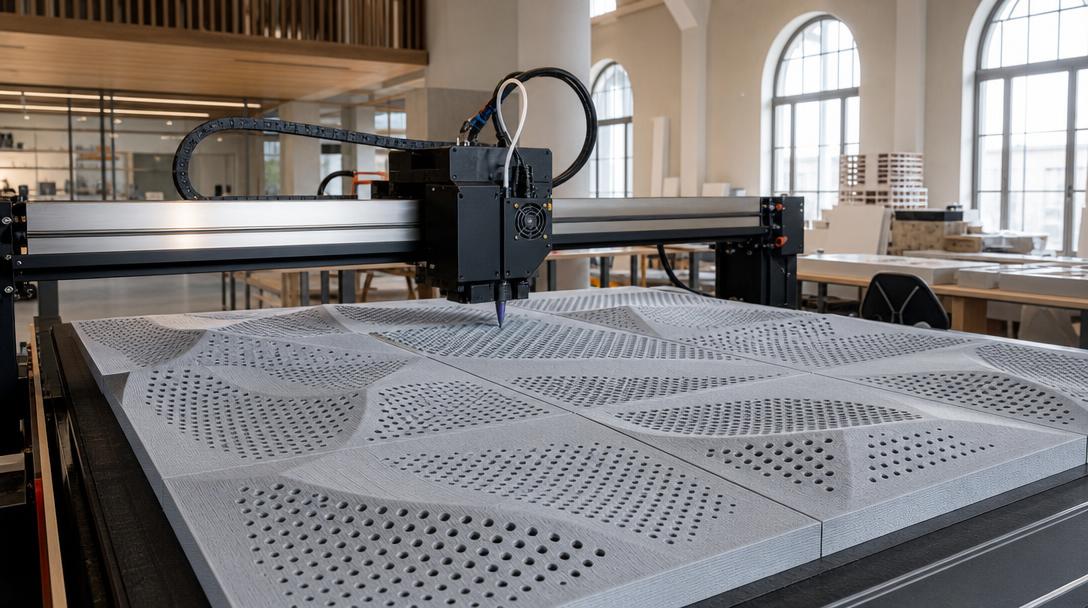
Acoustic Panel Printed with Kentstrapper Mille Shows FDM’s Contribution to Architecture
FDM 3D printing is often associated with prototypes, fixtures, and small parts, but large-format systems are now being used to test different building components too. The acoustic panel produced with a Kentstrapper Mille uses measurements to show how printed geometry could contribute to sound performance in school and office renovations. The key point is not that the technology can replace mass production in every situation, but that it makes it possible to validate components with custom geometries in a functional building system.
Panel tested in a university project
According to a 30 September 2026 report by 3D Printing Industry, Italian printer manufacturer Kentstrapper printed an interior acoustic panel as part of the University of Florence’s REVERSING research project. The project is developing a prefabricated, dry-assembled façade system for energy renovations of existing schools and offices. The panel was designed to control reverberation, which affects speech intelligibility in classrooms and offices.
The panel was tested according to the ISO 354 method in a reverberation room, where reverberation is measured under controlled—not echo-free—conditions. According to the results reported, its weighted sound absorption coefficient was measured at 0.90, achieving Class A under the ISO 11654 classification. Compared with the mineral wool panel used on its own, reverberation time fell by 41% at 500 Hz and 45% at 1,000 Hz. The STI value, which assesses speech intelligibility, also rose from 0.47 to 0.52. These results apply to a specific panel and test setup; they should not be generalized to every FDM part or every room.
Acoustic performance depends on more than the material
The panel has a wavy surface profile and holes of different diameters. The geometry of the holes and the cavity behind them varies by location according to acoustic calculations; the printed shell works together with a layer of mineral wool placed behind it. The University of Florence team created the parametric model in Rhinoceros and Grasshopper, then adapted the design with the manufacturer to suit the limits of the printing process.
Production used a Mille with a 1,000 × 1,000 × 1,000 mm build volume. The report says the parts were printed in PETG with a 0.8 mm nozzle and a low material flow rate. The panel consists of eight sub-components, each measuring 860 × 344 mm, and each took around 56 hours to produce. These details also show the role of splitting a large part into modules for assembly and production planning, rather than printing it in one piece.
Prototype success is not the same as mass production
The researchers clearly state that the current production time and material consumption are suitable for an experimental prototype, but not for mass production under the same conditions. This cautious assessment matters: measured acoustic performance does not automatically guarantee cost-effective mass production or the same results in every project. Factors such as design scale, material, assembly method, fire safety, and building regulations need to be assessed separately.
Even so, this case makes the potential of FDM beyond prototyping tangible for building components that require custom geometries and will be produced in limited quantities. To assess which material and part-splitting approach might suit your project, you can explore the 3D printing service, review the pricing approach on the affordable 3D printing prices page, and check your model with the online 3D printing calculator. You can also compare FDM printing materials when deciding on geometry and material. Source: 3D Printing Industry, 30 September 2026.



 Türkçe
 العربية
 Русский
 فارسی
فارسی Deutsch