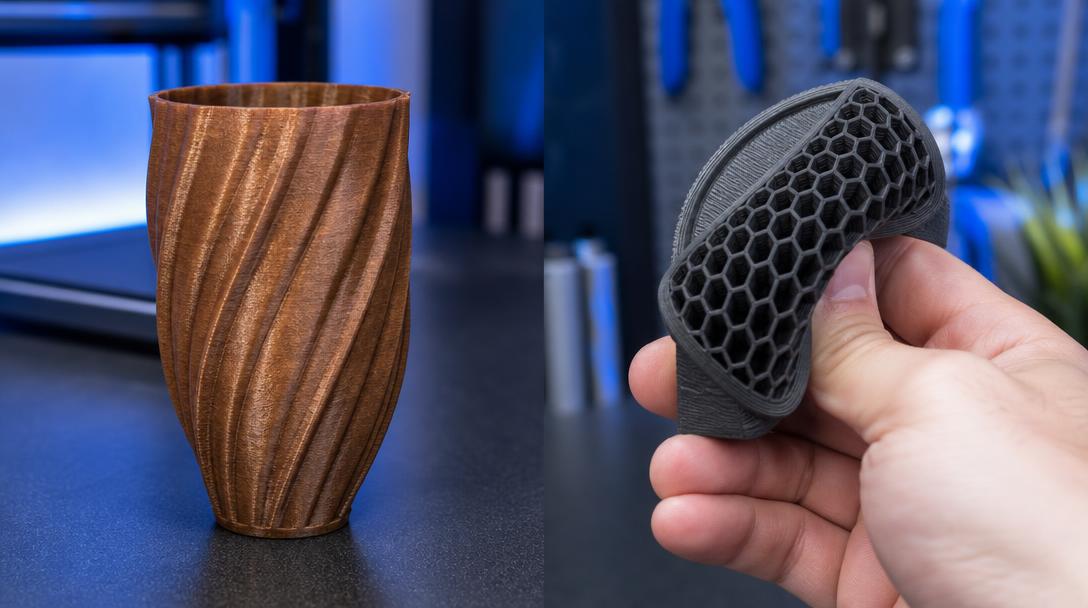
Wood PLA or TPC? Decorative Appearance or a Flexible, Functional Part?
When deciding between Wood PLA and TPC, first consider how the part will be used: are you looking for a wood-like appearance on its surface, or does it need to flex under load and spring back? These two FDM materials serve different needs. Wood PLA is used for decorative, wood-filled PLA-based prints, while TPC is considered for flexible parts with elastomer-like properties. Clarifying the design’s purpose from the outset helps avoid mismatched material expectations and unnecessary test prints.
Wood PLA: when appearance and shape come first
Wood PLA is a family of filaments made by adding compounds that give PLA a wood-like appearance. The texture and tone of the finished part can vary depending on the formulation and print settings; it should not be assumed to behave like solid natural wood. It can offer an appearance advantage for decorative objects, scale models, presentation pieces, and desktop accessories with limited exposure to wear. However, it is not a suitable choice for a part that needs to bend repeatedly, absorb impacts, or function as a flexible seal.
In wood-filled materials, the composition of the additives and the nozzle characteristics can affect print behavior. It is therefore sensible to follow the manufacturer’s profile, run a small test, and check the surface finish for designs with fine details. If your design has thin protrusions, small text, or precise fits, review not only the material but also the print orientation and model geometry. The Wood PLA and decorative filaments guide can help you assess these appearance-focused options.
TPC: for applications that need controlled flexibility
TPC belongs to the flexible thermoplastic elastomer family. Depending on the design, it may be considered for a bumper, flexible spacer, vibration-damping element, or component expected to tolerate bending. However, not all TPC has the same hardness; how much a specific part will flex depends on the filament grade, geometry, and print conditions. So the word “flexible” alone is no guarantee of performance.
TPC is not a substitute for a rigid decorative model, and Wood PLA is not designed to be bent repeatedly like an elastomer. With flexible filaments, print speed, filament feeding, and wall structure can all affect the result. Very thin sections, sharp corners, or shapes that concentrate force between layers may limit the material’s advantages. For functional engineering parts where rigidity matters, also consider FDM printing with engineering materials.
Choose based on the part’s purpose
- Wood-like appearance: Wood PLA makes more sense for a decorative object or presentation model.
- Flexibility: Consider TPC for a part expected to bend or cushion impacts.
- Rigidity: Do not automatically assume either material offers high load-bearing strength; the actual load and connection method matter.
- Outdoor use: Check the material’s technical data for exposure to sunlight, temperature, and humidity; do not decide based only on appearance or flexibility.
- Ease of printing: Flexible filament’s feeding requirements and Wood PLA’s additive-filled composition may call for different settings and test prints.
Once you have clarified the part’s operating conditions, dimensions, and file, choosing a material becomes easier. Explore FDM options through our 3D printing service, and use the online 3D printing calculator to see an estimated price based on your file. When comparing Ucuz3D’s printing materials, be sure to mention whether flexibility or decorative appearance is your priority. Pre-printing consultation is free; you can discuss the right option for your intended use with a human consultant who reviews your file.


 Türkçe
 العربية
 Русский
 فارسی
فارسی Deutsch