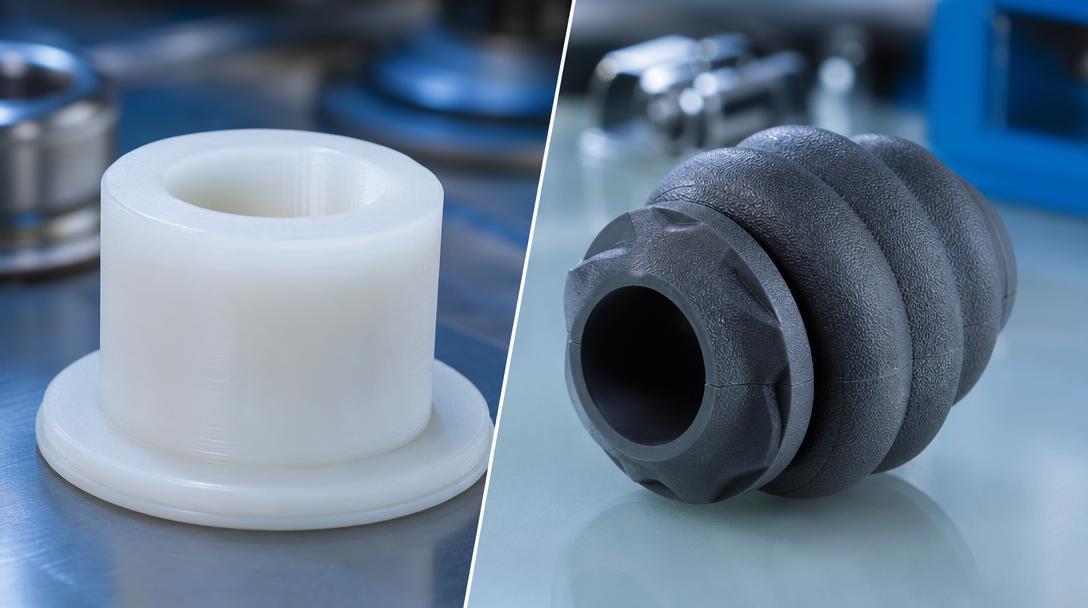
Nylon (PA) or TPE? Durability for a Wear-Prone Part or Controlled Flexibility?
Whether to choose nylon (PA) or TPE depends on how the part needs to behave under load: do you need a more rigid functional part for wear and repeated use, or a component expected to flex noticeably and return to its original shape? Both are engineering-focused options that can be produced using FDM, but they do not serve the same purpose. The material name alone cannot determine the right choice; geometry, print orientation, and actual operating conditions also affect the result.
The key difference between the two materials
Nylon (PA) may be considered for parts subject to friction or repeated loads, such as gears, bushing-like moving components, and mechanical connections. It can offer a tough performance, but not all nylon types have the same properties; it is also affected by moisture, making proper storage and drying before printing important. If chosen for a very thin part that needs to bend easily, it may not provide the expected flexibility.
TPE is a thermoplastic elastomer in which flexibility is the main feature. It may be suitable for applications such as bumpers, flexible feet, protective covers, or spacers that need to compress and conform to a surface. However, it is not the default choice for a rigid support, a connection that must retain precise dimensions, or a part requiring high stiffness. Hardness can also vary between TPE blends, so performance requirements should be confirmed using the material data.
What conditions will your part operate in?
- Wear and movement: If there is sliding or repeated mechanical contact, PA may be considered with a suitable design and printing conditions. TPE can flex and soften impacts, but should not be expected to function like a rigid bearing or gear.
- Need for flexibility: TPE is a strong candidate if the part needs to change shape when pressed and conform to its surroundings. PA is generally not a suitable starting point for this degree of flexibility.
- Stiffness and dimensions: PA may be a more sensible candidate if a part needs to retain its shape. TPE’s flexibility can be useful in some press-fit and seal-like designs, but may make dimensional stability harder to achieve.
- Printing and design: Feeding flexible filament and designing the part geometry may require more care than with rigid filaments. For PA, moisture management and interlayer behavior are important. The result depends on printer settings and part orientation.
Which material for which part?
For a mechanical part that bears loads, experiences friction, and needs to retain its shape, consider PA first; for a protective component that needs to compress, bend, or absorb impacts by flexing, consider TPE first. For example, a vibration-damping part in a machine foot may benefit from TPE’s flexibility, while a rigid bushing attached to it may require a different material. Rather than forcing parts that work closely together to use the same material, it may be better to choose materials according to their functions.
For conditions involving outdoor exposure, temperature, chemical contact, or sustained loads, it is not advisable to guarantee durability based solely on the general polymer name. Define the environment the part will face and the acceptable level of deformation from the outset. For critical applications, verify suitability with a small sample or prototype.
Consider cost as part of the decision
PA and TPE will not use the same amount of material or have the same geometry and print time, so you cannot calculate the total cost by comparing filament names alone. Part volume, walls, infill structure, and support requirements all affect the estimate. Review the general material options on our printing materials page, or upload your file to see an instant price. When considering the price per gram, keep in mind that it depends on the part geometry and print settings.
If you are unsure which material to choose, share what the part will do and how it will be stressed to get advice before using our 3D printing service. The right choice is less about whether PA or TPE is better overall and more about matching the stiffness and flexibility the part needs.



 Türkçe
 العربية
 Русский
 فارسی
فارسی Deutsch