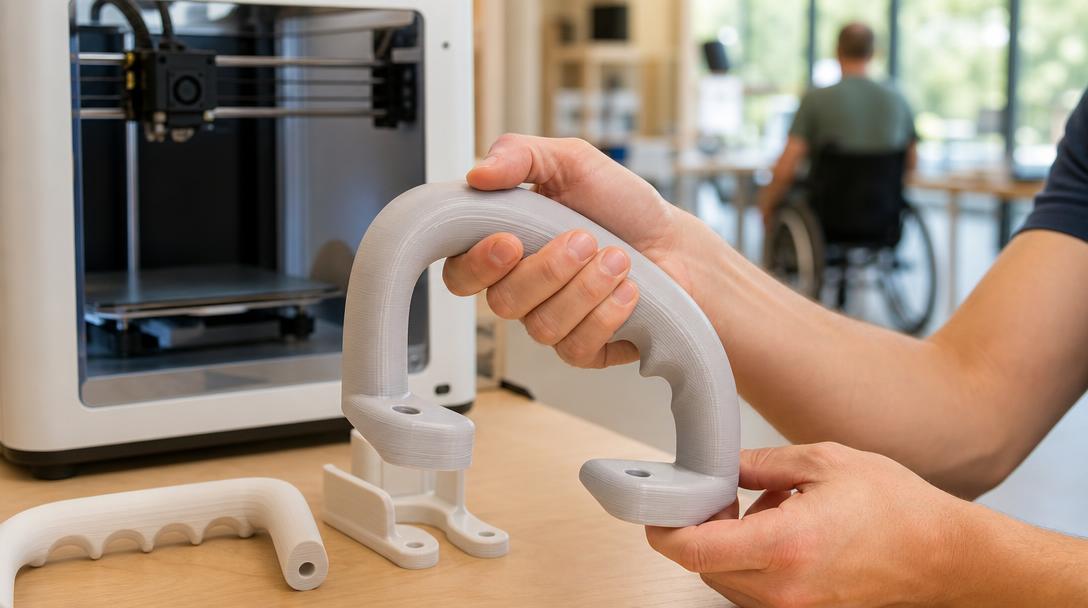
Bambu Lab and Makers Making Change Launch Global 3D Printing Challenge for Accessibility
3D printing can deliver tangible value not only in prototyping and production lines, but also in assistive tools that make everyday life more accessible. The global 3D printing challenge launched by Bambu Lab and Makers Making Change invites the maker community to design solutions for the needs of people with disabilities. According to a 3D Printing Industry report dated September 28, 2026, the initiative aims to encourage accessibility-focused design and manufacturing.
The impact of small components in assistive technology
An accessibility solution does not always have to be a complex device. A grip that makes an object easier to hold, an attachment that simplifies the use of buttons, or a support component sized for a specific user can make an everyday task more manageable. The value of customizable design becomes clear when the dimensions or way of using a standard product do not suit an individual.
FDM printing can make it easier to turn a digital model into a physical part and test low-volume ideas tailored to an individual. However, a prototype is not automatically ready for use: how the part will be held, the forces it will be exposed to, whether its edges could irritate the skin, and how easily it can be cleaned should all be considered during the design stage. Printing is not a substitute for product safety or professional medical assessment.
The message to the maker community
What stands out about this announcement is that it presents the 3D printer not merely as a production tool, but as part of a design process grounded in understanding user needs. Developing a useful assistive component requires speaking with the user or caregiver, defining the problem accurately, and evaluating the prototype under real-world conditions. Community initiatives can broaden knowledge-sharing, but it should not be assumed that a shared model will suit every user.
Sharing a design file alone does not solve an accessibility problem. Dimensions, print orientation, and material should be selected according to the intended purpose; the part should be checked and improved based on user feedback. A culture of collaborative design and repeated testing is just as important as rapid prototyping.
What to consider for an assistive part made with FDM
- Use case: What movement will the part make easier, and will it be used in the hand or on a tabletop?
- Ergonomics: Sharp corners, narrow grip areas, or rough surfaces may cause discomfort.
- Load and orientation: The forces on the part and the direction of the layers should be considered together; print orientation can affect strength.
- Material: The need for a flexible, rigid, or more durable material depends on the part’s function; no single option is right for every use.
If you have an idea for a custom attachment or prototype that can be made with FDM, your file and intended use can be assessed as part of our 3d baskı hizmeti. You can compare properties by exploring our printing materials, or upload your file to get an estimate with the 3D printing price calculator. Our guide to the advantages of 3D printing in prototyping may also offer ideas for the design and prototyping stages.
Developing the solution with the user
The call from Bambu Lab and Makers Making Change brings the 3D printing community’s potential for practical contributions to accessibility into focus. Success means more than producing a printable model: it means defining the need together with the user and improving the solution through feedback until it is safe, comfortable, and useful. 3D printing can speed up this cycle, but it cannot replace sound design decisions.


 Türkçe
 العربية
 Русский
 فارسی
فارسی Deutsch