
Wall Thickness and Perimeter Selection: How Many Perimeters Are Enough?
Wall thickness perimeter selection directly affects both the strength of the part and the print time in FDM printing. The short answer is this: for decorative parts, 2 walls are usually enough; for everyday-use parts, 3 walls are a solid choice; and in critical areas such as load-bearing sections or around screw holes, 4 or more walls provide safer results.
Many people first increase the infill rate to improve part strength; however, in FDM printing, the perimeters that form the outer shell are often more decisive. Especially in thin arms, clips, box bodies, and impact-prone edges, if the wall count is insufficient, the part may break earlier than expected even if the inside is solid. That is why, when planning a good 3d printing service, not only the material but also the wall thickness should be considered according to the function of the part.
What exactly do perimeters change?
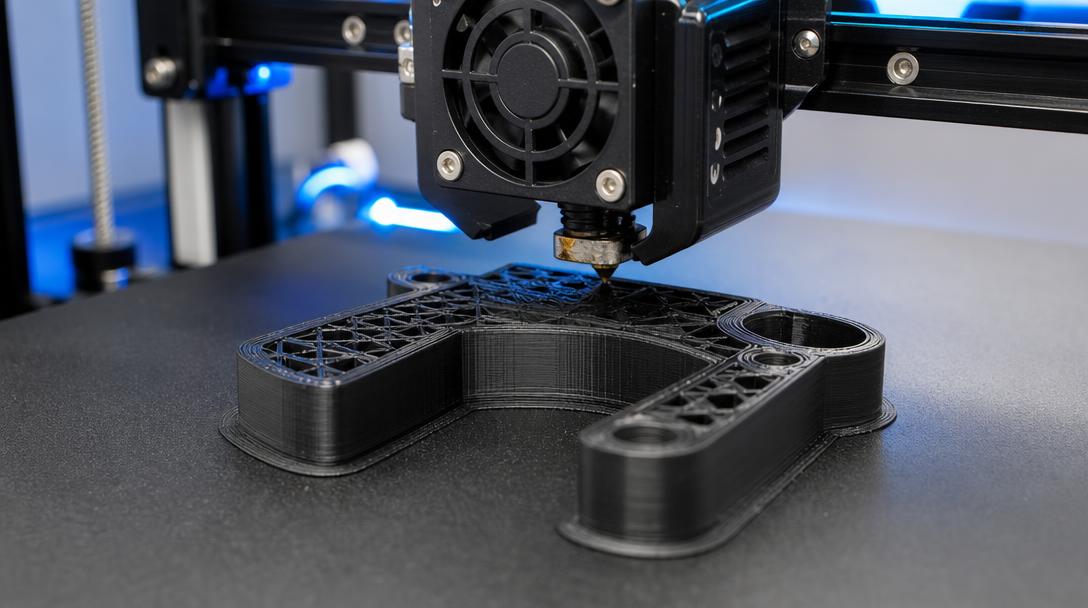
Perimeters are the closed wall lines that form the outer surface of the part. If your nozzle diameter is 0,4 mm, then 2 walls mean approximately 0,8 mm thickness, 3 walls approximately 1,2 mm, and 4 walls approximately 1,6 mm. This value alone is not enough, but it is a good starting point for making a decision.
- 2 walls: Suitable for lightweight, visual, or low-load parts.
- 3 walls: A balanced option for general-purpose boxes, lids, fixtures, and most prototypes.
- 4 walls: Preferred for screw areas, clips, impact-prone corners, and functional parts that need to feel more reliable.
- 5+ walls: Can make sense for parts with special geometry that need to stay thin but strong; however, print time and material consumption increase quickly.
How many walls make sense for which part?
If you have a visual prototype, 2 walls are often sufficient. But if you are designing a part that will be used constantly on a desk, a spare piece replacing broken plastic, or an enclosure with snap-fit features, 3 walls are a safer starting point. In areas such as latches that are stressed when a lid closes, furniture foot pads, corners of electronics enclosures, or small mounting tabs, 4 walls make a serious difference.
The key point here is to identify the regions where the load is concentrated instead of making the entire part unnecessarily thick. A screw socket, a thin arm, or a mounting tab on a corner needs far more walls than a wide, flat panel. If you are designing interlocking parts, it is helpful to consider the wall decision together with fit clearances; in this regard, the tolerance guide for interlocking parts is a good companion resource.
A common mistake: overdoing the infill rate
Using 50% infill while staying at 2 walls is often less efficient than using 20-25% infill with 3-4 walls. That is because the load first reaches the outer shell. Especially in FDM parts that work under bending and impact, the shell structure plays a critical role. For this reason, increasing the wall count can produce smarter results than simply increasing the infill rate. Still, for large parts that should not feel hollow, the infill setting is not completely unimportant; when getting an instant quote, it is useful to compare different thickness scenarios in order to choose the right combination.
Practical decision rule
When you are unsure, you can follow this simple order: first determine whether the part really carries a load, then choose the minimum wall thickness suitable for the nozzle diameter, and then increase the wall count in critical regions. If necessary, printing the first prototype with 3 walls and adjusting only the problematic areas in the second iteration is more efficient in terms of both time and cost.
In short, choosing the right wall thickness is a more important design decision in an FDM part than it may seem. If you clarify the perimeter selection before having a functional part printed, you will get results that are stronger, more predictable, and often more economical.


 Türkçe
 العربية
 Русский
 فارسی
فارسی Deutsch