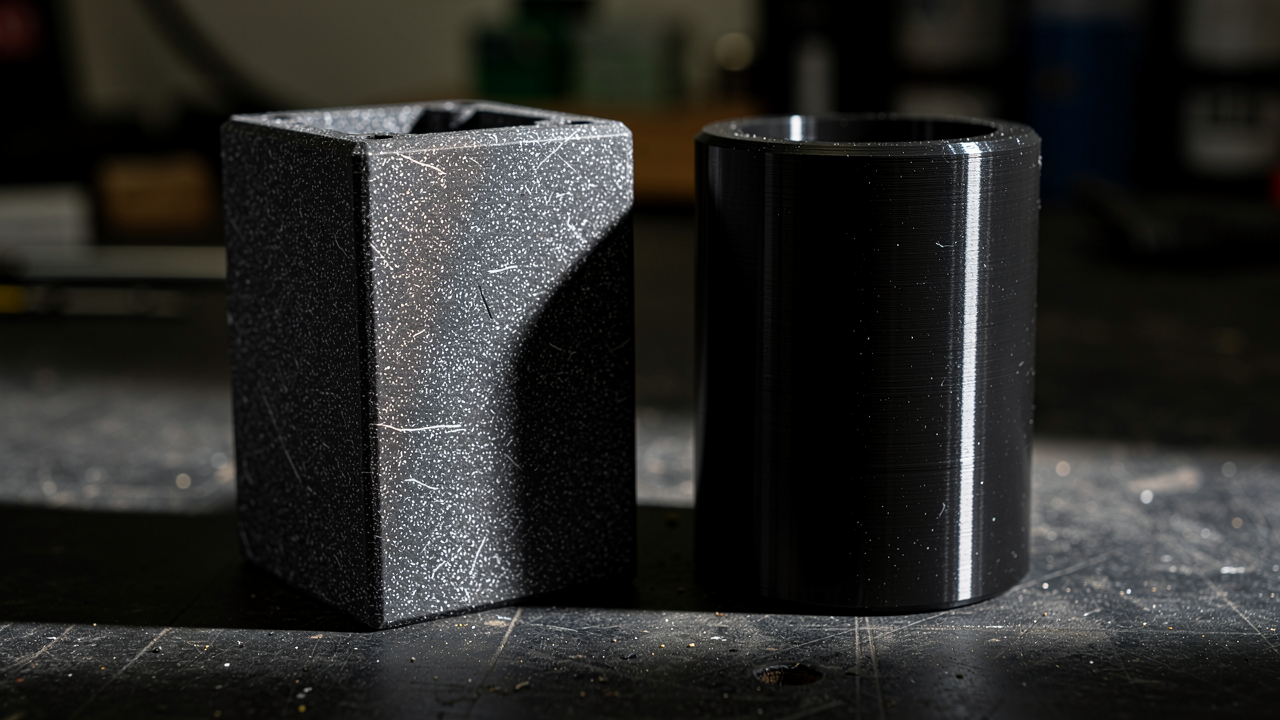

Carbon Fiber Reinforced or ABS+? Which Makes More Sense for Rigidity, Printability, and Functional Parts?
When having a functional FDM part printed, one of the most commonly confused choices is whether to go with a carbon fiber reinforced material or a more classic but balanced option like ABS+ filament. Both can be used for serious applications; however, they do not serve the same need. While carbon fiber reinforced filaments generally stand out in parts that need greater rigidity and better dimensional stability, ABS+ often remains the more sensible choice for balancing impact resistance, everyday use, and ease of production.
If you are considering getting a professional 3d printing service for your project, material selection should be based on how the part will actually perform in real use. Simply choosing the material that looks “more technical” often does not lead to the right result. If you want to see the general material families, the engineering materials 3d printing page is also a good place to start.
What is it good for, and what is it not?
Carbon fiber reinforced filaments are generally FDM materials with short fiber additives mixed into the base polymer. Thanks to this structure, the part can behave in a much more rigid and stable way rather than simply looking tougher. In other words, they make sense for brackets, jigs, fixtures, and certain technical parts that should not bend or drift dimensionally. However, there is an important limitation here: greater rigidity does not always mean better impact resistance. In parts exposed to sudden hits or that need a bit of flex, performance may fall short of expectations.
ABS+, on the other hand, can be seen as a more general-purpose functional material. Variants that make the printing process a bit more manageable than standard ABS are common. It behaves in a more balanced way in applications such as boxes, enclosures, connectors, workshop fixtures, and everyday-use parts. In return, if you are looking for very high rigidity or a composite feel, it may not be as assertive as a carbon fiber reinforced option.
The difference in terms of heat, impact, and outdoor use
In terms of heat, both materials can be considered for more serious jobs than the PLA class; however, the result depends on the main polymer to which the carbon fiber additive has been added. For this reason, it is not correct to see carbon fiber reinforced material on its own as a “high-heat solution.” ABS+, on the other hand, can be a safer choice than most basic materials for covers, enclosures, or car-interior-like parts exposed to warm environments. Still, in areas where very high temperatures are expected, the part geometry and usage conditions should also be evaluated separately.
For impact resistance, the critical distinction for most users is this: should the part be rigid, or a bit forgiving? If rigidity is your priority, carbon fiber reinforced filament may offer an advantage. But if the part will be dropped, knocked, strained during assembly, or needs to survive with slight flex, ABS+ may make more sense in most scenarios. Outdoors, the term “carbon fiber” alone is not enough to make a decision; again, the real difference is determined by the base polymer. For this reason, material selection should be confirmed separately for parts that will face constant sun, UV, and weather conditions.
Ease of printing and the logic of cost
In terms of printability, ABS+ is often the more predictable choice. Because carbon fiber reinforced filaments can be positioned in a more premium class, expectations may rise not only on the material side but also on the equipment side. In addition, proper nozzle selection becomes important due to abrasiveness. This means that, in the overall production logic, you need to look not only at filament price but also at process durability.
That is why, when requesting a quote, you should look not only at the question “which filament is stronger?” but also at factors such as part weight, print time, and error risk. For this, it is healthier to review the logic of price per gram and evaluate the part on a case-by-case basis. If your file is ready, seeing an instant price quickly through the online 3d printing system also makes the decision process easier.
Which one is right for which part?
- Carbon fiber reinforced: fixtures, jigs, technical holders, and rigid parts requiring dimensional stability that are not supposed to bend.
- ABS+: enclosures, everyday functional parts, connections strained during assembly, and use parts exposed to light impact.
- Weak point of carbon fiber reinforced: parts that need to flex or are expected to absorb sudden impact.
- Weak point of ABS+: more technical parts where maximum rigidity and a composite feel are expected.
In short, the choice depends less on the question “which is better?” and more on how the part is supposed to work. If your goal is a lightweight but rigid structure with a more technical character, carbon fiber reinforced material stands out. If you are looking for a more balanced, more forgiving, and versatile functional solution, ABS+ may make more sense for most jobs.


 Türkçe
 العربية
 Русский
 فارسی
فارسی Deutsch