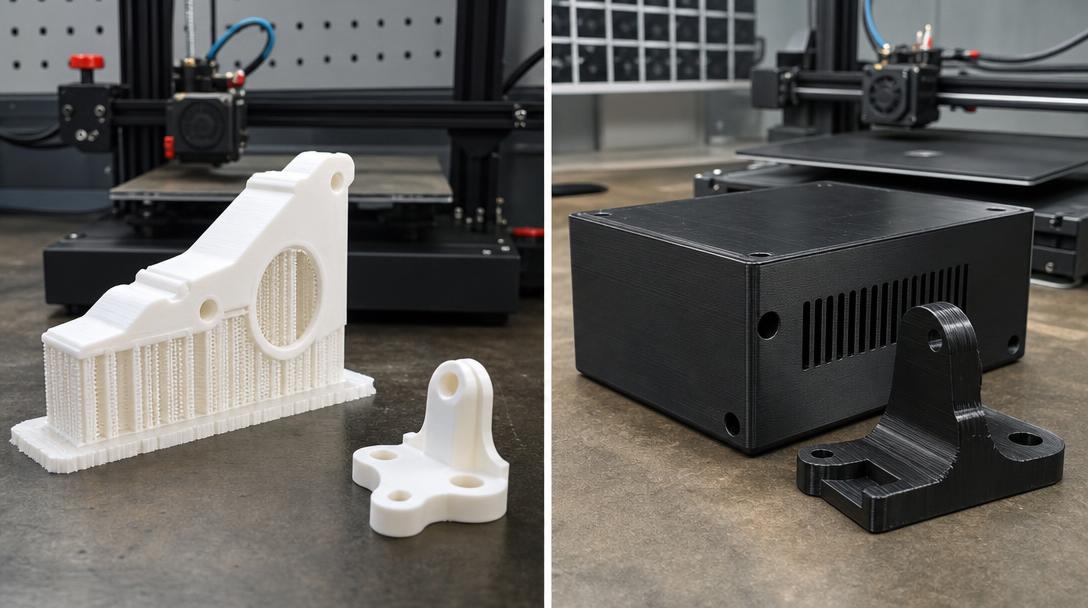

HIPS or ABS? Which Makes More Sense for Support Parts, Prototypes, and Impact-Exposed Prints?
In FDM printing, some materials are stars on their own, while others become very valuable in the right scenario. HIPS and ABS are exactly two such options. At first glance, they look similar; both are closer to a more technical class than PLA, and both require more careful print settings. However, when the intended use changes, the preferred choice also changes significantly. If you are unsure about part selection when ordering a 3D printing service, the real difference between HIPS and ABS is determined by how the part is expected to perform in the end.
The short answer is this: for general-purpose, impact-exposed, and everyday functional parts, ABS is usually the more sensible choice. for support structures, lightweight prototypes, or cases where easier post-processing and shaping are needed, HIPS may stand out. In other words, even if these two look similar on paper, they do not play the same role in real-world use.
What is HIPS used for, and what is ABS used for?
ABS has long been a preferred material for enclosures, covers, connector parts, clips, workshop aids, and functional parts intended for daily use. Its impact resistance can be better than PLA, and it also tends to feel more reliable in environments exposed to moderate heat. That is why it is a sensible choice for desktop equipment parts, device housings, and workshop fixtures.
HIPS, on the other hand, is a filament that can be printed on its own, but most users know it especially for its role as a support material. In some print setups, it is valuable for support strategies that can be dissolved afterward. In addition, it can also work well for relatively lightweight, easy-to-process, and matte-looking prototypes. In other words, HIPS should be thought of more as a material that solves a specific problem; ABS, by contrast, is a workhorse material with a broader range of uses.
In which situations do they fall short?
Although ABS is a strong candidate for functional parts, it is not the easiest option for everyone because of shrinkage during printing, corner lifting, and the need for an enclosed build space. In parts with thin and long geometries, the process can become difficult if it is not managed properly.
On the HIPS side, the limitation comes more from the use scenario. If the goal is a mechanical part that carries continuous loads, lasts a long time, and requires high reliability, HIPS is generally not the first recommendation. So it would not be accurate to say that it can simply replace ABS everywhere.
Differences in outdoor use, heat, and impact
In this comparison, both should be evaluated cautiously for outdoor use. If sun, UV, and long-term weather exposure are factors, options other than HIPS or ABS are often more suitable. Therefore, if an outdoor fixture will be produced, the material should be selected again with that in mind; you can review general material options on our printing materials page.
When it comes to heat, ABS is generally positioned as the safer option compared to HIPS. Especially for parts around desktop equipment that remains in place but heats up from time to time, ABS may be the more sensible choice. A similar picture applies to impact: for light impacts and everyday usage stress, ABS is more commonly preferred. HIPS is not a fragile presentation material, but positioning it as the main material for heavy-duty use would not be the right choice for most jobs.
Rigidity, machinability, and printability
ABS offers a balanced combination of stiffness and toughness; for that reason, it works well for applications such as clips, bodies, and assembly parts. The advantage of HIPS is that, in some projects, it can be sanded more easily and gives more of a prototype feel. For aesthetic mock-ups, form trials, or concept parts whose surfaces will be processed afterward, considering HIPS makes sense.
In terms of printability, neither of them is really in the “plug-and-play” category. Controlled temperature, good bed adhesion, and preferably an enclosed space all improve print quality. For this reason, material selection matters not only for desktop users but also for corporate customers placing orders. When evaluating part cost, it is healthier to look at the logic of price per gram instead of relying on memorized figures, because the real cost is affected not only by the filament itself, but also by print difficulty and the risk of failed prints.
Which one makes more sense for which part?
- Choose ABS: device housings, fixtures, protective covers, impact-exposed everyday parts, workshop equipment, assembly components.
- Choose HIPS: prints focused on support structures, lightweight prototypes, mock-ups to be processed afterward, visual form studies.
- Reconsider both: parts that will stay outdoors for a long time, jobs continuously exposed to high heat, critical parts requiring very high mechanical performance.
In conclusion, when choosing between HIPS and ABS, the real question should not be “which is better?” but “what job will the part do?” If the goal is general functional use, ABS is the safer and more common choice for most projects. If the need is support strategy, a lightweight prototype, or ease of post-processing, HIPS can provide a serious advantage in the right place. If your file is ready, the most practical way is to upload it through the online 3D printing system and move forward with guidance on the most suitable material.


 Türkçe
 العربية
 Русский
 فارسی
فارسی Deutsch