
TPC or Nylon (PA)? Which Is the Better Choice for Parts That Wear, Operate Under Load, and Need Some Flex?
When choosing a material for parts that are flexible but not toy-soft, operate under load, and experience friction over time, the decision often comes down to TPC or Nylon (PA). Both go beyond standard hobby materials; however, they do not behave the same way. If you want your part to both do its job and keep its shape for a long time, the decision is not just about “which one is stronger.” When ordering from Ucuz3D’s 3D printing service, the choice between these two materials should be evaluated according to the part’s real usage conditions.
When does TPC stand out, and when is Nylon the more logical choice?
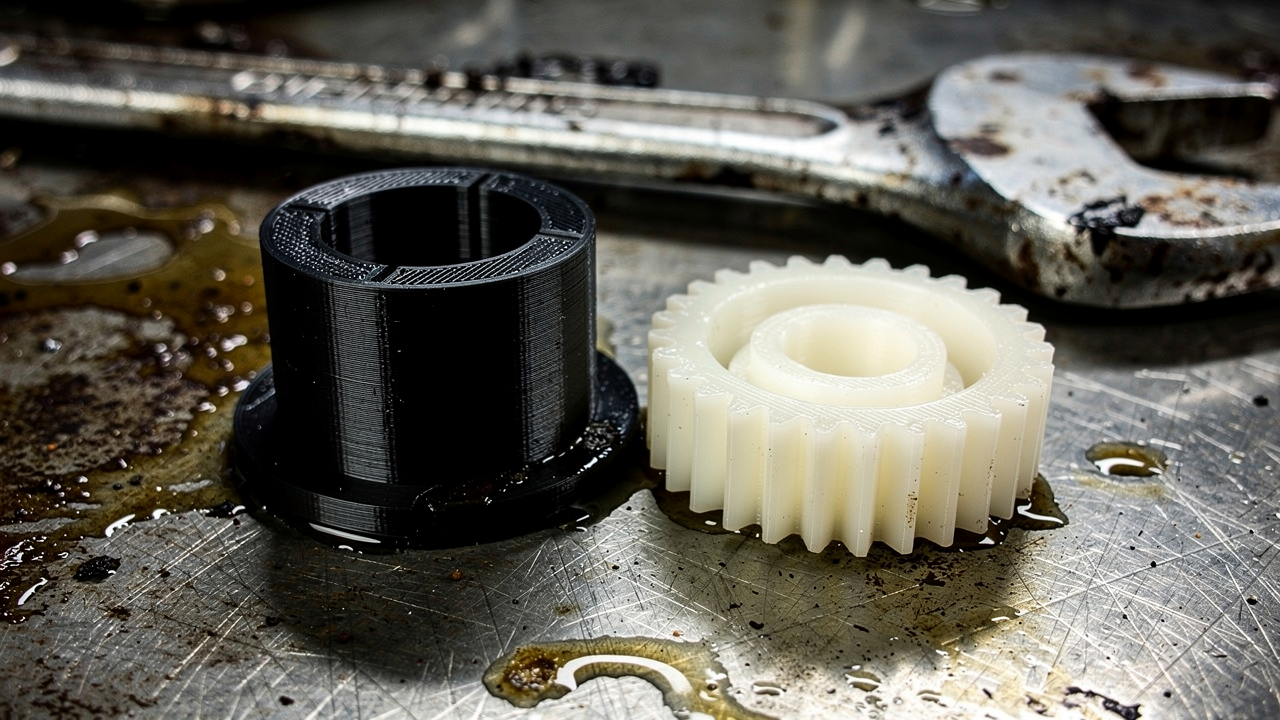
TPC is generally considered for applications where flexibility must be maintained, especially in repeated bending and contact-based use cases. Examples include bumpers, protective covers, flexible connectors, cable guides, feet that press against a surface, or parts that need light impact absorption. Nylon, on the other hand, sits more on the structural side. It is more commonly considered for parts such as bushings, hinge-area components, wearing sliders, load-bearing connectors, or mechanically functional fixtures.
In short, if you want the part to flex without falling apart, TPC is the better fit; if you want the part to be more rigid, carry load, and perform a mechanical function, Nylon is the more logical starting point in most scenarios. If you want to see engineering-focused options together, the engineering materials 3D printing page is a good reference.
What is it good for, and what is it not good for?
Where TPC is strong
- It can offer an advantage in parts that require repeated bending and impact softening.
- It makes sense for parts where surface grip, vibration damping, and quiet operation are desired.
- It can be preferred for applications exposed to friction but that do not need to be fully rigid.
On the other hand, TPC is generally not the first choice for rigid assembly parts that must hold their dimensions with millimetric precision. In tasks requiring screw tightening, tight tolerances, and high rigidity, it may remain too flexible.
Where Nylon is strong
- It is suitable for producing tough, functional parts that do not behave brittly under impact.
- It is a strong candidate for parts exposed to wear, carrying load, and involving mechanical movement.
- Compared with TPC, it is a more direct solution for parts that need to feel stiffer and more structural.
However, Nylon is not a cure-all either. In bumper-like parts that require very soft contact, it may remain unnecessarily rigid. In addition, because of its sensitivity to moisture, it requires disciplined storage and printing, which makes the printing process more demanding.
Differences in outdoor use, heat, and operating conditions
Both materials can work outdoors, but expectations must be set correctly. TPC is meaningful for outdoor-use parts where flexibility must be preserved. Nylon may seem advantageous on the mechanical strength side, but because of its tendency to absorb moisture, it can be affected by environmental conditions. If constant sun, strong UV, and open-air lifespan are the main decision criteria, in many projects another class such as ASA is actually considered; in other words, this pair is usually selected more with mechanical needs in mind.
A similar distinction exists when it comes to heat. In general, Nylon offers a safer range than PLA for everyday functional parts. TPC becomes meaningful in applications where flexibility must be maintained. But in both materials, the exact temperature limit depends on the specific filament formula used and the part geometry. For that reason, in the final selection it is healthier to share the usage environment and request a technical evaluation through the online 3D printing system.
Impact, rigidity, flexibility, and ease of printing
If you want impact absorption and controlled flexibility, TPC clearly stands out. If you want rigidity, shape retention, and structural confidence during assembly, Nylon is the better candidate. When flexibility is required, Nylon’s natural toughness alone may not be enough; this is where TPC makes the difference.
In terms of printing ease, neither is considered a beginner-level material. TPC is sensitive to the feed system because of its flexible structure. Nylon, on the other hand, requires moisture control and process control. So when making the decision, you need to think not only about part performance but also about production reliability. At this point, alongside the logic of the price per gram, the effect of failed print risk on total cost is also important.
Which one should be chosen for which part?
- Choose TPC: bumper, flexible foot, protective surface, cable guide, vibration-exposed connector, function part that bends in a controlled way.
- Choose Nylon: bushing, friction-exposed mechanical part, load-bearing fixture, tough clip, impact-prone functional part that still needs to hold its shape.
In summary, if the part must stay flexible while moving, TPC is the better option; if the part must remain mechanically sound while working, Nylon is more logical. The most accurate choice emerges when the part’s required flexibility, load-bearing demand, and operating environment are evaluated together.


 Türkçe
 العربية
 Русский
 فارسی
فارسی Deutsch