
TPU or Nylon (PA)? Which Is the Better Choice for Flexibility, Wear, and Functional Parts?
TPU and Nylon (PA) are two materials that are often confused in the FDM world, but they actually address very different needs. Both can be strong candidates for functional parts; however, while one stands out for flexibility and impact damping, the other offers more advantages in mechanical load, wear resistance, and service life. If you want to clarify your part selection at the ordering stage, the material decision in a professional 3d printing service can often be even more critical than print quality itself.
The basic difference: a flexible part or a structural part?
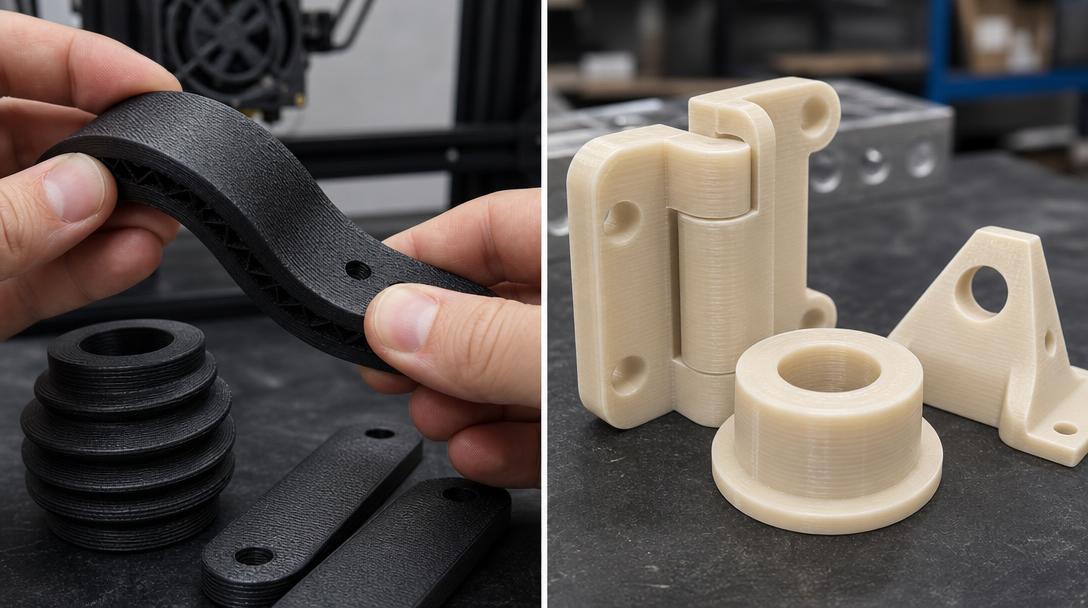
TPU is a flexible material that can absorb impact. It makes sense for cable protectors, bumpers, feet, cases, vibration-reducing spacers, or holding elements that should not damage a surface. Nylon (PA), on the other hand, generally behaves more structurally; it can be the better choice for parts that carry loads, are exposed to friction, or see repeated mechanical use. The first decision here is this: Is the job of the part to flex, or to keep its shape and perform?
What is it good for, and what is it not good for?
TPU is very useful for parts exposed to dropping, impact, compression, and surface contact. It performs well in phone-like protectors, non-slip feet, soft clips, and light gasket-like applications. However, it is usually not the right candidate for a bracket that requires high rigidity, an assembly fixture where hole tolerance is extremely critical, or a rigid load-bearing part.
Nylon, by contrast, makes more sense for bushings, gear-like low-to-medium load mechanical parts, hinge-like working components, wearing slides, and durable fastening elements. On the other hand, it is not as suitable as TPU for soft contact, vibration damping, or products that should flex when squeezed by hand. In other words, Nylon is strong, but you should not expect it to “behave like rubber.”
Differences in heat, impact, and outdoor use
When it comes to heat, Nylon can generally be a more reassuring option than TPU. PA-class materials are more often preferred for functional parts around motors, mechanical elements operating inside enclosed housings, or components exposed to some level of heat. TPU, while showing good impact behavior, may not be ideal for every application because of its tendency to soften in warm environments.
Impact is a bit different. If you want to prevent a rigid part from breaking, Nylon may have the advantage; but if you want it to absorb impact energy, avoid damaging a surface, and flex and return to shape, TPU stands out. Outdoors, both materials can work depending on the application; however, if the expectation is long life under constant sun, temperature cycling, and load, the design and the real operating conditions should be evaluated together. If you want an overall look at material options, the engineering materials 3d printing page is a good place to start.
Ease of printing and production logic
Printing with TPU, especially in very soft variants, requires a more sensitive process than standard rigid filaments. The feeding system, speed, and retraction settings can seriously affect the result. Nylon is not an easy material either; because it tends to absorb moisture, dryness, bed adhesion, and process discipline become important. In short, neither belongs in the “plug and print” category; they simply have different challenges.
For this reason, looking only at filament price is often misleading. The real logic is to choose the right material according to the function of the part. On the ordering side, a price per gram approach provides a useful reference, but choosing the wrong material can increase the total cost even more. If your file is ready, it is also possible to make a quick initial evaluation through online 3d printing.
Which one for which part?
- Choose TPU: non-slip feet, bumpers, protective cases, cable guides, impact-absorbing spacers, soft-contact holders.
- Choose Nylon: wearing mechanical parts, functional hinges, light load-bearing fixtures, friction-working elements, durable connecting parts.
- Do not choose TPU: for structural supports that require high rigidity and tight tolerances.
- Do not choose Nylon: for soft or rubber-like parts that need to work by flexing.
How should the final decision be made?
If your part is saying “let me bend, absorb impact, and protect the surface,” TPU is the better path. If the part is saying “let me carry load, handle friction, and work for a long time,” Nylon is usually the more sensible choice. The most critical point is to define the part not only with the word durability, but with rigidity, flexibility, wear, heat, and usage style. From this perspective, although TPU and Nylon may seem like alternatives to each other, in practice they solve different problems in most projects.


 Türkçe
 العربية
 Русский
 فارسی
فارسی Deutsch