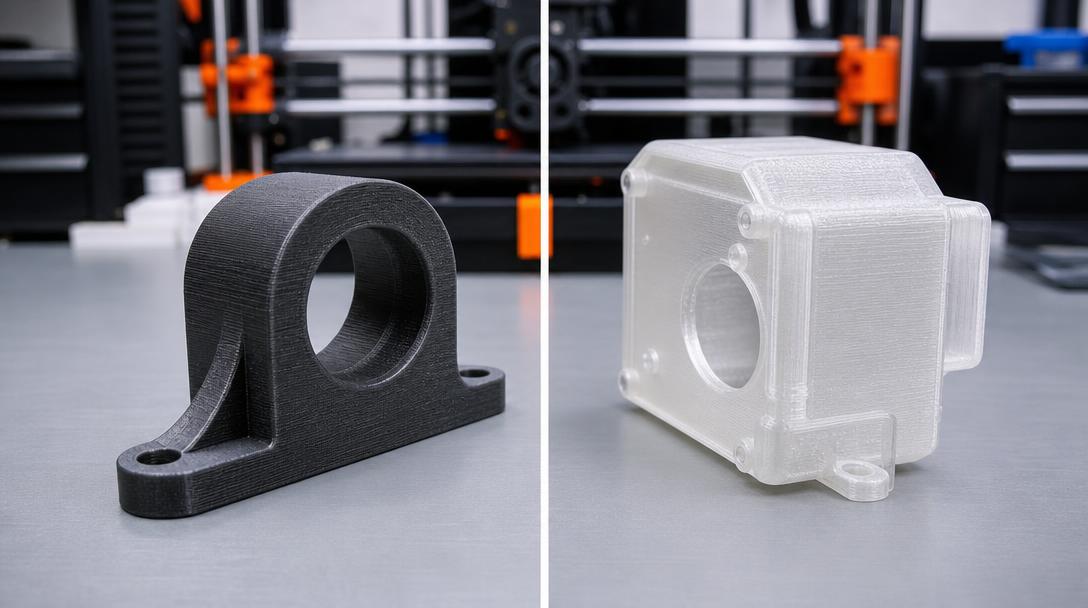

Glass Fiber Reinforced or Polycarbonate? Which Is Better for Rigidity, Heat, and Dimensional Stability?
When choosing a material for a functional FDM part, the decision often comes down to a single question: Should the part be more rigid and dimensionally stable, or more tolerant to impact and heat? This is where glass fiber reinforced filament and polycarbonate come to the same table. Both sit above standard PLA or basic prototyping materials; however, they do not serve the same need.
In short, glass fiber reinforced materials generally behave not as tougher, but as more stable and stiff. Polycarbonate, on the other hand, is a stronger candidate in most scenarios when it comes to higher impact resistance and high-temperature performance. To decide based on your application’s needs, it is useful to review the options on the engineering materials page.
What is it good for, and what is it not good for?
Glass fiber reinforced filaments are preferred to reduce bending, make the part more rigid, and improve dimensional stability in certain applications. They make particular sense for assembly fixtures, dimension-critical supports, fastening components, and parts that need to retain their shape. On the other hand, if the part is exposed to constant impact or needs some flex before breaking, it may not always be the first choice.
Polycarbonate stands out in parts exposed to high mechanical loads, impact, and heat. It makes sense for machine guards, enclosures used near hot environments, durable connecting components, and demanding prototypes. In contrast, the printing process can be more demanding; choosing it for every design simply because it is thought of as “the strongest” may create unnecessary cost and production difficulty.
Outdoor use, heat, and mechanical behavior
1) Heat resistance
If the part will be exposed to a hot environment, polycarbonate is the safer choice in most cases. PC may be a more logical option especially for in-car use, enclosures near hot air, or technical parts that gain extra heat under direct sunlight. Glass fiber reinforcement alone does not automatically turn a material into a high-heat hero; the base polymer used with the reinforcement is also the deciding factor.
2) Impact and fracture behavior
For parts that take impacts, may be dropped, or see sudden loads, polycarbonate is generally more advantageous. Even though glass fiber reinforced materials may feel stiffer, that does not always mean they will behave in a tougher way. In other words, the equation “stiff = unbreakable” does not apply here.
3) Rigidity and dimensional stability
If you are producing a long arm, a mounting leg, or a part that should not flex under load, glass fiber reinforced options can offer a major advantage. These types of materials tend to flex less in many applications. This benefit is especially clear in jobs such as fixtures, templates, and positioning parts.
4) Outdoor use
When deciding for outdoor use, it is not enough to ask only, “Will it be exposed to sunlight?” UV, temperature cycles, humidity, and mechanical stress must all be considered together. Polycarbonate is strong in terms of heat and impact; however, its outdoor performance can vary depending on the formulation. On the glass fiber reinforced side, outdoor behavior still largely depends on whatever the base material is. For this reason, the final decision for an outdoor part should not be made based only on the reinforcement name.
Printability and cost logic
Neither of these materials is as easy to work with as standard PLA. Polycarbonate usually requires higher temperatures, a more controlled process, and properly tuned equipment. Glass fiber reinforced filaments, on the other hand, may require extra attention because of abrasiveness during printing and nozzle wear. If your goal is a trouble-free first iteration, clarifying the project requirements and then getting a 3d printing service accordingly is often more efficient than trial and error.
On the cost side, instead of relying on memorized numbers, the following logic is more accurate: if the part is small but critical, the material difference may be insignificant compared to the total benefit; however, in large-volume or high-quantity jobs, the choice can have a serious impact. For that reason, it is important to consider the logic of price per gram. Especially in engineering parts, choosing the right material the first time is more important than the cost of a failed print or a part that breaks too early.
Which one is better for which part?
- Glass fiber reinforced: Rigid fixtures, supports that require dimensional stability, and assembly parts that should not flex.
- Polycarbonate: Enclosures exposed to impact, functional parts under temperature stress, and prototypes expected to deliver high durability.
- If you are undecided: To evaluate both the usage conditions and the part size together, it is practical to compare options through the model in the online 3d printing flow.
The final decision can be summarized like this: if you are saying it should flex less and keep its shape, then a glass fiber reinforced material may be the more logical choice. If heat, impact, and overall mechanical load are more dominant, then polycarbonate is the better candidate for most projects. For the best result, the material should be chosen not by its category name alone, but according to the part’s real usage scenario.


 Türkçe
 العربية
 Русский
 فارسی
فارسی Deutsch