
PLA or Polycarbonate? Which Is the Better Choice for Prototyping, Heat, and Impact Resistance?
When producing a part with 3D printing, the most critical decision is often not the design but the material choice. The question from users deciding between PLA and polycarbonate (PC) is usually the same: Do you need a fast and economical prototype, or a part that is more resistant to heat and impact? In many projects that request 3D printing service from Ucuz3D, these two materials may be considered for the same need, but in practice they behave very differently.
In short, PLA stands out for its ease of printing and clean surface quality, while PC is an engineering material better suited to tougher conditions but more demanding in printing and process control. Before choosing a material, it also helps to review the options on the engineering materials side so you can set the right expectations.
What is it good for, and what is it not good for?
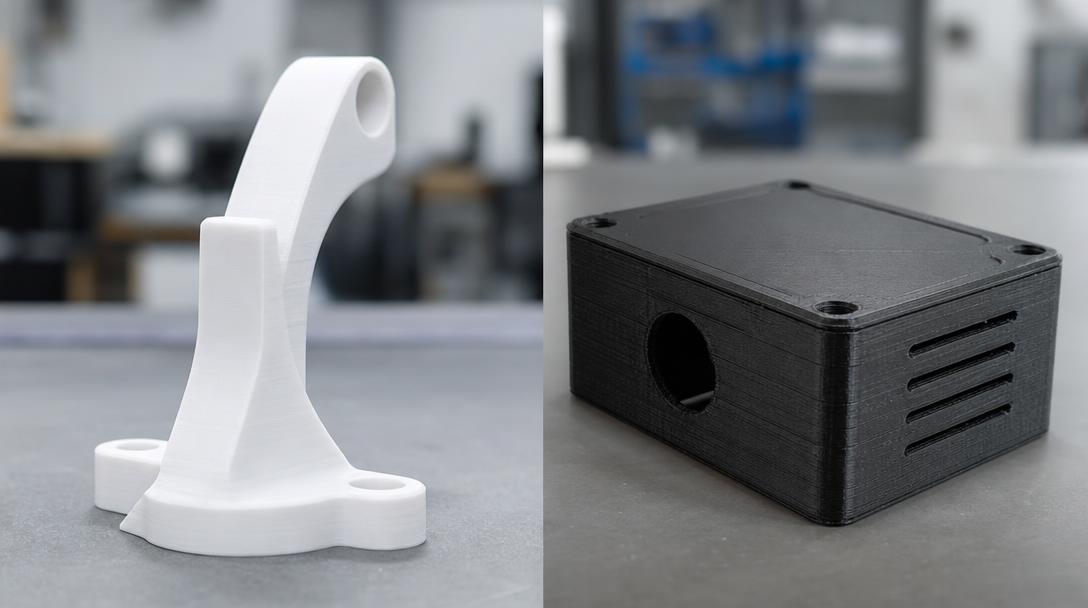
PLA makes a lot of sense for visual prototypes, desktop accessories, presentation models, lightly loaded parts, and jobs that require fast iteration. It has a strong tendency to deliver dimensionally consistent results and usually performs smoothly across most geometries. However, choosing PLA as the first option for parts exposed to high temperatures, direct sunlight, or sudden impact is generally not the right call.
PC is considered more for parts that are exposed to heat, subject to impact, and take on more serious mechanical duties. Protective covers, technical enclosures, workshop fixtures, and more durable prototypes are good examples. On the other hand, if you are only printing a decorative model, PC can often be an unnecessarily ambitious and costly choice.
Heat resistance and the difference outdoors
The clearest distinction between the two materials appears in heat performance. Since PLA can begin to soften at relatively low temperatures, it can be risky in scenarios such as in-car use, parts left under the sun, or areas around hot equipment. Even if the part does not visibly deform, it may gradually lose its shape over time.
Polycarbonate is a more reassuring option in this area. In applications that require higher temperature tolerance, it is generally a more sensible choice than PLA. Still, when deciding for outdoor use, you need to consider not only temperature but also UV exposure, mounting style, and the real service load together. For that reason, instead of automatically choosing a single material just because a part will “stay outside,” it is important to define exactly what the part is supposed to do.
Impact, rigidity, and part behavior
PLA feels hard and rigid; this can lead some users to think it is more durable. In practice, however, PLA often behaves as hard but more brittle. In other words, while it performs well in parts that remain measured and stable, it can be weak in parts that may be dropped, struck, or need flexibility.
PC is generally regarded as more impact-resistant. For that reason, it may be the more sensible choice not only for parts that need to look “strong,” but for parts that are genuinely under stress. That said, higher mechanical expectations do not always automatically mean PC; if there is a design flaw, the material alone will not solve it.
Ease of printing and production risk
One of PLA’s biggest advantages is how easy it is to print. Problems such as warping, cracking, and poor bed adhesion are relatively less common. This makes results more predictable both for one-off prototypes and for repeat production.
On the PC side, the process is a bit more sensitive. The need for high temperature, a controlled print environment, and proper settings increases. Under the wrong conditions, warping, weak layer adhesion, or surface defects may appear. For that reason, in technical parts you should evaluate not only the material’s theoretical strength but also the discipline of the production process. If you want to clarify the production approach for your project, you can upload your model on the online 3D printing page to see the initial overview, and you can evaluate the cost logic through the price per gram approach.
Which one makes more sense for which part?
- PLA: Visual prototype, fast product validation, desktop-use accessory, educational model, light-duty cover, and enclosure.
- PC: Technical cover exposed to heat, protective part with impact risk, fixture with more serious mechanical expectations, prototype for harsh environments.
If your priority is fast results, a clean surface, and more accessible production, PLA is generally the more logical starting point. If the part will face heat, impact, and heavier service conditions, polycarbonate is worth considering. In short, PLA is the material of economical and fast decisions, while PC is a strong candidate for more demanding and tougher tasks. The right choice should be made according to what the part will actually experience.


 Türkçe
 العربية
 Русский
 فارسی
فارسی Deutsch