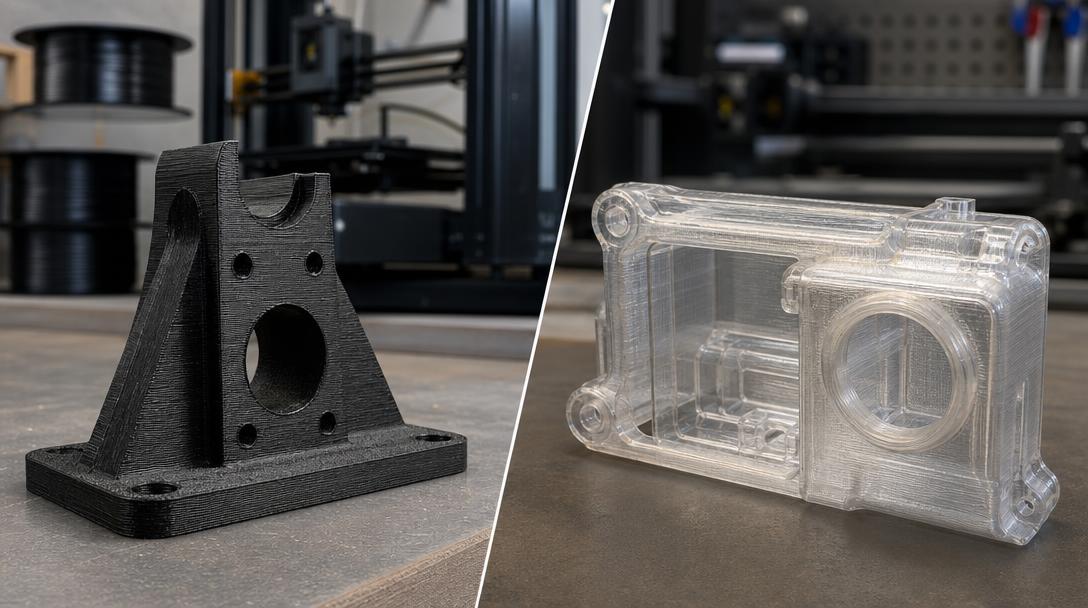

Carbon Fiber Reinforced or Polycarbonate? Which Makes More Sense for Stiffness, Heat, and Mechanical Stress?
For a functional FDM part, the decision point usually does not end with simply saying “it should be durable.” Will the part be exposed to heat, subjected to impact, need to hold its dimensions, or require as little flex as possible? In these questions, two common candidates stand out: carbon fiber reinforced filaments and polycarbonate (PC). At first glance, both seem to belong to the “engineering” category; however, in practice, they do not solve the same problem.
In short, if stiffness and dimensional feel are the priority, carbon fiber reinforced options draw attention; if heat and impact resistance are both required, polycarbonate is the more natural candidate in many projects. Still, it is important to remember that with carbon fiber reinforced filaments, the result is influenced not only by the fiber itself but also by the carrier polymer to which the fiber is added.
If your part concept is not yet fully defined, choosing the material according to the part’s actual use in a professional 3d printing service process reduces the need for later revisions. On the cost side, it is also healthier to look not only at the total order but at the logic of the price per gram. If your file is ready, making an early comparison in the online 3d printing workflow can speed up the decision process.
What is it good for, and what is it not good for?
Carbon fiber reinforced filaments are generally preferred to give a part a denser and stiffer character. They can make sense for camera mounts, jigs, lightweight structural parts that need to keep their shape, or fastening elements that should not flex. On the other hand, they may not always be the best answer for parts that take very high impacts or require continuous flexing.
Polycarbonate, by contrast, stands out in more demanding use scenarios. It is a sensible choice for heat-exposed enclosures, technical parts at risk of impact, and more durable engineering applications. However, PC is not the answer for every job either; because the printing process is more demanding, it may be unnecessarily troublesome for purely visual prototypes or very fast test parts.
Which performs better in heat and outdoor conditions?
When talking about heat resistance, the advantage in most cases shifts toward polycarbonate. Especially for parts that move beyond desktop environments into hotter surroundings, PC can be a more reassuring option. With carbon fiber reinforced filaments, heat performance varies according to the main polymer used; in other words, not every carbon fiber reinforced filament automatically performs at the level of PC.
In terms of outdoor use, the phrase “carbon fiber” alone is also not enough. That is because behavior under UV, moisture, and temperature cycling again depends on the base polymer. Although polycarbonate is technically a strong candidate, for long-term outdoor use, the design, thickness, and real operating conditions should all be evaluated together. For this class of technical materials, the general framework on the engineering materials 3d printing page can also provide useful guidance.
Impact, stiffness, and flexibility differences
The most critical distinction here is this: carbon fiber reinforced materials usually feel stiffer, while polycarbonate manages impact better in most scenarios. So if you have a long arm, fixture, or a part that needs to bend less under load, a carbon fiber reinforced option may make sense. But if the part faces sudden loads, collision, or drop risk, PC may behave more forgivingly.
For a project that requires flexibility, neither is the first candidate. Neither side of this comparison is intended for flexible parts; both are more suited to robust and functional use. The choice here is made according to the priority between “let it flex as little as possible” and “let it tolerate impact without breaking.”
Printability and cost logic
Even carbon fiber reinforced filaments vary among themselves in terms of printability; however, in the overall picture, it can be said that polycarbonate requires a more sensitive process. PC can be more challenging when suitable machine conditions are not available. Carbon fiber reinforced filaments can also raise equipment requirements for reasons such as abrasiveness. In other words, for both materials, the issue is not just the spool price, but print success and repeat production rate.
That is why, in cost calculations, the question “which material is more expensive” remains incomplete on its own. A part coming out correctly on the first attempt, reducing the need for re-production later, and its service life are at least as important as the material itself in total cost logic.
Which one makes more sense for which part?
- Carbon fiber reinforced: Stiff fixtures, lightweight structural parts that need to keep their shape, jigs that should not bend, and technical holding components.
- Polycarbonate: Heat-exposed enclosures, functional parts with impact risk, and body and fastening elements that will be used in more demanding engineering applications.
The final decision sentence is usually this: If your priority is stiffness and a premium technical feel, carbon fiber reinforced filament is the better fit; if your priority is heat and impact resistance, polycarbonate is the more sensible choice. If the part is both load-bearing and exposed to harsh real-world conditions, the most accurate approach is to match the material not just by name, but by the actual use scenario.


 Türkçe
 العربية
 Русский
 فارسی
فارسی Deutsch