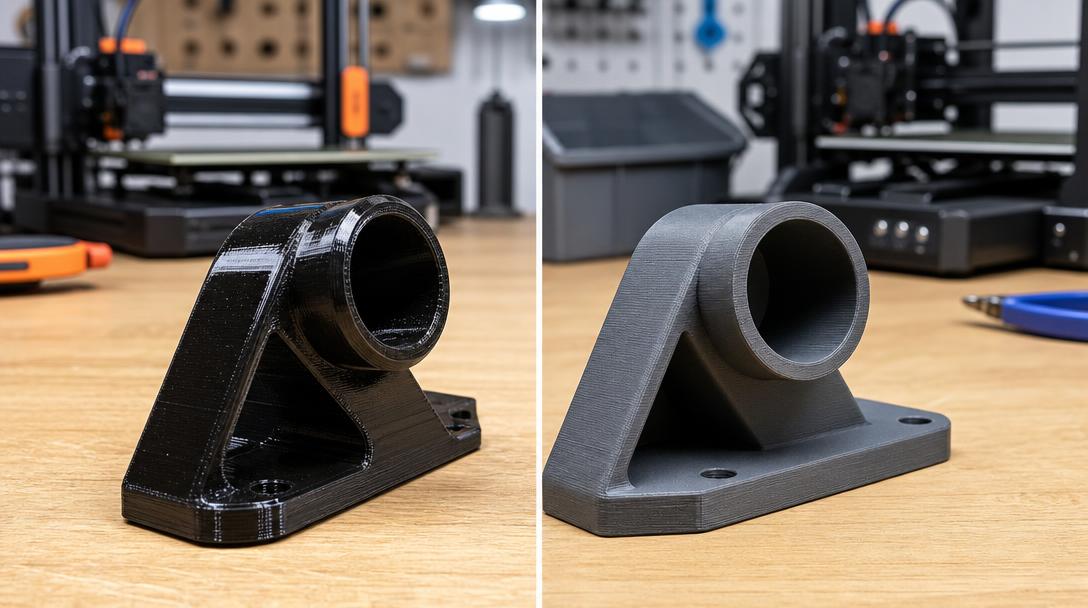

PETG or ABS+? Which Makes More Sense for Boxes, Fixtures, and Everyday Functional Parts?
In FDM printing, one of the most common difficult choices is between PETG and ABS+. That is because both are preferred not only for visual prototypes, but also for parts that are actually used. Still, they do not do the same job. In one project, PETG may stand out when you want a material that feels more solid, is easier to print, and is better suited to everyday conditions such as moisture and splashes. ABS+, on the other hand, which leans more toward higher-temperature use, feels a bit more technical, and is often positioned as a more manageable derivative of ABS, may make more sense in other scenarios. The important point here is not so much asking “which material is better,” but rather “which one is more appropriate for which part.”
If you want to see the result through a professional 3d baskı hizmeti before trying production on your own machine, choosing the material according to the part’s intended use is often more critical than print quality itself. Ucuz3D’s baskı malzemelerimiz page is also a good starting point for seeing which material is closer to which need.
What is PETG good for, and what is ABS+ good for?
PETG is often preferred for parts used in everyday conditions that may take impact, be exposed to light moisture, or need a bit of flexibility. It makes sense for parts such as cable holders, covers, electronics enclosures, simple mounting fixtures, bottle holders, and workshop organizers. In most cases, its interlayer bonding is satisfactory, and it does not feel completely brittle.
ABS+, on the other hand, usually comes up when there is an expectation of more technical use. Although its formula varies by manufacturer compared to standard ABS, the general expectation is that it makes print behavior a bit more manageable and delivers more balanced results in functional use. It can be worth considering for indoor parts that need to get somewhat closer to heat than PETG, but may still face more demanding conditions such as summer temperatures or the area around machinery.
Where do they fall short?
PETG’s strongest points also reveal its limits. Its slightly flexible behavior is useful for impact resistance; however, if you expect a part with very high rigidity and dimensional feel, it can sometimes be perceived as “too soft.” Thin clips, very tight friction-fit tolerances, or parts exposed to warm environments may not always be ideal in PETG.
On the ABS+ side, the main risk is the printing process. It may not be as problematic as standard ABS, but warping, corner lift, and sensitivity to environmental conditions can still occur. Not every model gives equally easy results on open-frame desktop printers. In other words, even if the part makes sense in use, the production side may be more selective.
Differences in outdoor use, heat, impact, and rigidity
Outdoors, neither material is an “automatically correct choice.” PETG can do the job in short- and medium-term outdoor use; it is a practical option against rain splash, moisture, and everyday wear. However, expectations should be set carefully under prolonged sun exposure and heat load. ABS+, meanwhile, may inspire more confidence around heat than PETG; even so, it is not as naturally suitable a candidate as ASA for long-term outdoor use.
In terms of impact, PETG feels more forgiving to most users. Since it has a low tendency to shatter like glass under sudden load, it feels reliable in everyday fixtures and hand-used parts. If a stiffer feel and a harder character are desired, ABS+ may be preferred. But whether that hardness is an advantage or a disadvantage in very thin sections depends on the geometry of the part.
Ease of printing and cost logic
As for ease of printing, the overall picture favors PETG. Its settings window is broad, it is more comfortable for a wider range of users without requiring a closed chamber, and it offers a good “middle ground” for functional parts. ABS+ can produce very good results with the right equipment and a controlled environment, but it is not equally forgiving on every printer.
On the cost side, instead of deciding based only on the filament price tag, it makes more sense to look at the total production logic of the job. Waste, the need for reprints, support cleanup, and the success rate per part all affect the total cost. That is why not only the material name, but the real production scenario matters. Before ordering, it is healthier to review the gram başı fiyat approach and then compare on a model basis by getting an anında fiyat.
Which one for which part?
- Choose PETG: Electronics enclosures, workshop organizers, covers exposed to light impact, everyday parts that may encounter moisture, and connections that need a bit of flexibility.
- Choose ABS+: Indoor parts that may face warmer conditions, functional components where a stiffer character is desired, automotive interior trim-like applications, and well-tuned enclosed-environment prints.
- Evaluate both carefully: Parts that will remain under the sun for a long time, highly tolerance-sensitive mechanical components, and parts continuously exposed to high heat.
In short, while PETG is a safer choice with a broader range of use for most users, ABS+ can better meet more technical needs under the right conditions. When making the decision, not only strength but also heat, ease of printing, part geometry, and the usage environment should be evaluated together.


 Türkçe
 العربية
 Русский
 فارسی
فارسی Deutsch