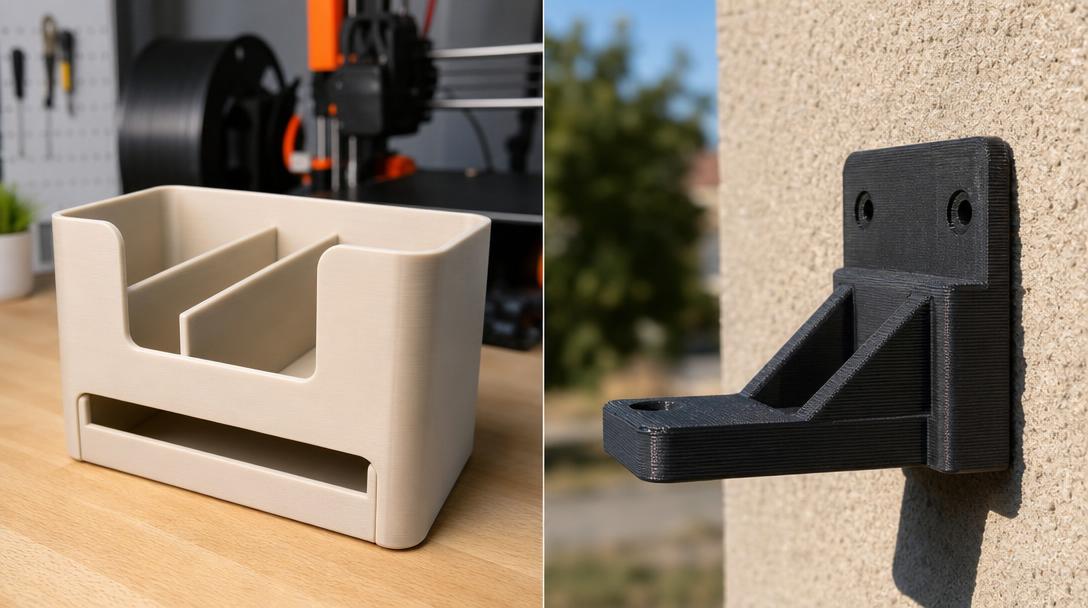

PLA+ or ASA? Which Makes More Sense for Everyday Functional and Outdoor Parts?
At first glance, PLA+ and ASA may seem to do the same job; both are materials frequently preferred in FDM printing and commonly encountered by both standard users and professional customers. However, the differences become clear very quickly when it is time to decide. The short summary is this: while PLA+ is often more practical for clean-looking, fast, and economical prototypes used indoors, ASA is generally the better choice when sun, heat, and weather conditions come into play.
Before turning your part into an order, it is useful to review application examples on the 3d printing service page. If you want to see a general framework on the material side, the our printing materials page is also a good place to start.
What is it good for, and what is it not good for?
Compared to standard PLA, PLA+ is generally a slightly tougher option and can be more forgiving during printing. It makes sense for desktop accessories, prototypes, enclosures, organizers, everyday parts exposed to low to medium loads, and jobs where visual quality matters. On the other hand, PLA+ is not always the safest choice for parts that will stay under the sun for long periods, heat up inside a vehicle, or are expected to keep their shape in summer temperatures.
ASA, by contrast, stands out especially for outdoor use. Within the ABS-like family, it is a more balanced candidate against sunlight, UV, and higher service temperatures. If the application involves environments such as a garden equipment accessory, an outdoor box, a cover, a bracket, a vehicle-side accessory, or a window ledge, ASA is often the more sensible choice. On the other hand, for very fast, low-risk, and economical prototype production, ASA may be more trouble than necessary.
The difference in outdoor use and heat
This is exactly where the main dividing line between the two begins. PLA+ parts can perform well in short-term everyday use; however, the risk of softening at high temperatures creates a question mark for parts exposed to sunlight. Areas such as car interiors, balconies, windowsills, or enclosed spaces that heat up in summer are places where PLA+ should be approached with caution.
ASA, on the other hand, is more reassuring for outdoor use. Thanks to its UV resistance and performance in warm environments, it delivers more consistent results in functional parts intended for seasonal use. Still, in cases involving very high mechanical loads and continuous impact, geometry, wall thickness, and print orientation are at least as decisive as the material itself.
In terms of impact, rigidity, and flexibility
PLA+ feels rigid and consistent in most applications. This is an advantage for parts that require a good dimensional feel and surface quality. However, rigidity does not always mean durability; under sudden impact, some PLA+ formulations can behave in a brittle way. In other words, it is a sensible option for showcases, desks, offices, and light functional use, but it may not always be the first choice for impact-heavy field use.
ASA generally offers more balanced toughness. If the part will work in a slightly more technical environment, be exposed to light impact, and stay outdoors, the overall logic of using ASA becomes stronger. It is not a highly flexible material; for parts where flexibility is required, it is already necessary to move to the TPU/TPE class.
Ease of printing and cost logic
PLA+ is ahead when it comes to ease of printing. In most projects, it allows progress with lower risk, a cleaner surface, and faster iteration. This is a major advantage especially in test parts, concept models, and projects that require quick revisions. When planning an order, rather than memorizing exact figures, it is more accurate to understand the price per gram logic.
ASA, on the other hand, may require more controlled conditions during printing. Warping tendency, environment management, and part geometry become more critical. For this reason, it may not shine on the first attempt, but it can be more valuable in the right use scenario. If your file is ready, you can get an instant quote and make a clearer cost-benefit comparison between the two materials.
Which one for which part?
- PLA+: desktop accessories, indoor boxes, prototypes, aesthetic parts, everyday-use products exposed to low heat
- ASA: outdoor brackets, sun-exposed covers, vehicle-side accessories, functional parts with a risk of hot environments
Short conclusion
If your priority is easy printing, a clean appearance, and indoor functionality, PLA+ is generally the more sensible choice. If the part will be exposed to sunlight, summer heat, or is expected to have a longer service life outdoors, ASA is the better choice in most cases. In short, PLA+ stands out for easy production and economical iteration, while ASA stands out for outdoor durability and heat resistance.


 Türkçe
 العربية
 Русский
 فارسی
فارسی Deutsch