
Glass Fiber Reinforced or Nylon (PA)? Which Makes More Sense for Dimensional Stability and Wear-Prone Mechanical Parts?
In some 3D printed parts, the real question is not just whether it should “be durable”; questions like should it be rigid, should it stay tough, should it keep its dimensions, should it perform better under friction also come into play. At this point, glass fiber reinforced filaments and nylon (PA) often end up on the same table. Both are serious candidates for functional FDM parts, but they do not solve the same job in the same way.
If it is important for your part to better retain its shape after printing, feel stiffer, and flex less under load, glass fiber reinforced options stand out. If your goal is a part that takes impact, operates, rubs, or needs to do its job without breaking thanks to a bit of flexibility, nylon may make more sense in many cases. If you cannot choose the right material for your part, it is healthier to match the material to the use case during a professional 3d baskı hizmeti process.
The basic difference: stiffness or toughness?
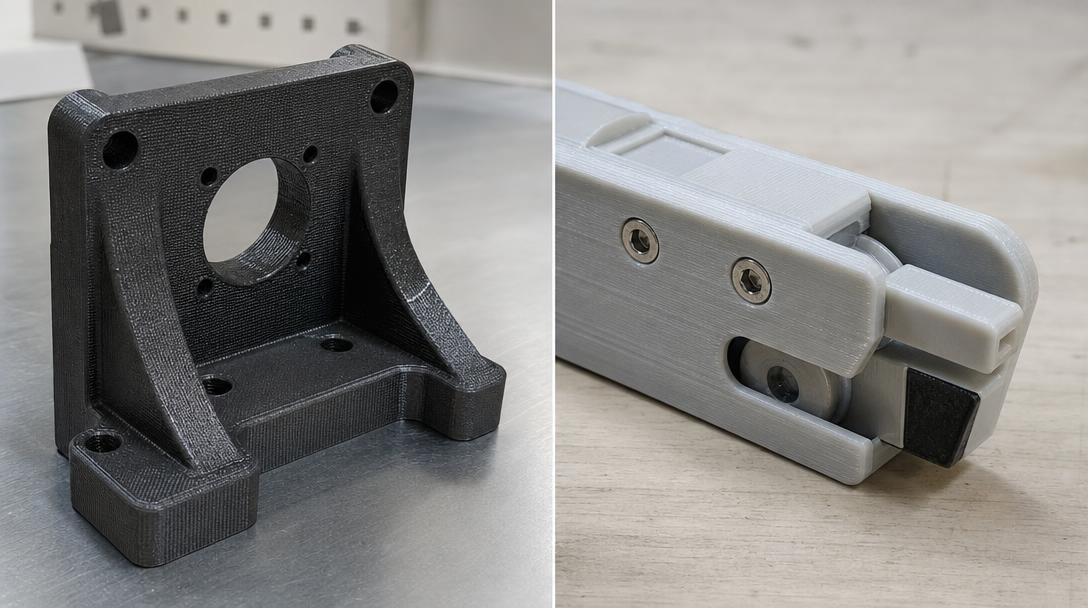
Glass fiber reinforced filament aims for higher stiffness and better dimensional stability thanks to the glass fibers added into the base polymer. That is why it stands out in jigs, support bodies, mounting plates, or technical parts that need to keep their shape. The part gives more of an “engineering feel”; however, as with any rigid material, it may behave more brittly under excessive impact.
Nylon (PA), on the other hand, is generally a tougher material, more tolerant to impact, and more balanced against wear. That is why it is often preferred for gear-like working parts, sliders, hinge-area parts, or products exposed to mechanical stress. In return, nylon has a higher degree of flex; in other words, if you expect a very rigid geometry, it may not always be the clearest solution on its own.
What is it good for, and what is it not?
When does glass fiber reinforced make sense?
- If dimensional stability is important
- If the part is expected to flex little under load
- If you are producing a jig, fixture, support bracket, cover, or body-type part
- If you want a more technical and rigid part character
On the other hand, glass fiber reinforced material is not always the first choice for parts that work under constant impact or require controlled flex.
When does nylon make sense?
- If there is friction and wear
- If it is expected to work under impact without cracking
- If slight flex is not a problem, or is even an advantage
- If you are producing a clip, hinge-area part, mechanical connection, or moving part
On the other hand, nylon may require extra design and process attention in parts that need very sharp tolerances and must keep their form very rigidly for a long time. Ucuz3D’s mühendislik malzemeleri page is a good starting point for positioning the options in this class more accurately.
Which one comes out ahead in outdoor use, heat, and impact?
Sunlight is not the only criterion outdoors. Heat changes, impact, assembly stress, and moisture also change the picture. Depending on the base polymer, glass fiber reinforced materials can offer higher stiffness and more controlled thermal behavior. However, outdoor performance is not determined by the “fiber” alone; the carrier polymer is also decisive.
Nylon, meanwhile, is strong on the impact and mechanical operation side; however, its interaction with moisture means usage conditions should be considered. In a part that sees heat but also operates and is stressed, nylon may make sense; if what you want is only a very rigid body with stable dimensions, glass fiber reinforced material may be a more suitable candidate. In short, impact and operating load push nylon forward, while the need for stiffness and shape retention pushes the glass fiber reinforced option forward.
Printability and cost logic
Neither material is as easygoing as standard PLA. Nylon requires moisture control and process discipline. With glass fiber reinforced filaments, abrasiveness and equipment compatibility can be important. That is why producing the part directly in the right material is often more economical than desktop trial and error. Here, instead of memorizing numerical prices, it is more accurate to look at the gram başı fiyat logic; because the real cost is shaped not only by the material, but also by print time, success rate, and post-processing labor.
If your file is ready, it is also possible to make a quick initial assessment for the part type through the online 3d baskı flow.
Which one for which part?
- Mounting jig, support plate, dimension-critical technical body: Glass fiber reinforced may make more sense.
- Slider, stressed connection, wear-prone mechanical part, impact use: Nylon (PA) may make more sense.
- Low flex, high stiffness feel: Glass fiber reinforced.
- Toughness, service life, and mechanical tolerance: Nylon.
In summary, the choice should be made not so much by asking which material is stronger, but by asking how the part will work. Will the part stay fixed and keep its shape, or will it rub, be stressed, and take impacts? Your answer to that question will clarify the decision between glass fiber reinforced and nylon in most cases.


 Türkçe
 العربية
 Русский
 فارسی
فارسی Deutsch