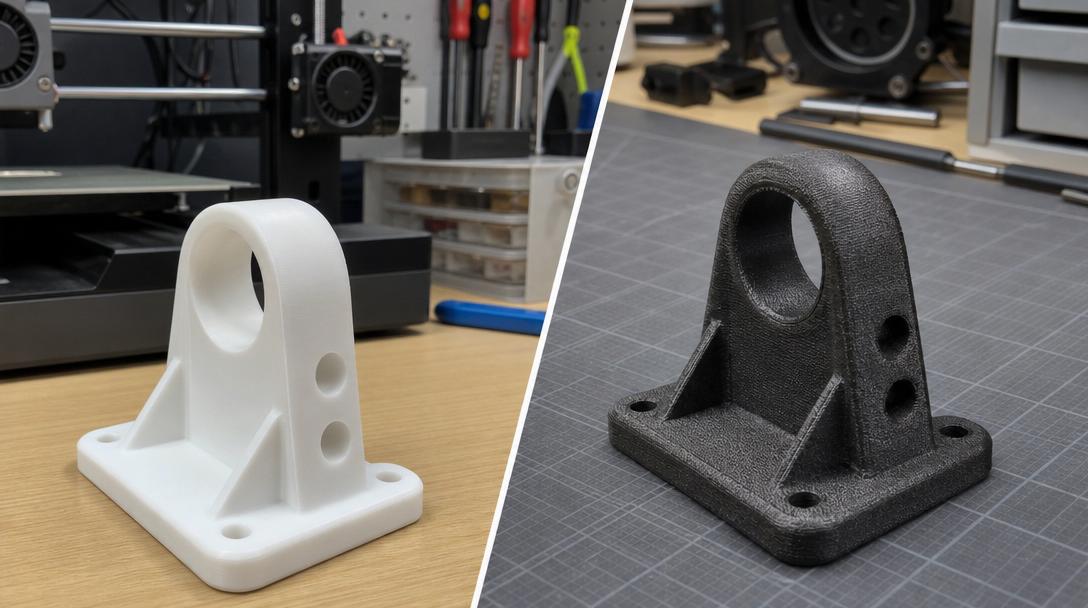

PLA or Nylon (PA)? Which Makes More Sense for Prototypes and Mechanical Parts?
Both materials are very well known in the FDM world, but in reality they serve completely different expectations. In short, PLA is an easier-to-print option that makes rapid prototyping and visual parts more straightforward. Nylon (PA), on the other hand, stands out more in functional parts exposed to load, friction, and fatigue. If you are thinking about having a part made through a 3d printing service, understanding the difference between these two materials correctly will directly affect both service life and unnecessary cost.
The real question is this: Do you want a fast and economical prototype, or a truly functional mechanical part?
What is PLA suitable for, and what is it not suitable for?
PLA is usually the first-choice filament because the printing process is relatively trouble-free, dimensional consistency can be good, and surface quality looks satisfactory in most projects. It is frequently preferred for mockups, device enclosures, presentation models, test parts for assembly checks, and desktop fixtures.
But PLA also has clear limits. If the part will be exposed to a hot environment, take repeated impacts, or if the risk of sudden fracture without much flex is critical, PLA may not always be the right choice. You need to be especially more cautious with parts left in a car, components around an engine, friction-based mechanisms, or connections that carry load for long periods.
When does Nylon (PA) stand out?
Compared to PLA, Nylon is an engineering material that can behave more toughly and can be more suitable in many scenarios against wear and impact. It can make sense for bushing-like parts, clips, working hinges, auxiliary components around gears, cable guides, and some functional parts operating under load. That is why, for engineering-focused work, it is often a better starting point to look at engineering materials 3d printing options.
On the other hand, Nylon is not the solution for every job either. It is not as easy to print as PLA, it tends to absorb moisture, and this can affect the result from surface quality to dimensional stability. For simple parts that are only for display, visually driven, or low-budget, Nylon can often be a more advanced choice than necessary.
Differences in terms of heat, impact, rigidity, and flexibility
- Heat: PLA is more limited against heat. It can lose its shape more easily in parts exposed to hot environments. Nylon, by contrast, is generally a more reassuring option in this respect.
- Impact: Under sudden load and impact, PLA can behave brittly. Nylon gives a tougher response in most applications.
- Rigidity: PLA feels stiffer. This is an advantage in some prototypes, but being stiff does not always mean being durable.
- Flexibility: Nylon can be a bit more forgiving. This creates an important difference in parts such as clips, snap-fits, and components exposed to repeated stress.
Which one makes more sense outdoors?
When it comes to outdoor use, this pair is not exactly a perfect open-air duel anyway. PLA can age quickly under sun and heat, so it is generally not the first recommendation outdoors. Nylon may be mechanically stronger, but it still requires attention depending on the application because of moisture and environmental conditions. In short, if you want an outdoor part, you should decide not only by asking, “which one is stronger?” but also by considering the actual environmental conditions.
Printability and cost logic
PLA is clearly much easier when it comes to printability. This has a positive effect on the number of trials, the risk of errors, and the overall production process. Since Nylon is a more demanding material, production conditions become more critical. This difference also matters in the overall order logic. If you only need a visual check or a form test, moving to a more expensive and more difficult material may be unnecessary; but choosing the wrong material for a working part can also create re-production cost later. That is why the material decision should be evaluated not only by part weight, but together with the use scenario. To see the general pricing approach, you can review the logic of price per gram, upload your model, and quickly compare which production path seems more sensible in the online 3d printing flow.
Which one should you choose for which part?
- PLA: Presentation prototype, visual model, lightweight fixture, desktop organizer, dimensional test.
- Nylon (PA): Wear-prone auxiliary part, clip, load-bearing connection, friction-working component, functional part expected to behave more toughly.
In summary, PLA makes more sense on the “fast and economical prototype” side, while Nylon makes more sense on the “truly functional mechanical part” side. Once you define what your part will actually go through, the choice also becomes largely clear.


 Türkçe
 العربية
 Русский
 فارسی
فارسی Deutsch