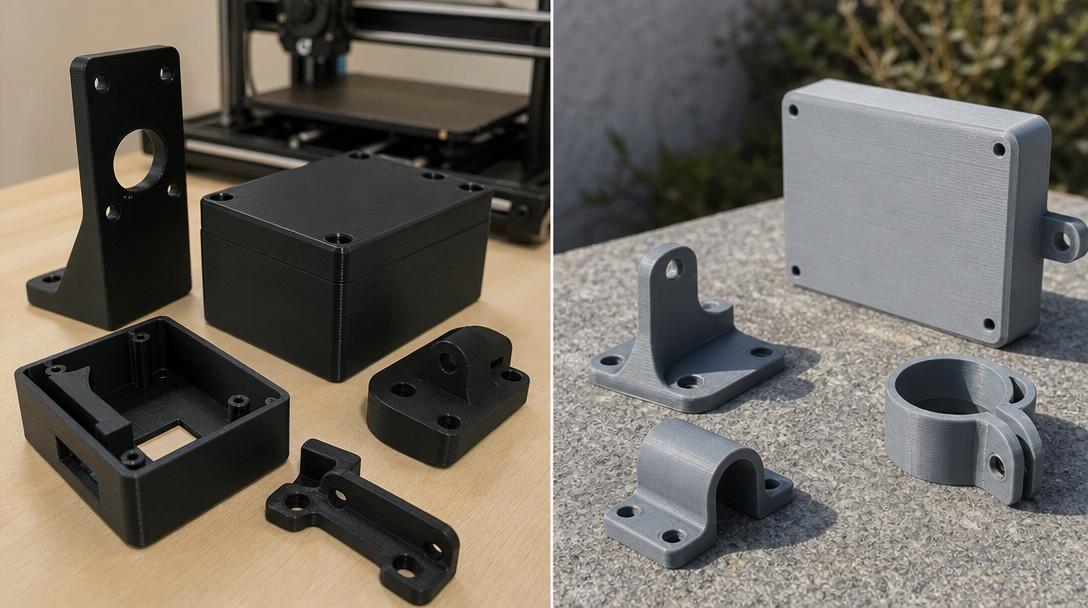

ABS+ or ASA? Which Makes More Sense for Outdoor and Everyday Functional Parts?
ABS+ and ASA are two FDM materials that are often seen as quite similar. Both are suited to more technical applications than standard PLA-class materials; however, their use cases are not the same. In short, the decision usually comes down to this question: Will the part be produced mainly for workshop use, indoor environments, and general functional applications, or will it operate outdoors where it is exposed to sun, weather, and temperature fluctuations?
If you want to move your part into professional production, it is possible to get suitable material-based production guidance through Ucuz3D’s 3d printing service. On the cost side, instead of memorizing exact figures, it is healthier to understand the logic of price per gram. To upload your model and quickly compare the effect of the material, the instant quote flow is also practical. These two materials are frequently compared, especially when making decisions in the engineering materials category.
The main difference: ASA handles outdoor conditions better, while ABS+ is strong in practical production
ABS+ can be thought of as a variation intended to reduce some of the weak points of standard ABS. Although the formulation varies by brand, most users expect more controlled print behavior, adequate impact resistance, and balanced performance in everyday functional parts. ASA feels similar to the ABS family on the mechanical side, but its real advantage appears in being a more logical choice against UV exposure and weather conditions.
That is why ABS+ can often be sufficient and sensible for indoor housings, fixtures, connectors, workshop support parts, or prototypes. In contrast, for applications such as balconies, gardens, exterior vehicle accessories, sun-exposed boxes, sensor covers, or sign mounts, ASA is generally the safer choice.
What is it good for, and what is it not good for?
What is ABS+ more suitable for?
- Everyday functional parts
- Housings and holders likely to take impacts
- Fixtures and jigs used in indoor environments
- Applications requiring higher heat resistance than PLA
ABS+ is not ideal for every job. For a part that will remain under sunlight for a long time, choosing it simply because it is “stronger than ABS” can be misleading. In this material class, outdoor stability is the main axis of the decision.
What is ASA more suitable for?
- Outdoor parts
- UV-exposed housings and covers
- Applications subjected to hot-cold cycles
- Jobs where the visible surface quality is expected to remain more stable over time
ASA is not automatically the right choice everywhere either. If there is very high mechanical load, friction, and wear, sometimes Nylon or more advanced engineering materials should be considered. In other words, ASA is a strong candidate for outdoor use; but it is not the single answer to every engineering problem.
Comparison in terms of heat, impact, rigidity, and printability
Both materials handle warmer environments better than PLA. However, in practice, questions like “Will it stay in a car, will it be exposed to sunlight, is it near a motor?” are important. When outdoor conditions and UV exposure come into play, ASA stands out. On the impact resistance side, ABS+ offers a satisfying balance for many everyday parts. For this reason, ABS+ can remain a sensible option for parts exposed to impacts but not required to survive outdoors.
In terms of rigidity, the two materials may feel similar; however, the real selection difference is environmental resistance rather than flexibility. In terms of printability, neither is as easy as PLA. Issues such as shrinkage, odor, the need for enclosed printing, and warping risk should be taken into account. Still, some ABS+ formulations on the market may be easier to manage than standard ABS. ASA can also deliver very good results with the right settings, but it still does not fall into the “easy material” category.
Which one makes more sense for which part?
- Indoor functional fixture: ABS+ may make more sense.
- Sun-exposed outdoor box or cover: ASA is generally the more correct choice.
- Workshop jig and rapid production part: If there is no outdoor exposure, ABS+ may be sufficient.
- Mounting part to be used outside a vehicle: ASA stays on the safer side.
In terms of cost logic, it is not correct to decide based only on the filament name. The possibility of reprinting the part, its outdoor service life, print success rate, and total weight should all be considered together. Sometimes being a little more selective in the first production run is more economical in the long term.
Conclusion
If your priority is everyday functional use, impact resistance, and an indoor part, ABS+ is a strong candidate. If the part will be exposed to sun, UV, and outdoor weather conditions, ASA is usually the more sensible choice. In short, in this comparison the question is not “which one is stronger,” but “where will the part live?” That is exactly where the right material choice is determined.


 Türkçe
 العربية
 Русский
 فارسی
فارسی Deutsch