
TPU or ABS+? Which Makes More Sense for Impact Absorption, Flexibility, and Everyday Functional Parts?
TPU and ABS+ are often considered in the same basket, because both come up for more functional uses than PLA. But the way they work is quite different. In short, TPU is flexible and impact-absorbing, while ABS+ is a more rigid option that holds its shape. Before having a part made with a 3d baskı hizmeti, the real question to decide is whether the part needs to bend under load or stay fixed.
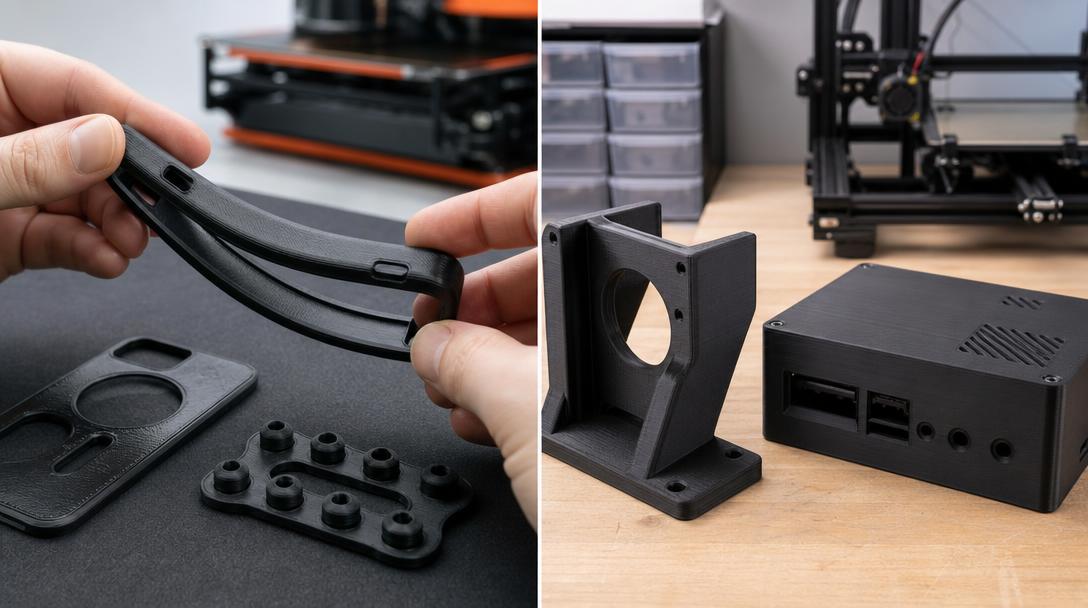
TPU behaves like rubber. It can compress, flex slightly, and offers an advantage in handling impacts without breaking. That is why it makes sense for non-slip feet, bumpers, protective cases, contact surfaces, and parts that need a little flexibility. ABS+, on the other hand, is stiffer and behaves more structurally. It feels more reliable in brackets, enclosures, fixtures, clips, and body-type parts. As seen on Ucuz3D’s baskı malzemelerimiz page, choosing the right material usually depends less on whether the material is “strong” and more on whether it fits the job.
What is it good for, and what is it not good for?
TPU stands out in parts that need to grip without damaging a surface, dampen impact, or change shape when squeezed by hand. However, it may be too soft for assembly parts that require tight tolerances and need to stay perfectly upright.
ABS+, on the other hand, is better suited to functional parts that need to keep their shape. It makes sense for electronic enclosures, desktop fixtures, assembly parts, and everyday-use brackets. In contrast, it does not behave as naturally as TPU in applications where soft contact, quiet operation, or impact absorption is needed.
The difference in impact resistance, rigidity, and flexibility
This is where the biggest difference between these two materials appears. Think of a corner protector, foot, or bumper that takes impact: in these kinds of parts, the goal is to spread the energy and delay breakage. TPU is better suited to this job. By contrast, if you need to carry a device, hold a lid, or secure a part in aligned position, ABS+ makes more sense. Because here, what matters is not flexing, but keeping its form.
In other words, if you want flexible durability, choose TPU; if you want rigid durability, look toward ABS+. The same word “durability” means two different things in these two materials.
Which makes more sense for heat and outdoor use?
For general use, ABS+ can be a safer choice than TPU when it comes to maintaining geometry in warm environments. Especially for rigid parts that may stay inside a car, enclosures exposed to mild heat, or parts that need to keep their shape in summer, ABS+ generally seems to make more sense in most cases.
Outdoors, however, the choice should not be based only on sunlight. TPU can work well in a part that touches the ground, receives vibration, or is exposed to impact. For a fixed holder or enclosure that needs to keep its shape, ABS+ may be more suitable. If the expectation for long-term UV resistance is very high, other materials may also need to be considered; that is why deciding based on the application is the safest approach.
Printability and cost logic
The printing process for TPU can be more sensitive because of its flexible structure; feed and speed settings become especially important on some printers. ABS+, in this respect, can be more predictable, although depending on the part geometry it may require controlled heat management. In other words, the difficulty of the two materials is not the same, only the type of difficulty is different.
Looking only at the list price can be misleading when it comes to cost. A bumper that is unnecessarily rigid and a bracket that is too soft are both expensive mistakes in practice. So when thinking in terms of price per gram, you should also consider whether the part achieves the correct function on the first try. When uploading your model to the online 3d baskı system, adding a note about the intended use will help ensure a more accurate material choice.
Which one for which part?
- TPU: non-slip foot, bumper, flexible case, contact protector, part that compresses slightly and springs back.
- ABS+: electronic enclosure, assembly fixture, fixed holder, desktop bracket, rigid body part.
In summary, TPU and ABS+ are not exact alternatives to each other. If the job of the part is to flex, absorb impact, or protect a surface, TPU is the better choice. If the part will function as a support, body, or rigid fixture, ABS+ is the more sensible option for most projects.


 Türkçe
 العربية
 Русский
 فارسی
فارسی Deutsch