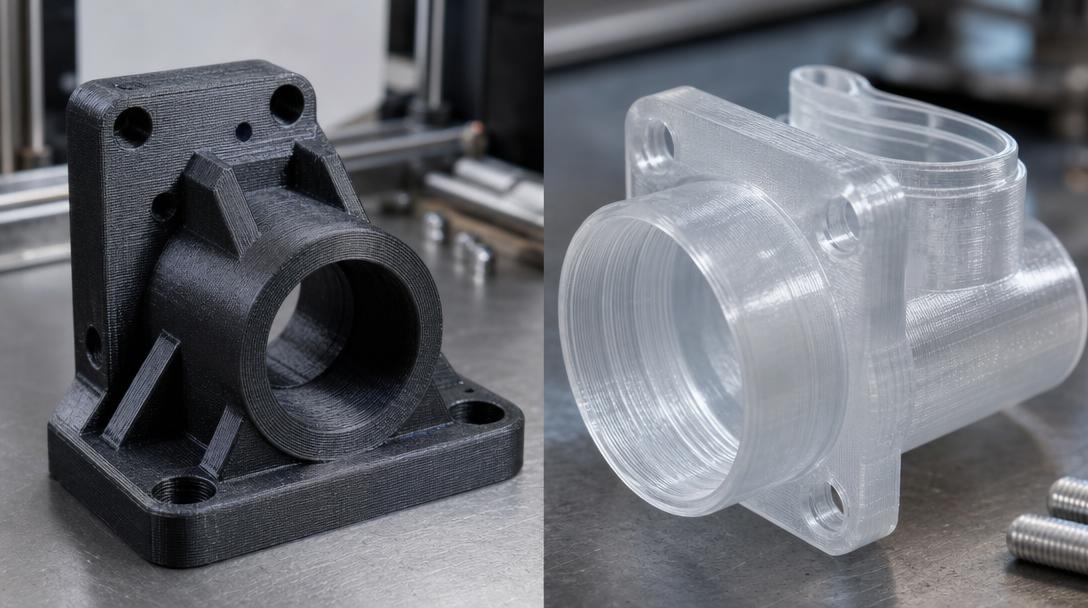

Glass Fiber Reinforced or PETG? Which Makes More Sense for Rigidity, Heat, and Dimensional Stability?
It is not only important for a part to be printed, but also how it behaves after printing. This is exactly where a serious difference in character appears between glass fiber reinforced filament and PETG. Both are sensible options for functional work in the FDM world; however, they do not serve the same need. If your part needs to be a bit more forgiving, economical, and geared toward general use, PETG stands out. If you need to print a part that is more rigid, more dimensionally stable, and calls for an engineering-oriented approach, glass fiber reinforced options may make more sense.
If you are having trouble deciding on a material, especially during the project stage, it is worth remembering that material selection directly affects part life when getting a professional 3D printing service. When evaluating cost, it is also healthier to think in terms of price per gram rather than memorized figures. To quickly see how your file may turn out in different materials, the online 3D printing page is also a good place to start.
What is it good for, and what is it not good for?
PETG is a versatile option for everyday functional parts. It delivers balanced results in boxes, lids, fixtures, hangers, protective parts, and light mechanical applications. It can be used without being as brittle as PLA; at the same time, it is not as temperamental as ABS. On the other hand, it would not be right to expect extremely high rigidity or long-term high heat resistance from PETG.
Glass fiber reinforced filament, on the other hand, becomes more meaningful in parts where rigidity, dimensional consistency, and a structural feel are desired. It can be attractive for fixtures, assembly jigs, body components, or technical parts that need to hold their shape. Even so, it is not the right candidate for parts that need to flex heavily, will constantly deform under impact, or are expected to behave softly.
Rigidity and impact behavior
One of the clearest differences between these two materials is the feeling of rigidity. Compared with PETG, a glass fiber reinforced structure generally offers not a tougher but a harder and more stable character. In other words, when you hold it in your hand, you can expect a part that flexes less and holds its shape better. This feature is especially important in fastening and load-bearing parts where dimensional deviation causes problems.
PETG is a bit more forgiving at this point. Its ability to flex to some extent can sometimes be an advantage under sudden loads. For this reason, PETG may be a more balanced choice for protective parts exposed to impact but not requiring absolute rigidity, or for everyday-use products. In short, if rigidity is your priority, glass fiber reinforced makes more sense; if you want controlled flexibility, PETG is the better choice.
What is the difference in heat and outdoor use?
PETG is in a safer zone than PLA when it comes to temperature; however, that does not make it the natural winner for high-heat applications. Under sunlight, inside a vehicle, or in use near a hot environment, PETG usually performs more safely than PLA, but it still has limits depending on the application.
With glass fiber reinforced materials, performance varies depending on which base polymer the reinforcement is added to. For this reason, it is not correct to generalize every glass fiber reinforced filament as a “high-heat material” on its own. Still, the general tendency is that this class addresses more technical expectations than PETG in terms of dimensional stability and structural stability. If your target is outdoor and engineering applications, it is better to look at the options on the engineering materials 3D printing page.
Ease of printing and cost logic
One of PETG’s biggest advantages is accessibility. It produces good results in many parts, offers a more predictable process for the average user, and is usually easier to justify in overall cost terms. It works across a wide range, from prototypes to end-user parts.
Glass fiber reinforced materials generally require a more niche decision. Print infrastructure, nozzle durability, and target performance become more important. In other words, this material should not be chosen just because it “looks more professional,” but because there is a real need for it. If part requirements are not yet clear, it may be more rational to validate first with PETG and move up to a glass fiber reinforced alternative only if necessary.
Which one is better for which part?
- PETG: everyday fixtures, protective parts, boxes, connectors, light outdoor use, and jobs that need balanced cost-performance.
- Glass Fiber Reinforced: more rigid fixtures, assembly parts where dimensional stability matters, technical bodies with a strong structural feel, and applications that are not supposed to flex.
In summary, the choice should be made not so much by asking “which is better?” but by asking how the part is supposed to behave. If you are looking for an easier, general-purpose, and balanced solution, PETG is a strong candidate. If you want a more technical, more rigid, and more controlled character, glass fiber reinforced material stands out.


 Türkçe
 العربية
 Русский
 فارسی
فارسی Deutsch