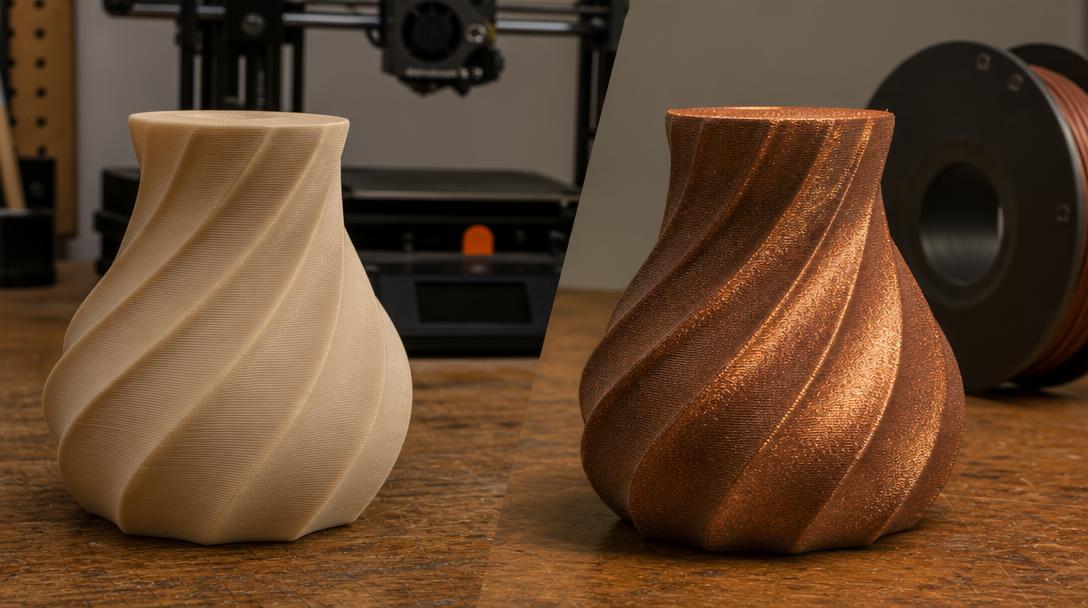

Copper PLA or PLA? Which Makes More Sense for Decorative Prints in Terms of Appearance, Weight Feel, and Printability?
When printing a decorative object, a desktop accessory, or a presentation model, one of the most common questions is this: is standard PLA enough, or does a metal-filled filament like Copper PLA really make a difference? The short answer is: both work well in FDM printing, but they do not serve the same purpose. While PLA is a more practical and economical general-purpose material, Copper PLA stands out in projects where you want stronger visual character and a fuller surface feel.
If you are considering having your part produced through a professional 3D printing service, choosing the material according to the use case reduces the risk of regretting the decision later. Because the choice here is not only about color; it is also about printability, surface effect, durability expectations, and cost logic.
What exactly does Copper PLA offer, and what does PLA offer?
PLA is one of the most accessible filaments thanks to its clean printing behavior and wide range of uses. It is often sufficient for presentation prototypes, scale models, figures, boxes, light fixtures, and visual samples. Copper PLA, on the other hand, is usually a special material based on PLA with a metal-like filler added. For this reason, it should not be thought of as a real metal part; its main advantage is its metallic appearance, a slightly fuller surface feel, and its decorative effect.
In other words, if the goal is not mechanical performance but a more distinctive-looking surface for a display case, office, or product presentation, Copper PLA can be a meaningful choice. On the other hand, if it is more important for the part to be printed quickly, cleanly, and with low risk, standard PLA is the more sensible option for most projects.
Where does it work well, and where does it not?
Suitable uses for PLA
- Visual prototypes
- General-purpose desktop parts
- Fast samples and form-validation work
- Small-scale batch production with lower risk
Suitable uses for Copper PLA
- Decorative objects
- Display parts intended to give a metallic feel
- Awards, plaques, figurines, and stage accessories
- Prints where a more distinctive surface is desired without paint
By contrast, neither material is considered the ideal first choice for parts exposed to high heat, heavy impact, or long-term outdoor use. In particular, even though Copper PLA includes the word “copper” in its name, it is not structurally a substitute for a real copper part; for applications such as bearings, hinges, high-load connections, or fixtures used in hot environments, expectations should be set correctly.
Is there a difference in heat resistance, outdoor use, and durability?
In general, both materials are evaluated within the limits of the PLA family. This means the following: you should be cautious when considering them for a hot car interior, an outdoor part left under the sun, or equipment used near heat. Copper PLA has decorative advantages, but that does not automatically make it a better material for outdoor use or high-temperature conditions.
In terms of impact resistance and brittleness, you should not expect a dramatic miracle over standard PLA either. Some formulations may feel slightly tougher or harder, but in most cases the main decision criterion is not mechanical superiority but surface appearance and intended use.
Printability and cost logic
PLA is generally a more predictable, smoother, and faster-moving option. This provides an important advantage especially in larger-quantity jobs, short delivery times, or orders where a low error risk is desired. Copper PLA, however, is a special-effect material, so it is not necessary for every project. If it will not provide a visual benefit, choosing it just so the part “looks more premium” may not be very logical in terms of cost.
At this point, instead of memorizing exact figures, it is more accurate to look at the logic of the price per gram. Because if the same geometry can already give very good results with standard PLA, moving up to a specialty filled material is not always necessary. To see how your file is priced according to its material and geometry, getting an instant quote can also speed up the decision process.
Which one is more suitable for which part?
- Presentation prototype, scale model, box, light fixtures: PLA
- Decorative figurine, plaque, display object, metallic-looking accessory: Copper PLA
- Part that will be painted later and where surface effect is not critical: PLA is usually sufficient
- Part that will be used unpainted and where the material’s own appearance will stand out: Copper PLA can be more impressive
If you want to see different options together, the our printing materials page can also make the decision easier.
In short, the choice between Copper PLA and PLA is more about purpose than strength. If your part needs to be functional, fast, and economical, PLA is a strong default choice. If you want the part to look “special” at first glance and to give a slightly heavier, fuller feel, Copper PLA starts to make sense. So the real question is not “which one is better?” but “what kind of effect do you want from which part?”


 Türkçe
 العربية
 Русский
 فارسی
فارسی Deutsch