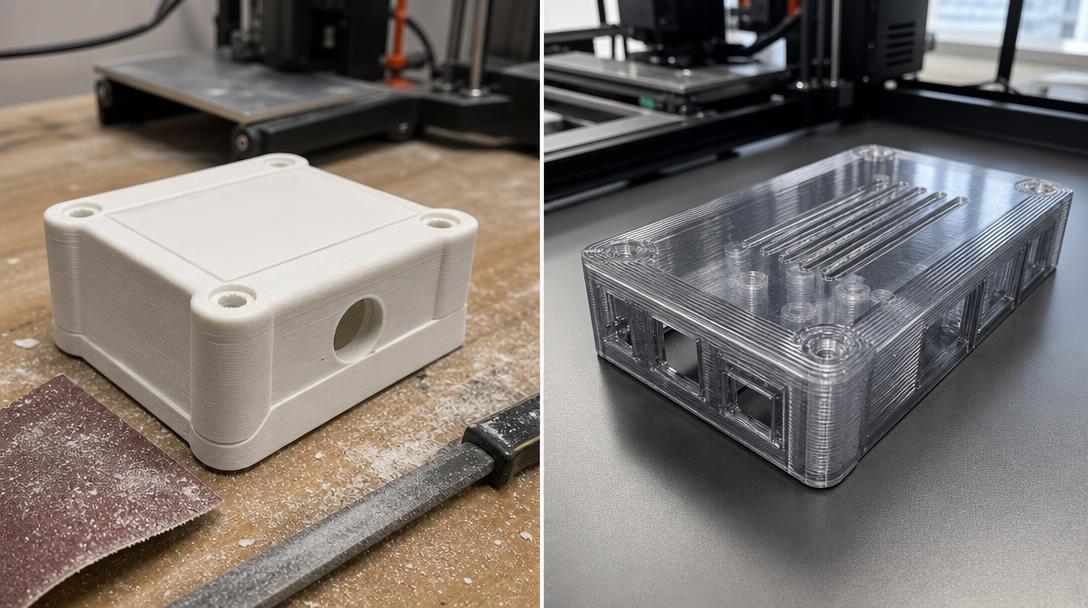

HIPS or PETG? Which Makes More Sense for Boxes, Prototypes, and Everyday Functional Parts?
In FDM printing, HIPS and PETG are not often discussed together; however, both are sensible options for certain types of parts. When making the decision, looking only at “which one is stronger” is often not enough. It also matters whether the part will be used outdoors, whether it will take impacts, whether a bit of flex is desirable, what kind of surface appearance is needed, and how smooth the printing process will be. If you want to evaluate your design through a 3d printing service before moving into production, making the right choice between HIPS and PETG has a direct effect on the overall result.
Let’s start with a short summary: PETG offers a broader safety margin for general-purpose functional parts. HIPS, on the other hand, is especially meaningful for matte surfaces, easy post-processing, and certain support/prototype scenarios. For that reason, it is more accurate to choose the material according to the type of part.
What is it good for, and what is it not good for?
PETG is often preferred for boxes, fixture bodies, protective covers, connector parts exposed to light impact, and products for daily use. Because it is less brittle than PLA and usually provides more reliable layer adhesion, it becomes a well-balanced option. On the other hand, it may not always be the first choice for very demanding environments such as car interiors with high heat exposure, or for very rigid engineering parts.
HIPS, meanwhile, can stand out for lightweight, machinable, and relatively tough prototypes; paintable mock-ups; presentation parts where a matte surface is desired; and as a support material in some dual-extrusion jobs. In contrast, it is better to be cautious with parts expected to face long-term outdoor use, intense UV exposure, or high heat. Also, when used on its own, it may not deliver the same easy “plug-and-play general-purpose material” comfort that every customer expects as easily as PETG can.
The difference in outdoor use and heat resistance
If the part will sit by a window, on a balcony, in a garden, or in a semi-open area, PETG is the more sensible choice in most cases. It behaves in a more balanced way against moisture and everyday environmental exposure. Still, for direct sun, summer heat, and long-term UV exposure, more specialized solutions such as ASA may need to be considered. At this point, it is useful to compare general material alternatives on the our printing materials page.
It would not be correct to say HIPS is completely unusable; however, if the goal is long service life outdoors, PETG usually stays on the safer side. On the heat side as well, HIPS can do the job in some prototypes, but as temperatures rise, the design geometry and duration of use become more important in the decision. In other words, a desktop prototype for short-term use is one scenario, while a constantly hot environment is a different one.
The balance of impact resistance, rigidity, and flexibility
One of PETG’s strongest sides is that it provides a reasonable balance between stiffness and slight flexibility. If you want the part to be fully rigid but not crack at the first impact, PETG is often the sensible choice. This balance matters in cable holders, covers, boxes, hanging brackets, or connectors carrying light loads.
HIPS, on the other hand, can feel more “tough” in some applications and may offer an advantage in prototypes that need sanding or machining afterward. However, expecting a very clear mechanical superiority would not be correct, because final performance is also seriously affected by the design, wall thickness, and print settings. If a part will work under continuous load, you need to consider not only the material but also the geometry.
Printability and cost logic
Today, PETG offers a more predictable production flow for many workshops. With the right settings, it gives clean results; however, stringing can occur. On the HIPS side, environmental control and part geometry may be more decisive. In short, for everyday functional jobs where a smooth serial workflow is desired, PETG is often the more operationally comfortable choice.
On the cost side, it would not be correct to give a memorized number. That is because print time, support requirements, waste rate, and post-processing time all change the overall picture. For this reason, the decision should be evaluated not only by the filament name, but together with the logic of price per gram and production difficulty. If your file is ready, making a quick cost comparison through the online 3d printing tool can also make the decision process easier.
Which one for which part?
- Choose PETG: boxes for daily use, protective covers, functional parts exposed to light impact, fixtures that come into contact with moisture, and general-purpose production.
- Choose HIPS: matte-surface prototypes, presentation parts that will be processed afterward, some support-focused scenarios, and jobs where appearance matters more than mechanical limits.
- Avoid both: for parts exposed to high heat for long periods or heavy outdoor stress, depending on the application, it may be better to consider more specialized engineering materials.
In conclusion, there is no “single right” material. If your goal is to make a safer and more general-purpose choice for an everyday functional part, PETG stands out for most users. If the goal is to produce a machinable, matte-looking, presentation-oriented prototype, HIPS can be a sensible option. The best decision comes from clearly defining the part’s real usage conditions from the start.



 Türkçe
 العربية
 Русский
 فارسی
فارسی Deutsch