SWISSto12 and Mitsubishi Electric Partnership: 3D-Printed Satellite Antennas Open Up the Asia-Pacific Market
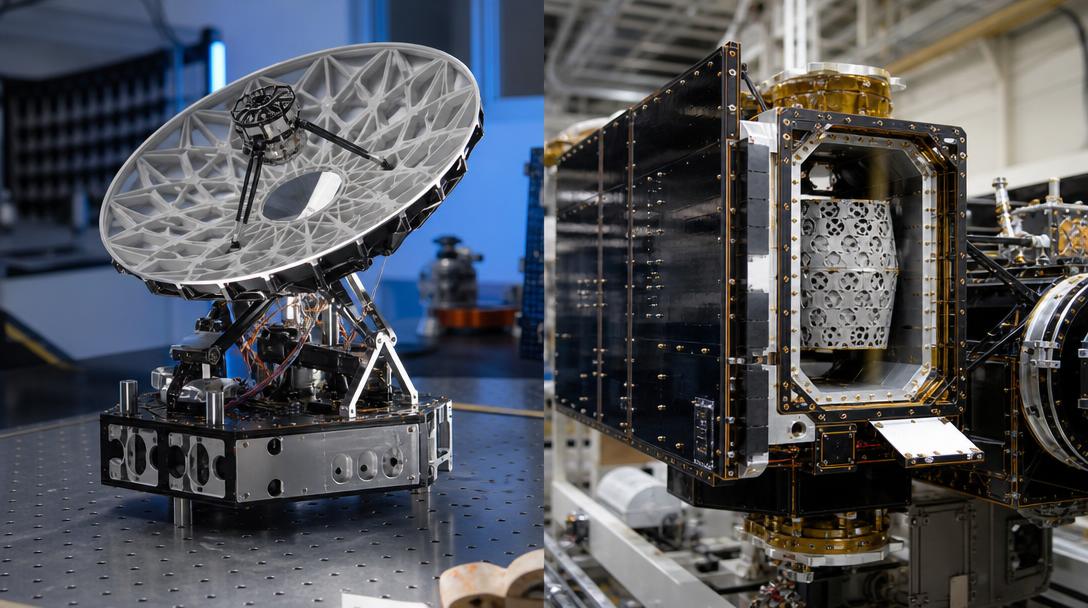
In satellite communications, 3D printing is no longer merely a method for speeding up prototype production; it also plays a role in developing RF components used in missions. Switzerland-based SWISSto12 and Mitsubishi Electric Corporation (MELCO) announced on 15 September 2026 that they had signed a strategic memorandum of understanding covering advanced satellite payloads, radio frequency products, and market opportunities in Japan and the Asia-Pacific region.
Source and date: The news was published by TCT Magazine on 15 September 2026. This article is not a product sales announcement; it reports an industry development in which the two companies will combine their expertise to explore new satellite and RF applications.
What is at the heart of the partnership?
MELCO will contribute its satellite systems and integration capabilities, while SWISSto12 will contribute its proprietary 3D-printing designs and manufacturing processes. According to TCT, SWISSto12’s 3D-printing-based production approach forms the foundation of the company’s next-generation payloads. The company also says that more than 2,000 of its products are currently in orbit and that use of the HummingLink platform is growing.
Alongside the memorandum, MELCO has also awarded SWISSto12 a contract to supply advanced phased-array antenna products for the Japanese government’s secure communications programme. This information shows that the development is not merely a laboratory-level joint research project; it is linked to a specific space communications application. However, the announcement did not disclose a delivery schedule, quantity, or contract value.
Why does this matter to FDM readers?
The production process described here should not be placed in the same category as desktop FDM filament printing. The technology referred to by SWISSto12 combines specialised design and 3D-printing processes for satellite and RF components. Even so, the news offers an understandable example of how additive manufacturing can create value in parts that demand high performance.
- Geometric freedom: In antennas and RF components, internal channels, complex surfaces, and lightweight structures can be important from a design perspective. 3D printing can provide an opportunity to produce these geometries while reducing traditional manufacturing steps.
- Satellite-specific production: Payloads and antennas may not have the same dimensions or functions on every mission. Connecting digital design to production makes sense for low-volume, mission-specific parts.
- Integration impact: In addition to design, testing, system integration, and qualification are required. This is why the combination of MELCO’s satellite systems experience and SWISSto12’s manufacturing approach is significant.
Lessons for Ucuz3D
This news does not mean that 3D printing automatically makes every part suitable for mass production. In a satellite environment, material selection, electromagnetic performance, vibration, temperature cycling, and quality verification must each be addressed separately. Therefore, it would not be right to directly compare an ordinary part printed on a desktop printer with space hardware.
Nevertheless, the decision-making logic can be adapted to FDM projects: You need to consider not only the part’s shape, but also its operating environment, dimensional stability, weight target, and testing requirements. When evaluating suitable production methods for everyday prototypes, jigs, or enclosures, you can review the 3D printing service options. If you are considering material selection together with your budget, examining the price per gram approach provides a healthier starting point than looking only at the price per kilogram. If your file is ready, you can make a quick preliminary assessment of your part with the online 3D printing tool.
The smaller-scale equivalent of this approach is to clarify the requirements before producing the part. Producing a model that is merely visually similar is not the same task as validating a part that carries a load, is exposed to heat, or requires precise dimensions. When design, material, and print orientation are not evaluated together, a part that looks successful at first glance may show deformation earlier than expected during use.
To see the applications and key differences of FDM materials, you can visit the our printing materials page. In summary, the SWISSto12–MELCO partnership shows that in the space sector, 3D printing is not a production trick in isolation; it is a manufacturing component that gains value when combined with antenna design, RF performance, and system integration.



 Türkçe
 العربية
 Русский
 فارسی
فارسی Deutsch