Creality K3 Unveiled: What Is the New FDM Printer Series Changing in Multicolour Production?
Creality introduced the K3 model and new products such as the SPARKX i8 at IFA 2026. The 3D Printing Industry report dated 15 September 2026 presents the announcement not merely as the launch of a new printer, but as a move by Creality to expand its desktop manufacturing ecosystem. The company’s PR Newswire announcement dated 5 September 2026 also highlights the K3, SPARKX i8 and creative production tools together.
Why is this development important for Ucuz3D readers? Because competition in desktop FDM is no longer based solely on build volume or nominal speed. Multicolour printing, filament management, software workflow and a product family designed for different levels of user experience are also becoming part of the decision. The K3 announcement shows Creality’s approach of building an interconnected manufacturing ecosystem rather than offering just one printer.
What stands out about the Creality K3 announcement
The K3’s presentation at IFA 2026 shows that Creality is positioning its next-generation desktop FDM products on a more visible platform. However, promotional statements in a launch announcement should not be confused with independent long-term test results. Actual print quality can vary depending on the filament profile used, bed calibration, model geometry, nozzle selection and environmental conditions.
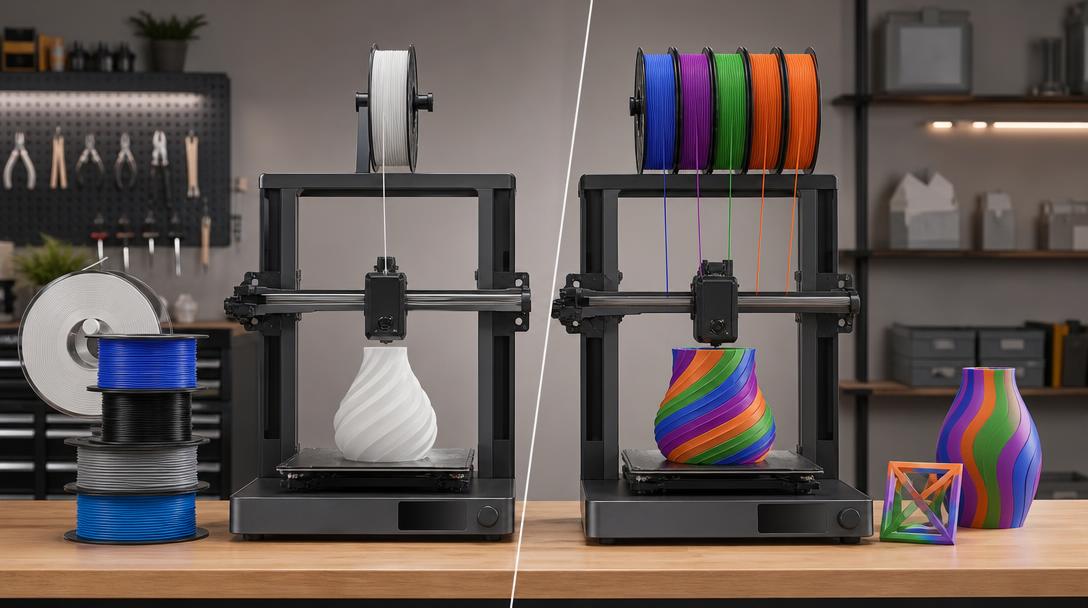
The SPARKX i8 is presented as another part of the same ecosystem, with the aim of reducing waste in multicolour FDM printing and colour changes. This approach may be particularly appealing to users producing decorative models, personalised products and small batches. However, in multicolour systems, spool changes, colour transitions, purge movements and slicing settings can affect total production time. Increasing the number of colours does not automatically mean more efficient production for every project.
What it means in practice for FDM users
When evaluating a new printer such as the K3, the first question should be what part the machine will produce. For simple prototypes, dimensional checks and visual experiments, an FDM workflow that is easy to configure may be more valuable. For functional fixtures, connectors or parts intended for outdoor use, material compatibility, the need for an enclosed body, bed adhesion and part orientation become more critical.
- Prototype: rapid iteration, easy profile management and a low failure rate are priorities.
- Multicolour model: the duration of colour transitions, purge movements and waste management should be assessed together.
- Functional part: the filament type, layer orientation, wall count and design tolerance matter just as much as the printer.
- Small-batch production: repeatability, spool tracking and process standardisation become more important.
Before buying a new device, requesting sample prints using your own parts is the safest way to compare promotional data with your real-world expectations. If you plan to print a dimensioned fixture, enclosure or replacement part instead of a ready-made model, you can review our printing materials and choose the material according to the part’s function.
Should you buy the Creality K3?
At this stage, the most accurate answer depends on whether the K3 fits the workflow you are targeting. If multicolour production and the Creality ecosystem are important to you, the new model appears worth following. On the other hand, if you produce only single-colour, low-volume and rapid prototypes, improving the print profiles of your existing FDM printer may be the more rational choice. The decision will become clearer as independent reviews, long-duration print results and real user experiences are published.
For those who want to produce parts without owning a printer, the 3d printing service option offers a practical solution, especially for one-off prototypes or pre-purchase samples. When planning production, you can also assess the price per gram model and the effect of part geometry on the total cost. If your file is ready, you can start the workflow through online 3d printing.



 Türkçe
 العربية
 Русский
 فارسی
فارسی Deutsch