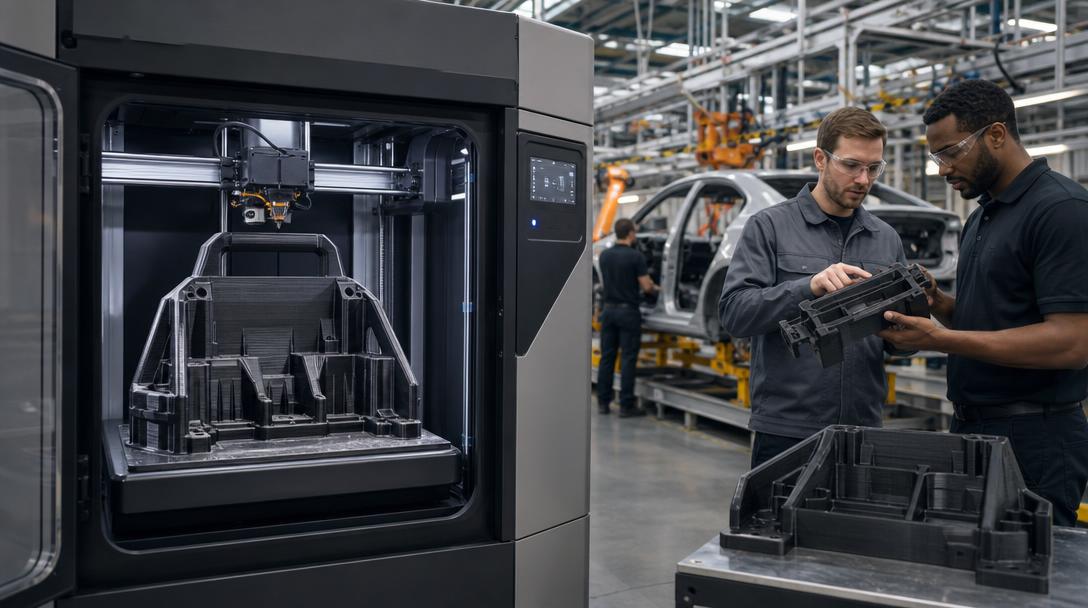
GM Shows a New Automotive Milestone by Expanding Stratasys FDM Printing Across Its Production Network
General Motors is reported to have adopted Stratasys FDM 3D printing technology across its production network. A Design News report dated September 15, 2026, presents the development not as a single prototype application, but as an approach being extended across different facilities in automotive manufacturing. This indicates that additive manufacturing is taking on a more established role not only in design offices, but also in the day-to-day needs of production operations.
Automotive production lines are constantly changing. A new model, a revised part, a different assembly sequence, or an ergonomic improvement may require new fixtures and auxiliary equipment within a short period of time. For suitable designs, FDM printing can shorten the path from a digital file to a physical part for these kinds of needs. Especially for low-volume or frequently revised parts, avoiding the need to wait for molds and lengthy procurement processes after every change can provide significant flexibility.
Why is GM’s move important?
The main message of the report is that 3D printing is moving beyond a single trial project and being distributed across the production network. When a technology begins to be used at different facilities and in different workflows, standardization, training, material management, and quality control become more important. In other words, success depends not only on the printer producing a part, but also on selecting the right part, preparing the design for manufacturing, and ensuring that the resulting part performs its intended function reliably.
Parts that can be produced with FDM may include prototypes, assembly aids, inspection fixtures, cable-routing components, and ergonomic handles. However, the same filament is not the right choice for every part. If continuous loads, impact, temperature, chemical contact, or dimensional stability are factors, the material and print orientation should be evaluated together. Producing a small-scale validation print for a fixture to be used on a production line can also reduce risk.
What advantages does this approach offer?
- Shorter iterations: When the design changes, a new fixture or prototype can be tested quickly.
- Low-volume flexibility: Producing only the number of parts needed can reduce inventory pressure for some specialized tools.
- Digital inventory: Files for frequently used parts can be stored so that remanufacturing can be planned when needed.
- Ergonomic testing: Handles and auxiliary components can be revised according to how workers use them on the line.
These advantages do not mean that FDM printing will replace traditional manufacturing in every situation. Different methods may be more suitable for high-volume parts with very tight tolerances. In addition, print time, support removal, surface finishing, dimensional inspection, and reprinting when necessary should all be included in the total cycle time. Looking only at machine speed when making a production decision can be misleading.
What does this mean in practice for Ucuz3D readers?
The GM example also offers a way of thinking that can be applied in workshops and small businesses: First define the part’s function, then choose the material and production method. While an easy-to-process filament may be sufficient for a simple protective component or prototype, an engineering material may be necessary for a fixture exposed to heat and impact. The number of walls, connection areas, print orientation, and need for supports should be checked from the beginning of the design process.
If you would like to evaluate the right production method for your part, you can visit the 3D printing service page. When considering weight and production time together, the price per gram approach provides a useful starting point. If your file is ready, you can use the instant pricing process. You can also review the engineering materials 3D printing page for technical parts and filament options.
In conclusion, GM’s expansion of Stratasys FDM use across its production network demonstrates the value of 3D printing in automotive manufacturing within a broader operational framework than individual prototypes. When suitable part selection, validation, and material knowledge come together, FDM can provide agile, repeatable auxiliary tools for production lines that can be updated as needs evolve.



 Türkçe
 العربية
 Русский
 فارسی
فارسی Deutsch