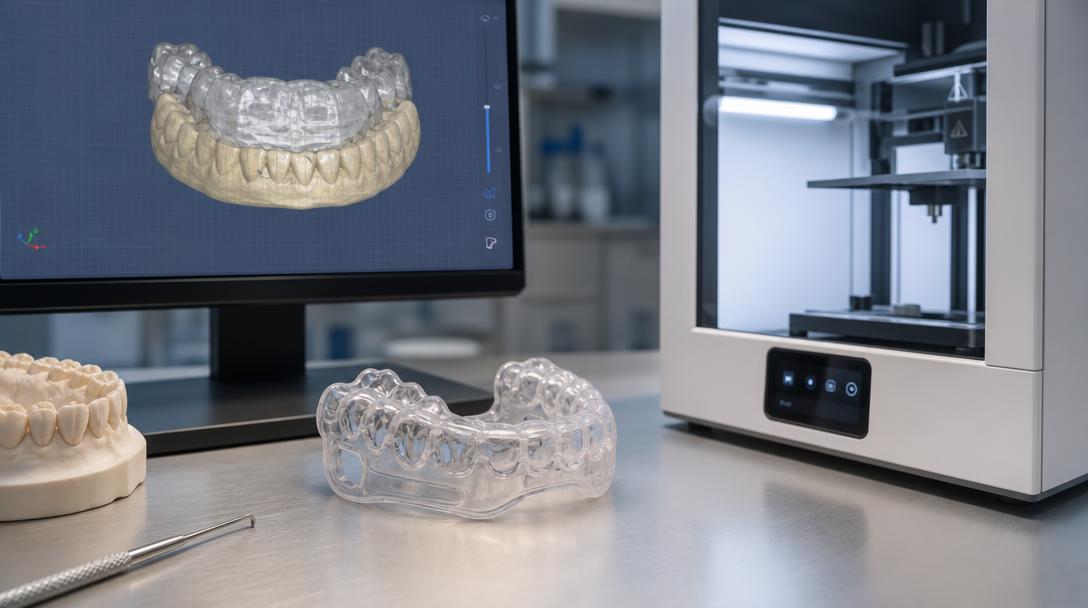
Kallisio’s 3D-Printed Stentra Device Expands Patient Access in Head and Neck Radiotherapy
Kallisio has announced a new access program to make it easier for patients undergoing radiotherapy for head and neck cancer to access a personalized intraoral fixation device. Announced by the company on September 14, 2026, the program aims to make the 3D-printed Stentra device, produced from digital oral scans, available to eligible patients at treatment centers that do not yet use this solution.
The TCT Magazine report, which is the source of this news, states that Stentra received FDA 510(k) clearance K232293 from the U.S. Food and Drug Administration and is already in clinical use at some cancer centers. A recently announced partnership with Stanford Health Care also indicates that this area of use is expanding. The important point here is that the device is not a general-purpose appliance, but an assistive solution prepared according to each patient’s oral anatomy.
How does Stentra work?
Stentra is prepared based on a digital dental scan of the patient’s mouth. During radiotherapy sessions, it helps keep the tongue, lips, and other intraoral structures in a similar position. This approach is intended to support the more consistent delivery of radiation to the planned treatment area while keeping healthy tissue as far as possible from the high-dose region.
This type of application shows that 3D printing is not limited to producing prototypes or visual models. Converting digital measurements into patient-specific geometry can enable healthcare teams to establish a more direct production process instead of adapting the same mold for every patient. However, the device’s clinical suitability, physician assessment, and the treatment center’s workflow remain decisive.
What makes the new program different?
According to Kallisio’s announcement, the patient or a family member can contact the company before treatment. The team then evaluates clinical suitability with the radiation oncologist, arranges the required digital oral scan with a local dentist, and coordinates the process so that the device can be used by the care team. If the center is not yet a Stentra provider, Kallisio will cover the cost of the device in cases deemed eligible.
This model is a reminder that, in medical 3D printing, not only printer capacity but also the scanning, design, approval, and clinical delivery chain is critical. For organizations seeking to establish a similar workflow on the production side, reviewing engineering materials and 3D printing options may help clarify the logic behind material decisions, provided they are not confused with the specific requirements of medical applications.
It is important to remain cautious about the level of evidence
Kallisio says that, in its observational case series to date, patients tolerated the device throughout treatment, daily positioning remained consistent, and no missed treatment days or interruptions caused by the device were reported. It is also reported that detailed clinical findings are being prepared for peer-reviewed publication. For this reason, it would be more accurate to view the results not as a definitive claim of clinical superiority, but as early data showing that access and practical experience are expanding.
For Ucuz3D readers, the practical takeaway from this news is that the production decision for personalized healthcare components is far more comprehensive than simply selecting a standard FDM part. Geometry, biocompatibility, cleaning, traceability, and clinical approval must all be considered together. If your organization needs prototype, fixture, or low-volume plastic part production, you can review the scope on the 3d printing service page. Reviewing the per-gram pricing model based on part weight and obtaining an instant preliminary quote through online 3d printing for your file can also make the initial evaluation easier.
Source and date: TCT Magazine, “Kallisio expands patient access to 3D-printed intraoral devices for head and neck cancer radiation therapy patients”, September 14, 2026. The news was also published by 3D Printing Industry on the same date.



 Türkçe
 العربية
 Русский
 فارسی
فارسی Deutsch