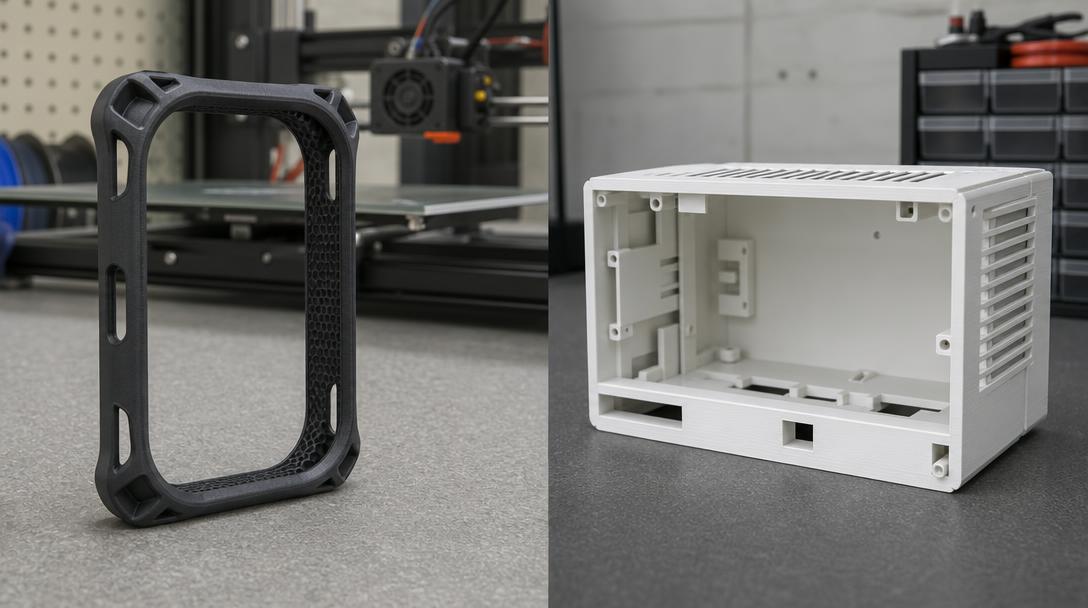
TPU or HIPS? Flexible Protection or Lightweight Prototype?
Material selection in FDM printing determines not only how a part looks, but also how it behaves during use. TPU is suited to parts that flex and absorb impact, while HIPS is better suited to more rigid, lightweight parts designed for prototyping. For this reason, the choice is less about which filament is generally better and more about what your part needs to do.
What are TPU and HIPS used for?
Thanks to its elastomeric properties, TPU is used for parts that can bend and change shape when compressed. It is a meaningful option for flexible components such as protective cases, vibration-damping feet, bumpers and gasket-like parts, as well as fixtures expected to soften impacts. Since Shore hardness can vary by product and manufacturer, different levels of flexibility may be found under the same name.
HIPS, on the other hand, can be considered for lightweight prototypes, housings, model parts and designs that require dimensional checks, thanks to its rigidity and relatively low-density structure. Although it is also used as a support material in some FDM setups, here we are discussing HIPS as the main part material. Whether the part is a load-bearing final product, as well as the printing conditions and surface expectations, should be verified separately.
Flexibility, rigidity and impact behavior
When flexibility is required, TPU is by far the more logical choice. If the part will be compressed, absorb vibration or protect surrounding components by absorbing energy during minor impacts, the rigid structure of HIPS may not be suitable. In contrast, HIPS provides a more stable feel than TPU in a box, cover or lightweight prototype that needs to retain its dimensions. While TPU’s flexibility can be an advantage in some press-fit connections, design tolerances need to be considered more carefully when precise dimensions and flat surfaces are expected.
Which one is suitable for outdoor and heat-exposed parts?
Neither of these materials should automatically be considered safe for outdoor use. TPU’s behavior under weather conditions depends on its formulation, UV exposure and whether the part remains under continuous stress. HIPS is also generally not the first choice for sunlight, temperature fluctuations and long-term outdoor use. TPU may be considered for a flexible protective part used outdoors; however, manufacturer technical data and sample testing are important for real-world applications.
When heat is involved, the material’s softening behavior, part geometry and load should be considered together. TPU may exhibit its flexibility differently as temperature changes, while HIPS may also fail to retain its rigidity as temperature rises. For parts around motors, components exposed to sunlight inside vehicles or parts near hot fluids, do not make a decision based solely on the filament name.
Printing ease and cost considerations
Because HIPS is a rigid filament, it may offer a more predictable starting point for printing than TPU for many users. TPU may require a low printing speed, a controlled filament path and a suitable extruder setup. Issues such as stringing, feeding jams or bridging performance may require more adjustment in long, flexible parts. Your printer’s compatibility with flexible filament and the material options offered by the production service should be checked in advance.
When comparing costs, consider not only the price per kilogram or gram, but also the risk of print failure, the need for supports, post-processing time and the part’s service life. A small TPU bumper can be more valuable than a cheaper rigid part when it provides the right function; for a simple prototype, however, making a quick and lightweight test with HIPS may be more rational.
Which material should you choose for each part?
- Choose TPU: for flexible cases, bumpers, vibration-damping feet, compressible protectors or parts requiring controlled deformation.
- Choose HIPS: for lightweight and rigid prototypes, housings, models, dimensional tests or parts requiring a hard surface.
- Consider another material: if high outdoor durability, high-temperature resistance or long-term heavy mechanical loading is a basic requirement.
Instead of producing the part yourself, you can share its dimensions, geometry and intended use to receive a 3D printing service. When finalizing your production decision, reviewing the price per gram approach and alternative materials can help you establish a healthier prototype budget. If your file is ready, use the calculator to get an instant price. You can also review our printing materials to see the currently available TPU and HIPS production options.




 Türkçe
 العربية
 Русский
 فارسی
فارسی Deutsch