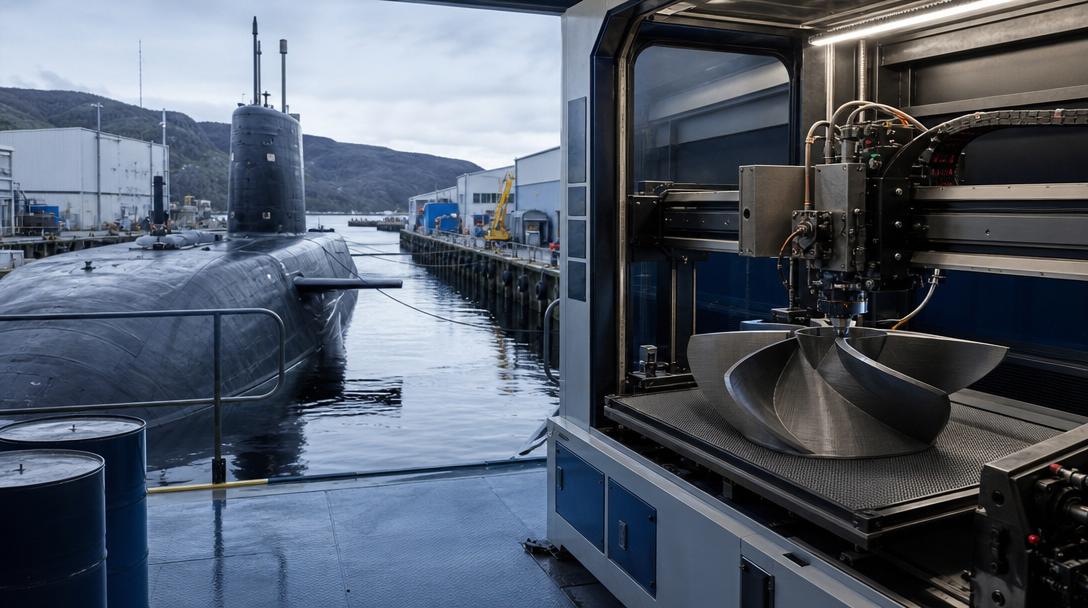

Submarine Spare Part 3D Printing: QinetiQ Sets Up a Pier-Side Facility at a Royal Navy Base
Defence technology company QinetiQ has set up a 3D printing facility that operates directly at the pier-side at HM Naval Base Clyde Faslane submarine base in Scotland. At this base, where nearly 600 personnel are stationed, the facility aims to produce and deliver parts on demand to submarines undergoing maintenance, and it is seen as a significant step forward in submarine spare part 3D printing.
The AM All In One Solution and the Market Access Cell
The facility was established under two separate contracts held by the Submarine Delivery Group (SDG) team. The Additive Manufacturing All In One (AIO) solution is described as a UK-specific point-of-need manufacturing capability. The Market Access Cell (MAC), meanwhile, handles reverse engineering and supply chain management for more complex parts. Together, the two structures promise a fundamental transformation in submarine maintenance processes:
- On-site production: Parts can be manufactured directly at the base by QinetiQ personnel and Royal Navy submariners.
- Reverse engineering network: More complex components are produced through an accredited network of UK SMEs that includes expertise from sectors such as Formula 1.
- Rapid supply: Maintenance times are reduced by lessening reliance on traditional supply chains.
Part of the Submarine Maintenance Recovery Plan
The Clyde facility was brought to life as part of the Submarine Maintenance Recovery Plan (SMRP), launched in January 2026 by First Sea Lord General Sir Gwyn Jenkins. General Jenkins said, “The arrival of these deployable workshops has the potential to transform submarine maintenance. This technology can increase the availability of the submarine fleet by shortening maintenance times.”
SDG Additive Manufacturing Lead Commander Max added: “Enabling engineers to produce parts on-site reduces reliance on complex supply chains and accelerates repair times. This in turn improves the submarine’s material state and availability.”
Materials Used in Submarine Parts
Parts used in demanding environments such as submarines must offer high strength, corrosion resistance and heat tolerance. Using FDM technology, engineering materials such as polycarbonate (PC), nylon (PA) and carbon fibre reinforced filaments make it possible to produce spare parts that meet these requirements. Especially on hard-to-reach platforms like submarines, the ability to manufacture at the point of need provides a major logistical advantage. Beyond the defence industry, similar materials and processes are used for industrial spare part needs.
Speed Gains Already Proven
QinetiQ’s expertise in this field was proven in early 2026 during the maintenance period of the submarine HMS Anson in Perth, Australia. Critical parts were designed and produced in four weeks — a significant speed gain compared with standard supply chain timelines. This achievement clearly demonstrates the advantages that 3D printing brings to spare part production.
In the defence sector, 3D printing continues to transform spare part supply. The same logic applies to civilian projects: whenever you need a prototype or a spare part, you can calculate the price instantly and get a fast solution with FDM 3D printing. We are by your side with our FDM production experience, particularly for defence and industrial projects. With FDM technology, we can produce in engineering materials such as polycarbonate, nylon and carbon fibre reinforced filaments, working at every scale from prototype to serial production. Upload your design and get a quote in minutes. We can also assess similar materials and processes for your project and determine the most suitable solution together.


 Türkçe
 العربية
 Русский
 فارسی
فارسی Deutsch