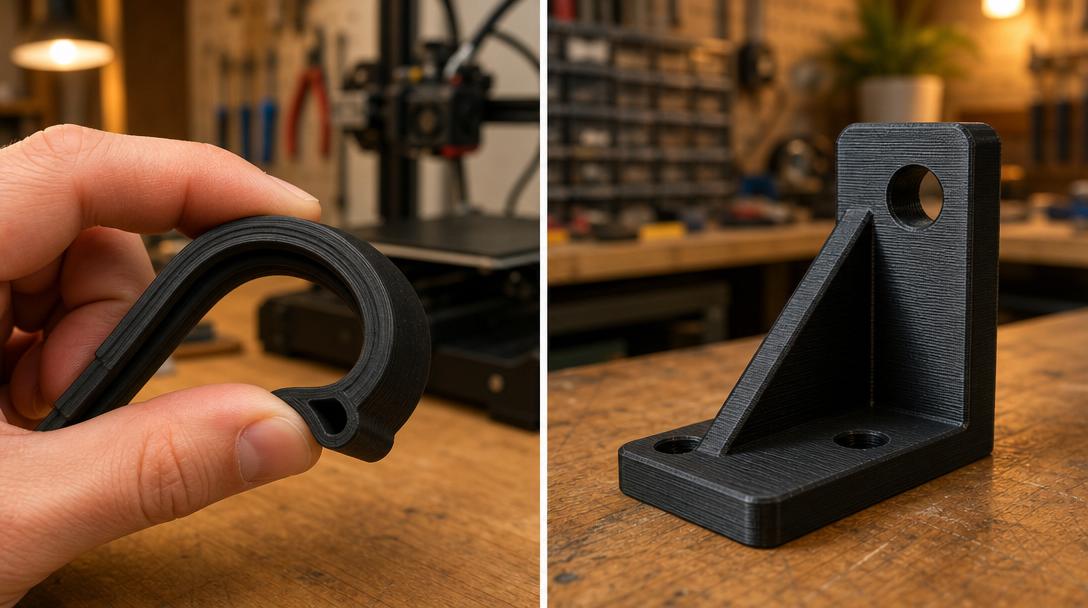

TPU or PLA? Should the Part Be Flexible or Rigid?
When starting a 3D printing project, one of the most critical decisions is the answer to the TPU or PLA question: should the part be flexible or rigid? In short: if you need flexibility, impact absorption, or sealing function, go with TPU; if you need rigidity, dimensional stability, and easy printing, PLA is the right choice. Both materials can be processed under Ucuz3D’s 3D printing service and offer solutions for different needs.
When to Use TPU?
TPU (Thermoplastic Polyurethane) is the most common representative of flexible filaments. With options ranging from 80A to 98A on the Shore hardness scale, it offers a wide range of uses from soft gaskets to relatively rigid bumpers. Thanks to its flexible structure, it is ideal for parts that need to be bent or compressed repeatedly.
Situations where TPU excels:
- Gaskets and sealing elements: Lid gaskets, dust seals, or applications requiring waterproofing
- Protective covers and bumpers: Impact-absorbing parts for drones, RC vehicles, or electronic devices
- Flexible connection elements: Anti-vibration feet, cable grommets
- Wearable parts: Straps, bracelets, or grip coatings requiring a soft touch
With Ucuz3D’s TPU flexible printing service, you can have such parts manufactured in professional quality and benefit from all the advantages of flexible material.
When to Use PLA?
PLA (Polylactic Acid) is the most common and easiest-to-process material in 3D printing. With its rigid structure, low shrinkage, and wide range of color options, it is the top choice for both beginners and professionals. Areas where PLA excels:
- Prototypes and concept models: Designs requiring quick validation
- Decorative and display pieces: Detailed models, miniatures, figurines
- Mechanical fixtures and apparatus: Light-load jigs, assembly aids
- Boxes and enclosures: Rigid body parts for electronics projects
PLA is the first choice for many projects due to its balance of rigidity and cost-effectiveness. Thanks to our transparent per-gram pricing, you can clearly see your PLA printing costs upfront and plan according to your budget.
TPU vs PLA Comparison
Let’s briefly summarize the key differences between the two materials:
- Flexibility: TPU high (bendable, compressible) — PLA low (rigid, brittle)
- Impact resistance: TPU very high (absorbs impact, won’t tear) — PLA medium (may crack under sudden impact)
- Ease of printing: TPU difficult (slow speed, direct drive recommended) — PLA very easy (compatible with any printer and settings)
- Heat resistance: TPU resistant up to about 120°C — PLA starts to soften at around 55-60°C
- Cost: TPU significantly more expensive than PLA — PLA is the most economical FDM material
These differences show that material selection directly depends on the part’s operating conditions. A part manufactured with the right material may not perform the same function if made with the wrong choice.
Make the Right Decision
You can clarify your choice with these questions: Will the part be bent or compressed after printing? If yes, TPU. Will it be subjected to constant impact? Again, TPU. Does it need to stay rigid, hold dimensions, and be cost-effective? Then PLA. Do you need a highly detailed and smooth surface? PLA performs better in this regard.
If you’re not sure, you can see the cost difference for both materials by calculating your price instantly on Ucuz3D, and get the right guidance by specifying your needs when placing an online 3D printing order. You can also check out our guide on TPU and flexible filament applications to decide which material suits your project more easily.


 Türkçe
 العربية
 Русский
 فارسی
فارسی Deutsch