
Direct Drive vs Bowden Differences: Which Extruder System Is Right for Flexible Filament?
Anyone stepping into 3D printing with flexible filaments like TPU faces a nagging question: Bowden or direct drive? While both seem to do the same job, the difference between them directly determines printing success when it comes to flexible materials. In this article, we explain the direct drive vs Bowden differences, how each system works, and which one is better suited for flexible filament — all in plain language.
Bowden System: Remote-Controlled Extruder
In a Bowden system, the extruder motor is separated from the print head and mounted on the frame. A long PTFE tube (Bowden tube) carries the filament between the motor and the nozzle to push it into the hotend. The advantage of this design is that it keeps the print head lighter — a lighter head moves faster and reduces vibration during high-speed printing. Many popular brands (Creality Ender series, Prusa Mini, Bambu Lab models) use Bowden architecture.
However, the Bowden system’s weakness with flexible filaments is clear: soft materials like TPU tend to buckle and jam as they travel through the PTFE tube. Pushed over a long distance, the filament loses feed consistency, especially with low Shore hardness TPU (85A and below), causing the extruder gear to lose its grip on the material during printing.
Direct Drive: Direct Contact, Short Path
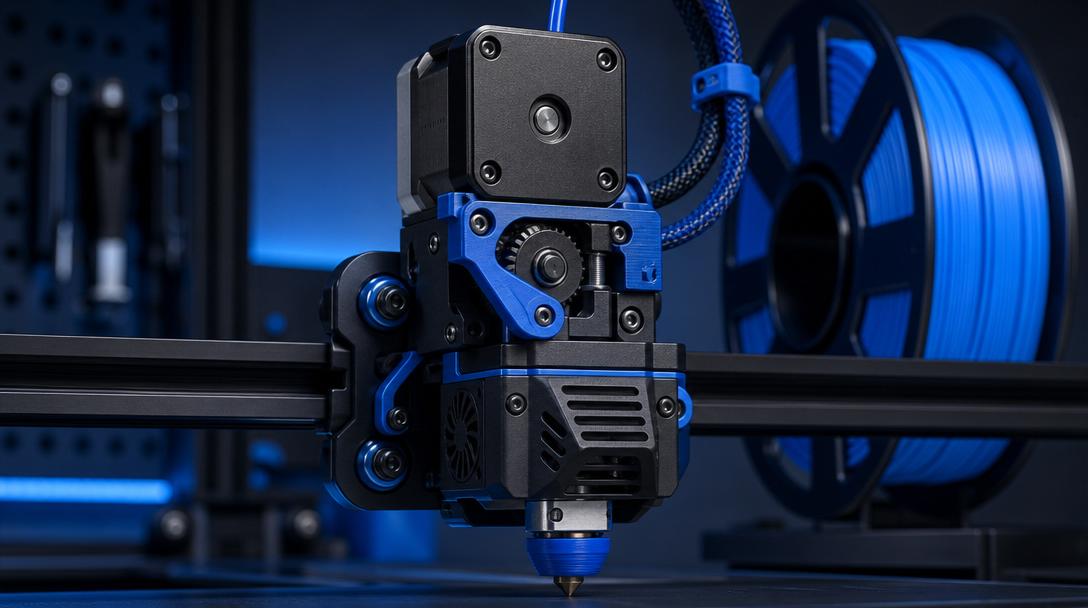
In a direct drive system, the extruder motor is mounted directly on top of the hotend. The distance the filament travels from the motor to the nozzle is no more than a few centimeters. This short path is the biggest advantage for flexible filaments: the material enters the melt zone right after leaving the feed gear, reducing the risk of buckling and jamming to nearly zero.
The downside of direct drive is head weight. Since the motor sits on the head, the total weight increases noticeably compared to Bowden. This raises the risk of ghosting and oscillation during high-speed printing. However, with modern lightweight motor options (NEMA 14, NEMA 17 pancake) and compact hotend designs, the gap is gradually closing.
Which One Is Better for Flexible Filament?
Short answer: Direct drive. With highly flexible filaments like Shore 85A and below TPU or TPE, achieving consistent results on a Bowden system is very difficult. Direct drive, on the other hand, enables trouble-free printing with the same materials. Stiffer flexible filaments (such as Shore 95A TPU, TPU 98A) can be printed with Bowden too, but retraction settings need to be tuned precisely.
Another advantage of choosing direct drive for flexible filament printing lies in retraction settings. On Bowden systems, the distance is long so retraction must be set to high values like 4-6 mm; on flexible filament, such long retraction can cause material jamming. On direct drive, 1-2 mm retraction is sufficient and stringing control is much easier.
So What Should You Choose?
You can base your decision on these criteria:
- If you’ll primarily print flexible filament (TPU/TPE) — Direct drive is a must. Especially for parts like gaskets, cases, and bumpers, success with flexible TPU printing directly depends on your system choice.
- If you’ll work speed-focused with rigid filaments like PLA, PETG, ABS — The Bowden system is more stable at high print speeds thanks to its lighter head.
- If you’ll use both in a balanced way — Quality Bowden systems like the Prusa i3 MK4 or Bambu Lab P1S can comfortably print 95A TPU; only go for direct drive with very soft Shore values.
If you’d like to convert your printer, many brands offer upgrade kits — you can install a direct drive kit on your existing Bowden printer and enjoy the best of both worlds.
In conclusion: The direct drive vs Bowden difference becomes especially apparent with flexible filaments. While Bowden remains a fast and reliable choice for rigid filaments, direct drive is undeniably superior with materials like TPU and TPE. After choosing the right system for your project, it’s time to print — upload your STL and get an instant price quote, then have your part produced in professional quality with the right material and extruder choice. If you need flexible parts, check out the TPU and other flexible options on our engineering materials page. Don’t forget to also take a look at our TPU and flexible filaments guide for more information.



 Türkçe
 العربية
 Русский
 فارسی
فارسی Deutsch