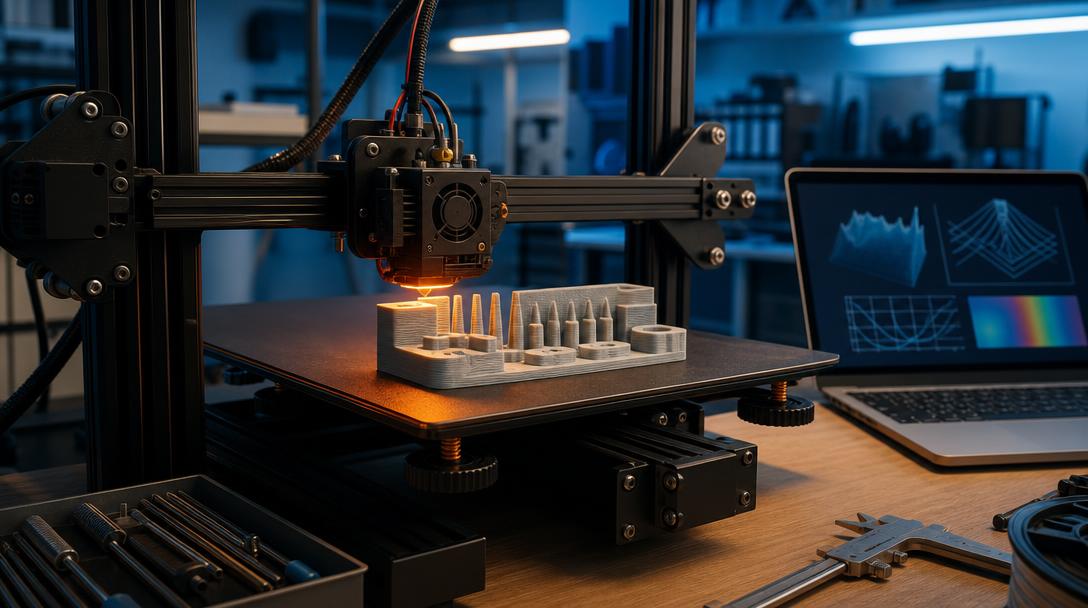

New Research on FFF Print Quality: What Does Physics-Informed Machine Learning Promise?
Achieving good results in FDM/FFF printing often involves more than simply running the printer. Parameters such as nozzle temperature, layer height, print speed, infill, and cooling can affect interlayer bonding, porosity, and tensile strength of the part. However, establishing these relationships reliably requires printing and testing a large number of samples. According to the August 28, 2026 Fabbaloo report, the study by Berkcan Kapusuzoglu and Sankaran Mahadevan investigates whether physics-informed machine learning can make this process more efficient.
The problem is not only the amount of data
On an FFF printer, process settings can be recorded easily. By contrast, measuring actual part performance is more demanding. Outputs such as bond quality, porosity, and tensile strength require producing samples and then testing them. A general-purpose machine learning model trained on a small dataset may produce predictions that look numerically reasonable but are physically inconsistent.
This is where the core idea of the research becomes important: instead of giving the model only past measurements, can the known physical behavior of the FFF process also be taught to it? Such an approach could help make better use of a limited number of experiments.
How is physics added to the model?
The study cited by Fabbaloo considers three approaches. In the first, physical constraints are incorporated directly into the training process of the neural network. The model is not only expected to stay close to experimental results; it is also penalized when it violates known physical relationships.
In the second approach, information from multiphysics FFF simulations is provided to the model together with standard process parameters. This supplies additional context for thermal history or bonding conditions between layers that may not have been measured directly during printing.
In the third approach, the model is first trained on physics-based simulation data and then refined using the results of real printed samples. In short, simulation helps the model learn which behaviors are reasonable, while experimental data helps it better match real printer and material behavior. The researchers tested eight different combinations of these methods.
What this means in practice for the Ucuz3D reader
The outcome of the study should not be read as “artificial intelligence will perfectly predict the strength of every part.” A more cautious and useful interpretation is this: models supported by physics knowledge can narrow the parameter search even when experimental data is limited, and they can identify physically questionable settings earlier.
This could be especially valuable when developing a profile for a new filament or a new printer. Instead of trying every temperature-speed-layer combination at random, promising options can first be ranked with the help of simulation and modeling. The final decision should still be made according to real printing, measurement, and usage conditions. Before starting material selection, you can review our printing materials to evaluate options suitable for the function of your part.
This approach should not be expected to immediately provide desktop users with automatic and guaranteed strength results. Variables such as filament moisture level, printer mechanical adjustment, bed adhesion, print orientation, and layer cooling all affect the outcome. Even so, the research strengthens the idea of improving FFF quality control not only by doing more trial runs, but by using smarter experimental design.
Validation is essential before production
At the prototype stage, model recommendations can save time; however, they cannot replace validation tests for load-bearing, heat-exposed, or safety-critical parts. Design, material, print orientation, and process settings should be evaluated together. When obtaining a professional 3d printing service for your needs, sharing the usage conditions and expected loads helps ensure the right production approach is selected.
If you are planning a sample run or a small batch, you can also optimize material and geometry together by considering the price per gram logic. Once your file is ready, getting an instant quote makes it easier to compare different design options before production.
In summary, this research, reported on August 28, 2026, aims to achieve more reliable process prediction in FFF printing with fewer experiments by combining physics knowledge with machine learning. The approach does not yet eliminate the need for real printing and testing; however, it may pave the way for a more selective and measurable workflow in filament profile development and quality control processes.


 Türkçe
 العربية
 Русский
 فارسی
فارسی Deutsch