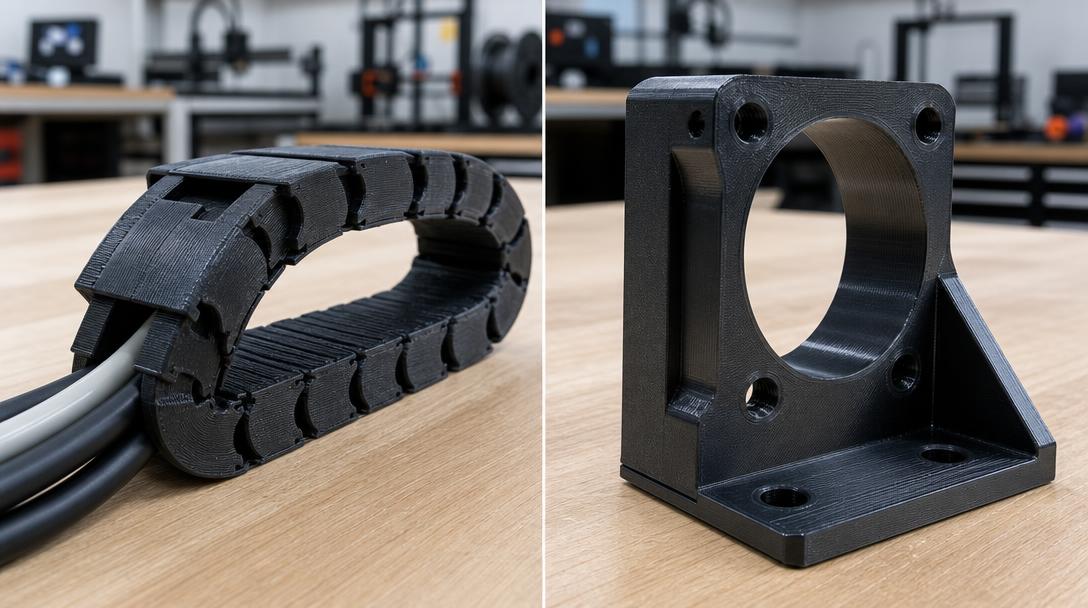

TPC or Polycarbonate? Flexible Wear Resistance or High Heat?
Does a part need to flex a little and withstand repeated friction, or should it stay rigid and retain its shape under heat? TPC and Polycarbonate (PC) are not materials that address the same need. Both can be considered for producing technical parts; however, the right choice depends on how the part moves and the environment it operates in.
What is TPC used for?
TPC is a flexible FDM filament in the thermoplastic copolyester family. It can be considered for parts that do not need to be as soft as TPU, yet should not behave as brittlely as standard rigid plastics. Cable protectors, flexible fasteners, bumpers, belt-like parts, and components exposed to repeated bending are examples of applications where TPC performs well.
The advantage of TPC is that the part can deform in a controlled way. This feature can help absorb part of the impact energy and behave more tolerantly under stress caused by friction. However, the result depends on the filament’s hardness grade, print orientation, wall count, and the manufacturer’s profile. It would not be correct to automatically choose TPC for a rigid body, a tight-tolerance seat, or a load-bearing part operating under high temperature.
What is Polycarbonate used for?
Polycarbonate is used for engineering parts where high rigidity, impact strength, and heat resistance are the main expectations. It may be a more suitable candidate for enclosures, mounting brackets, machine fixtures, and rigid parts that carry loads during operation. That said, PC may require more process control than TPC on desktop FDM printers. High print temperature, good bed adhesion, dried filament, and preferably an enclosed chamber are key factors that affect print success.
Five critical differences when making a decision
- Flexibility: TPC stands out in parts that require controlled flexing. PC, on the other hand, makes more sense when you want a rigid part that largely keeps its shape.
- Impact: TPC can absorb impact by flexing. PC can also offer high impact resistance; however, if the part must both take impact and flex at the same time, TPC may be more suitable.
- Heat: For parts exposed to continuous heat, PC is generally a safer starting point. TPC’s temperature performance varies by product grade and should not be assumed to be suitable for high heat.
- Printability: With TPC, flexible filament feeding and speed control are important. With PC, warping, interlayer stress, and bed adhesion may be more pronounced problems.
- Dimensional stability: Rigid PC can offer advantages for precise and load-bearing geometries. With flexible TPC, dimensional change under load must be included in the design calculation.
Cost logic: When choosing TPC, the material should not be evaluated only by comparing cost per kilogram. Producing a flexible part at the correct hardness may require low print speed and appropriate feed settings during printing. On the PC side, drying, an enclosed chamber, and trial prints can affect the total production time. For this reason, a fast and low-risk TPC solution may make more sense at the prototype stage, while investing in PC may be more meaningful for a final part that requires long-term heat resistance and rigidity. Reducing sharp corners in the design, distributing the load according to layer direction, and thickening connection areas can benefit both materials.
Which one for which part?
If you are producing a flexible guard, vibration damper, or cable-guiding part, start with TPC. If the part must sit with tight tolerance inside a housing, be exposed to heat, and maintain its rigidity, Polycarbonate is the more appropriate candidate. With both materials, print orientation, wall thickness, and infill ratio are as important as the material itself; a small sample and functional test give more reliable results than relying only on catalog data.
To evaluate the material and production method that best fit your needs, you can review our printing materials page. Before sending your part to production, you can explore 3d printing service options, see the logic of price per gram, and upload your file to get an instant quote.





 Türkçe
 العربية
 Русский
 فارسی
فارسی Deutsch