
PETG or PVA? Durable Part or Clean Support?
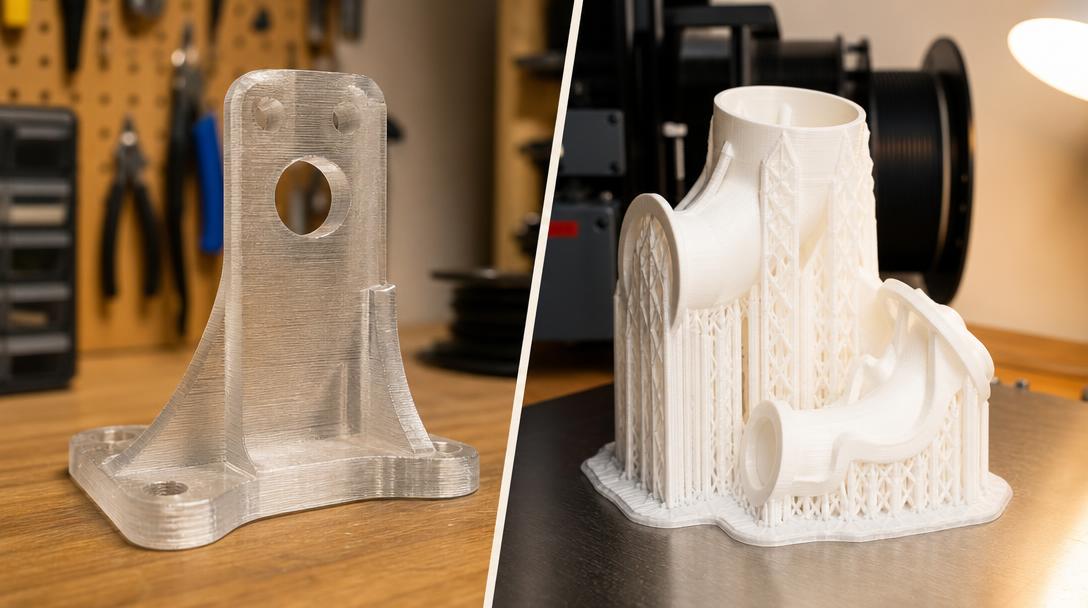
In FDM printing, PETG and PVA are not two filaments that serve the same need. While PETG is chosen for durable parts intended for direct use, PVA mostly serves as a temporary support material in complex geometries. Knowing this difference from the start affects not only print quality, but also the overall workflow and cost logic.
What are PETG and PVA used for?
PETG is a material frequently used for functional products such as boxes, fixtures, connectors, enclosures, and parts exposed to light mechanical loads. Compared with PLA, its tougher behavior and its ability to provide good integrity between layers can create an advantage in everyday-use parts. Since the part’s dimensions, design, print settings, and usage conditions determine the result, PETG should not automatically be considered more durable in every application.
PVA, on the other hand, is a water-soluble support filament. It is especially useful in models with internal channels, complex overhangs, or areas where support marks are difficult to clean mechanically. After printing is complete, it can be dissolved under suitable conditions and separated from the main part. For this reason, it is generally more accurate to think of PVA not as the main body material of the final product, but as part of the support strategy.
Differences in outdoor use, heat, and impact
PETG may be a more sensible candidate than PLA in humid environments and for everyday outdoor use; however, if there is constant sun exposure, high temperatures, or heavy mechanical loads, the design and material choice should be verified separately. PETG’s rigidity and impact behavior should be evaluated together with part thickness and print orientation. For parts that will remain outdoors for a long time, reviewing baskı malzemelerimizi and specifying the usage scenario will make the right choice easier.
PVA’s strength is not outdoor durability, but its ability to form supports in a controlled way. Its dissolving when exposed to water is a disadvantage for a permanent outdoor part. Instead of choosing PVA as the structural material for a product exposed to heat and impact, PVA should be considered for support purposes together with a suitable main filament such as PETG.
Print ease and equipment expectations
PETG can be processed on many FDM systems with proper bed preparation and temperature settings. Since stringing, excessive adhesion to the surface, or sagging on bridges may occur, doing a small test on the first part is helpful. Dried filament, a clean nozzle, and cooling settings suitable for the model can improve the result.
PVA is more sensitive. When it absorbs moisture, bubbles, irregular flow, and weak support structures may occur during printing. For this reason, dry storage and drying when necessary are more critical steps for PVA compared with PETG. In addition, a dual-extruder or multi-material FDM setup makes it practical to use PVA separately from the main material. In single-nozzle systems, the material change and cleaning process can extend the workflow.
Cost logic and which one to use for which part
PETG may make sense for small batch fixtures because it offers predictable material consumption per part and delivers a product ready for direct use. When evaluating the cost of PVA, do not look only at the spool price; support volume, dissolving time, water use, and the operations required by multi-material printing should also be taken into account. Seeing the gram başı fiyat logic of your project helps you compare the total consumption of the main part and the support material.
- Choose PETG: If you are printing a ready-to-use, tough, and functional everyday part; for example, an enclosure, fixture, or connector.
- Choose PVA: If you are printing the main part in PETG or another suitable filament and need clean, dissolvable support in hard-to-reach areas.
- Consider both together: For functional FDM parts with complex internal geometry where cleaning support marks afterward is difficult.
The final decision should be based less on the material’s name and more on the load the part carries, the heat it is exposed to, and the print geometry. Once your requirements are clear, you can evaluate production options with 3d baskı hizmeti and upload your file to get anında fiyat.



 Türkçe
 العربية
 Русский
 فارسی
فارسی Deutsch